

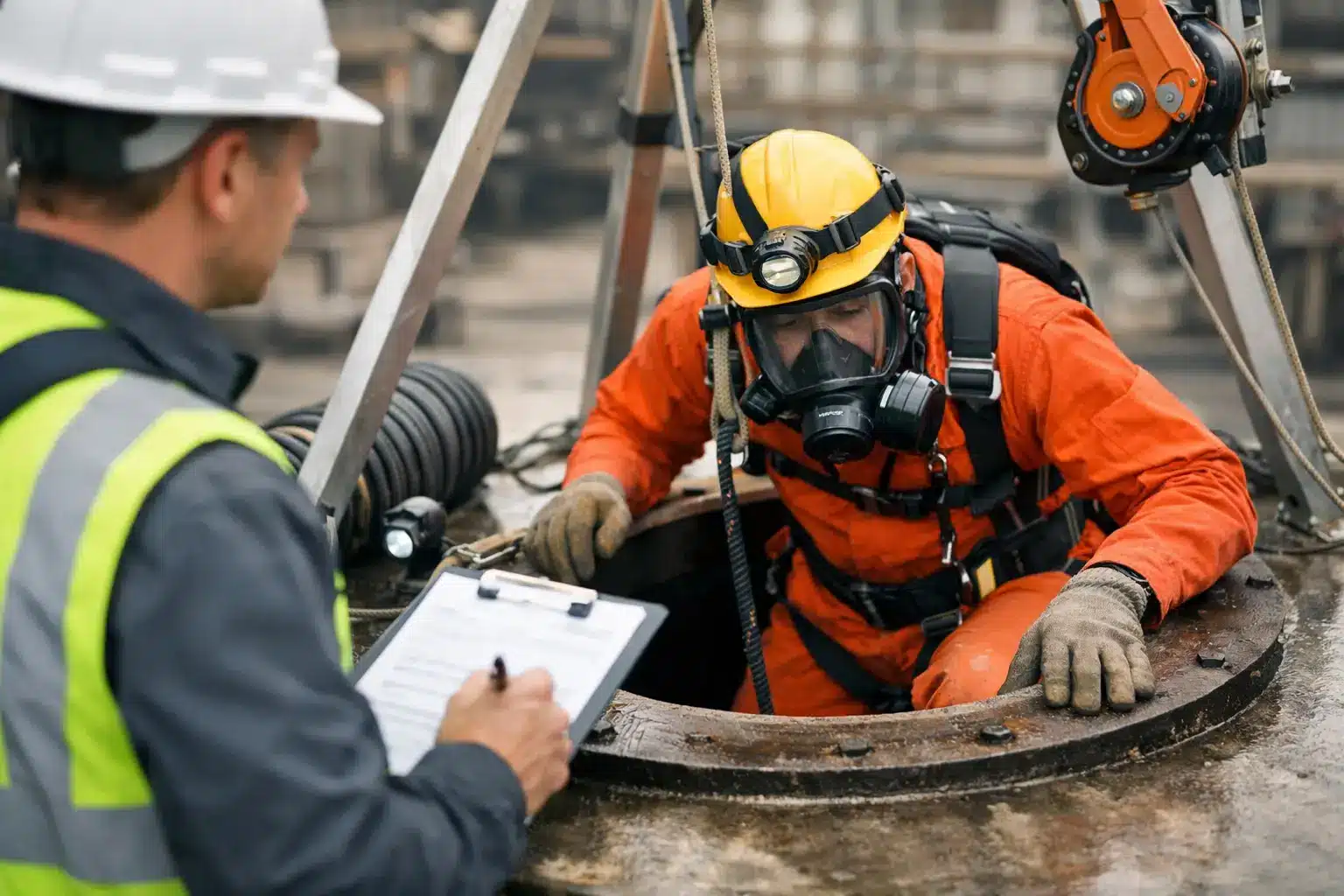

A blocked floor drain, a foul odor from a tank, or a maintenance issue inside a utility vault can quickly become a high-risk job. For facility teams asking who needs confined space permits, the key point is this: permits apply to the entry operation and the employer controlling it, not simply to a worker because their job title includes cleaning or maintenance.
A confined-space permit system is designed to prevent workers from entering areas where the atmosphere, access conditions, equipment, or stored materials could turn routine work into a serious incident. Before anyone goes in, the responsible party must identify the hazards, establish controls, and confirm that the work can be carried out safely.
Who Needs Confined Space Permits?
A permit is generally required when workers must enter a permit-required confined space. This is a confined space with one or more serious hazards, such as a potentially hazardous atmosphere, engulfment risk, inwardly converging walls, a floor that slopes and narrows, or another recognized safety hazard that could trap, injure, or incapacitate an entrant.
Common examples in commercial and industrial properties include sewage or stormwater manholes, underground pits, tanks, silos, ducts, sumps, process vessels, crawl spaces, utility vaults, and certain large pipelines. A space does not need to look dangerous to require controls. Many are quiet, enclosed, and accessed only occasionally, which can make risks easier to overlook.
The employer or contractor directing the entry typically needs to issue and manage the permit. That responsibility includes coordinating everyone involved: the authorized entrants who perform the work, the attendant who remains outside the space, and the entry supervisor who verifies that conditions are acceptable for entry.
For building managers, the practical responsibility is different but equally important. If your team hires a cleaning or maintenance contractor, you need to identify confined spaces on the property, communicate known hazards, and ensure the contractor has an appropriate entry plan. A contractor should never be expected to discover critical site information only after arriving at an access point.
A Confined Space Is Not Always a Permit Space
Not every enclosed or difficult-to-access area requires a permit. A confined space is usually large enough for a worker to enter and perform work, has limited means of entry or exit, and is not designed for continuous occupancy. Whether it becomes a permit-required space depends on the hazards present or reasonably foreseeable.
For example, an equipment room may be cramped but still have normal doors, ventilation, and no special entry hazards. It may not be a confined space at all. A below-grade pump pit with a ladder access point, poor natural ventilation, standing water, electrical equipment, and possible gas accumulation is a very different situation.
This distinction matters because over-classifying every tight area can slow maintenance unnecessarily, while under-classifying a hazardous area exposes workers and property owners to unacceptable risk. A competent site assessment should determine the classification before work is scheduled, particularly where cleaning requires entry into tanks, pits, drains, or enclosed service areas.
What the Permit Must Control
A confined space entry permit is not paperwork for its own sake. It records the conditions that must be met before and during entry. The exact form and legal requirements vary by jurisdiction, site rules, and the nature of the work, but a proper permit process normally addresses the same operational questions.
It should identify the space, the scope of work, the authorized entrants, the attendant, and the entry supervisor. It should also record atmospheric testing results, including oxygen levels and potential flammable or toxic contaminants where relevant. If conditions change, testing may need to continue throughout the work rather than being treated as a one-time check.
The permit should also confirm isolation of hazards. This may involve locking out mechanical equipment, blanking or disconnecting lines, controlling electrical energy, draining materials, securing moving parts, and preventing water or product from entering the space. Ventilation, communication methods, access equipment, personal protective equipment, and rescue arrangements must be specified before entry begins.
A common mistake is assuming that a harness alone makes an entry safe. Fall protection and retrieval equipment can be essential, but they do not remove atmospheric hazards, engulfment risks, or the need for a trained attendant. Safe entry depends on the full control plan working together.
The Roles That Must Be Covered
The authorized entrant performs the work inside the space and must understand the hazards, alarm signals, communication process, and exit procedures. The attendant stays outside, monitors the entrants and surrounding conditions, prevents unauthorized entry, and initiates emergency response when necessary.
The entry supervisor confirms that every required control is in place, signs off on the permit, and cancels the entry when work is complete or conditions become unsafe. On larger sites, a facility representative may also coordinate access, isolation, permits, and contractor activities. These roles should be clear before the crew mobilizes, not improvised at the manhole cover or tank hatch.
When Contractors and Building Owners Share Responsibility
Commercial properties often involve multiple parties: the building owner, facilities manager, managing agent, tenant, maintenance provider, and specialist contractor. The company performing the entry may manage the permit, but the site controller still has a duty to provide relevant information and coordinate conditions that affect safety.
Before confined-space work begins, share available drawings, previous inspection records, chemical-use information, utility details, access restrictions, and known hazards. Confirm whether adjacent systems could introduce water, fumes, steam, product, or energy into the space while work is underway. If several contractors are operating nearby, sequence the work so one activity does not create a hazard for another.
For example, cleaning a grease interceptor may appear straightforward until nearby wastewater flows are not isolated. Entering a rooftop water tank may require more than access equipment if chemicals, limited ventilation, or difficult rescue access are involved. The right approach depends on the actual space and task, not a generic service checklist.
When a Permit May Not Be Needed
Some spaces can be reclassified or handled through alternate procedures if all hazards are eliminated or controlled through continuous forced-air ventilation and other approved measures. This is not a shortcut. It requires a documented evaluation showing that the conditions for non-permit entry are genuinely met and will remain controlled throughout the job.
A permit may also be unnecessary when workers do not enter the space. Remote inspection cameras, vacuum equipment, long-handled tools, robotic cleaning systems, or external flushing methods can sometimes complete the task without entry. For facility managers, eliminating entry is often the safest and most efficient option when it can achieve the maintenance objective.
However, remote methods have limits. Heavy sludge, damaged internal components, blockages, or detailed repairs may still require trained personnel to enter. In those cases, the savings from avoiding preparation are minor compared with the potential cost of an unsafe entry, work stoppage, property damage, or emergency response.
Practical Checks Before Scheduling Work
Before approving confined-space cleaning or maintenance, confirm the space location, its intended use, access dimensions, and the reason entry is required. Ask whether hazardous materials, wastewater, fuel, cleaning chemicals, gases, or process residues may be present. Establish who controls isolations and whether work must occur outside operating hours.
You should also ask the service provider how it will test the atmosphere, ventilate the space, maintain communication, provide standby coverage, and arrange rescue capability. A capable contractor can explain the plan in practical terms and adjust it to site conditions. If the answers are vague, the risk has not been properly assessed.
For high-risk cleaning and maintenance work, Urban Solutions Services Sdn Bhd approaches access, site conditions, and work scope as connected issues. A site assessment helps determine whether entry is necessary, what controls are required, and how the work can proceed with minimal disruption to building operations.
The most useful question is not whether a permit will slow the job down. It is whether the team has enough information, equipment, and authority to stop work when conditions change. When the answer is yes, confined-space maintenance becomes a planned operation rather than a preventable emergency.