

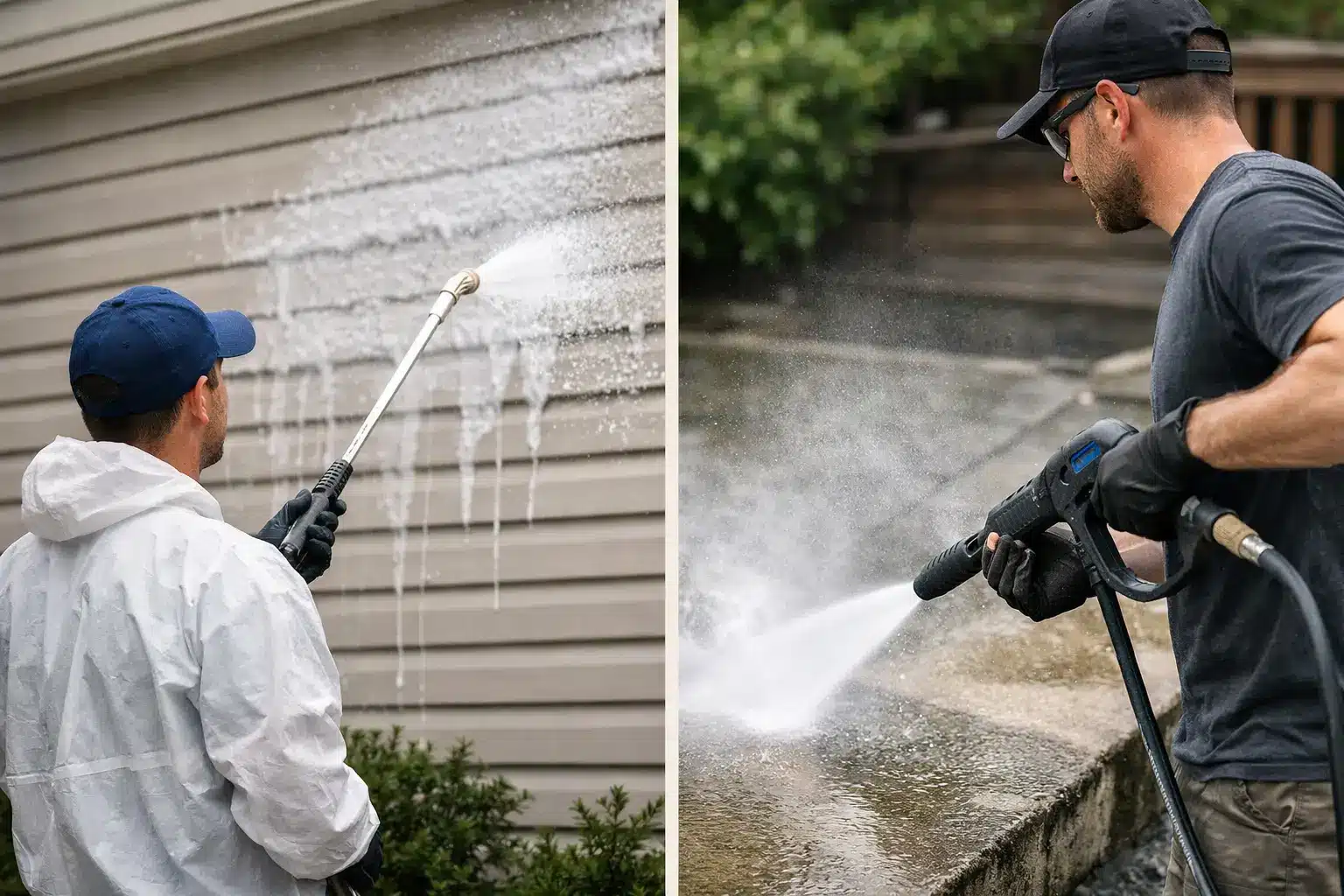

A stained façade, algae-covered roof, or blackened loading-bay wall can make a well-managed property look neglected fast. In the decision between soft washing vs pressure washing, the right method is not simply the one that removes visible dirt quickest. It is the one that cleans the surface effectively without creating damage, water intrusion, safety issues, or unnecessary disruption to your operation.
For commercial and industrial properties, cleaning methods should be selected around surface material, contamination type, access conditions, drainage, and the building’s maintenance history. A qualified contractor assesses these factors before equipment is set up, especially when elevated facades, rooftops, glazing, or restricted work areas are involved.
What Is Soft Washing?
Soft washing is a low-pressure cleaning method that uses purpose-formulated cleaning solutions to break down organic growth, atmospheric staining, mold, mildew, algae, and accumulated grime. The solution does much of the cleaning work, while water is applied at low pressure to rinse the treated surface.
This approach is designed for surfaces that can be damaged by forceful water impact. Suitability depends on the specific surface, coating, condition and cleaning product; low pressure alone does not establish compatibility. Soft washing is also effective when staining is caused by living organisms rather than loose dirt alone.
The key advantage is controlled cleaning. Instead of relying on water force to blast contaminants away, technicians allow the treatment to loosen and neutralize buildup before rinsing. This helps reduce the risk of stripped paint, damaged roof finishes, displaced sealant, and water being driven behind cladding or into building openings.
Where Soft Washing Works Best
For roofs, facade panels and painted surfaces affected by biological staining, a contractor should first check the material and coating guidance, the condition of the surface and the proposed cleaning product before selecting a method. Ask how the proposed treatment will address staining without damaging the finish.
However, soft washing is not a universal solution. Heavy grease, compacted mud, thick concrete residue, or long-standing tire marks may require more mechanical cleaning action. The cleaning product must also be chosen carefully, with attention to nearby landscaping, drainage routes, glazing, painted finishes, and occupied areas.
What Is Pressure Washing?
Pressure washing uses water delivered at a substantially higher force to dislodge surface contaminants. It is highly effective for durable, hard-wearing materials such as concrete walkways, loading docks, driveways, parking areas, service yards, retaining walls, and certain uncoated masonry surfaces.
When used correctly, pressure washing can remove embedded dirt, loose paint, mud, vehicle residue, bird droppings, and surface grime efficiently. For large exterior ground areas, it can restore a cleaner, safer appearance and reduce slip hazards caused by slippery buildup.
The limitation is equally clear: pressure that is too high, used too close to the surface, or directed at the wrong angle can cause damage. It may scar concrete, erode mortar, strip paint, crack brittle finishes, force water into joints, or damage weather seals. Pressure washing is a skilled process, not just a matter of using a powerful machine.
Where Pressure Washing Works Best
Pressure washing is generally suited to robust, non-delicate surfaces where dirt is physically bonded to the surface. Parking structures, walkways, industrial floors, concrete aprons, bin areas, and loading zones are common examples.
Even on concrete, settings must be adjusted to the job. Older concrete, decorative finishes, loose mortar, damaged joints, and areas with poor drainage require a more cautious approach. The goal is to clean the surface without exposing aggregate, spreading contaminated runoff, or leaving slippery water behind.
Soft Washing vs Pressure Washing for Commercial Properties
The best choice depends on what needs to be removed and what the surface can safely tolerate. A building manager should not have to choose based on cleaning speed alone. The wrong method can turn a routine maintenance task into a repair issue.
Roofs and Gutters
Roof cleaning should be specified for the particular roof material, finish and condition rather than selected from a general preference for soft washing or pressure washing. High pressure can disturb roof coatings, damage tiles, dislodge granules, or force water under laps and flashings. Roof work also requires careful access planning, fall protection, and control of runoff into gutters and drains.
Gutters may need a separate process. Debris removal, flushing, and inspection are often more important than high-pressure washing. A blocked gutter can cause overflow, staining, water damage, and mosquito breeding conditions, so cleaning should be paired with a check for poor drainage and damaged sections.
Facades, Cladding, and Painted Walls
For painted facades, composite panels and metal cladding, the proposed method needs to be compatible with the particular finish, joints and sealants. These surfaces may carry a mixture of dust, traffic film, mold, algae, and rainwater streaks. Lower water pressure does not remove the need to check chemical compatibility and protect surrounding surfaces.
Pressure washing may be appropriate for selected masonry or concrete facade sections, but only after testing and setting the correct pressure, nozzle, stand-off distance, and application angle. High-rise facade cleaning adds another layer of complexity because access equipment, worker positioning, public protection, and water control all affect the method.
Concrete, Driveways, and Service Areas
For concrete surfaces, the choice of method depends on the finish, condition and deposits, rather than an assumption that higher pressure will be more effective. The cleaning scope should identify the affected pavement, dock areas, pedestrian routes or vehicle access points and the deposits to be removed. Degreasing treatment may be needed before washing if oil or food-service residue is present.
Soft washing can still play a role where algae or mildew creates slippery conditions, particularly in shaded walkways and external stairwells. In these cases, treating the organic growth before rinsing may produce better results than applying pressure alone. The practical solution may use both methods in sequence.
Windows and Glazed Areas
Neither aggressive pressure washing nor uncontrolled chemical application is suitable for routine window cleaning. High-pressure water can compromise seals, damage frames, and drive water into interior spaces. Cleaning solutions that are not compatible with glass coatings, frames, or surrounding panels can also leave marks or cause deterioration.
For elevated glazing, the priority is controlled access and a method suited to the building system. This may involve rope access, boom lifts, water-fed poles, or other site-approved equipment. The cleaning method must protect the glass while allowing technicians to reach difficult sections safely.
Access and Safety Matter as Much as Cleaning Power
On a commercial site, the cleaning method is only one part of the scope. Work at height, pedestrian movement, nearby vehicles, electrical fixtures, drainage systems, and active tenants all need to be considered before the job begins.
A professional site assessment identifies access points, anchor requirements, equipment positioning, exclusion zones, water supply, runoff management, and the condition of the surfaces being cleaned. This is particularly important for high-rise properties, industrial facilities, and buildings with hard-to-reach facade sections.
The lowest-cost proposal is not always the lowest-risk option. A contractor should be able to explain why a particular method is recommended, what protection measures are required, and whether cleaning can be completed outside peak operating hours to minimize disruption.
How to Choose the Right Method
Start with the material. Check the material and coating manufacturer’s care guidance and the condition of the surface before agreeing to a cleaning method. A description such as painted, coated or concrete does not by itself establish which treatment is suitable.
Next, identify the contaminant. Ask the contractor to explain how the proposed product and method address the identified deposits without assuming that a particular type of staining always requires chemicals or higher pressure. For grease, oil, or industrial residue, the cleaning agent, dwell time, water recovery needs, and wash method should be planned together.
Finally, consider the location. A ground-level service yard is different from a 20-story facade. Buildings with complex access conditions need technicians, equipment, and safety controls that match the work. Urban Solutions Services Sdn Bhd evaluates these site-specific factors before recommending a cleaning approach for commercial and industrial properties.
A clean building should not come at the cost of damaged finishes, unsafe access, or disrupted operations. Arrange a site assessment before scheduling exterior cleaning, and ask for a method that protects both the surface and the people working around it.