

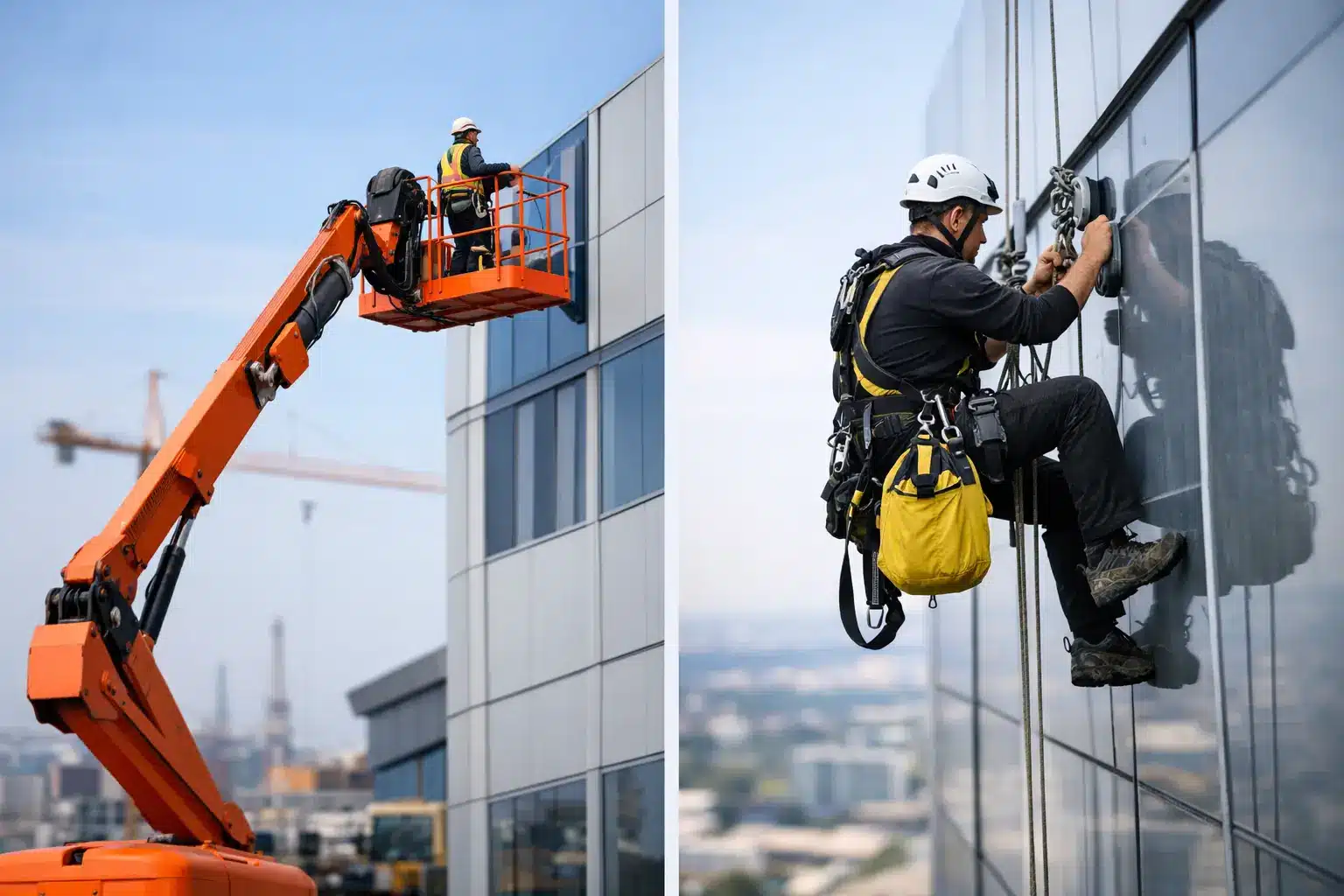

A boom lift vs rope access decision can change the cost, timing, safety controls, and disruption level of a façade cleaning or maintenance project. For property and facilities teams, the right choice is not simply the method with the lowest quoted price. It is the access method that lets trained technicians complete the scope safely, reach every required area, and keep your building operating with minimal interruption.
Both methods have a place in commercial and industrial maintenance. Boom lifts provide stable elevated platforms for certain tasks, while rope access allows technicians to work from suspension systems where ground access is limited or building geometry is difficult. A proper site review should determine which option fits the structure, the work scope, and the conditions on the day.
Boom Lift vs Rope Access: The Main Difference
A boom lift is a mobile elevated work platform with an extendable arm and personnel basket. It is positioned at ground level, then raised and maneuvered so technicians can access windows, façade panels, roof edges, signage, and other elevated areas. Depending on the equipment, a boom lift can provide considerable vertical height and horizontal outreach.
Rope access uses certified technicians, harnesses, ropes, anchors, and fall-protection equipment to descend or position themselves along a building exterior. It is commonly used for high-rise window cleaning, façade washing, sealant inspection, localized repairs, and other work on tall or irregular structures.
The practical difference is where each method gets its access. A boom lift works upward from suitable ground space. Rope access works downward or laterally from approved rooftop anchors or engineered rigging points. This affects everything from site setup and pedestrian control to how much of the façade can be reached.
When a Boom Lift Is the Better Choice
Boom lifts are often a strong option when the required work area is relatively low to medium height, ground conditions are suitable, and the building has sufficient clearance for equipment positioning. They can be particularly effective for commercial painting, canopy cleaning, gutter work, warehouse exteriors, low-rise glass, and repairs where technicians need to carry tools or materials in the platform.
The basket provides a stable work position and can make repetitive hands-on tasks more efficient. For example, a technician carrying paint supplies, replacement fittings, or cleaning equipment may work more comfortably from a platform than while suspended on ropes. Boom lifts also allow close supervision from ground level, which can be useful on active commercial sites.
However, the equipment needs room to operate. The site must have adequate access routes, a stable surface, safe ground-bearing conditions, and clearance from vehicles, trees, overhead utilities, and building projections. Outriggers, exclusion zones, and traffic management may also be required.
A boom lift may be less practical if the façade is set behind landscaping, a narrow driveway, a covered walkway, or parking areas that cannot be closed. Even when a lift can reach the height, it may not have the horizontal outreach or positioning angle needed to access recessed windows, internal corners, or sections above a podium.
Best-fit applications for boom lifts
Boom lifts are generally well suited to work where equipment access is straightforward and the task benefits from a stable platform. Typical applications include exterior painting, gutter cleaning, low-rise window cleaning, lighting maintenance, warehouse wall cleaning, and façade work above open loading or parking areas.
The key question is not just whether the lift can reach the top of the building. It must be able to reach every work area without creating avoidable risk or excessive disruption on the ground.
When Rope Access Is the Better Choice
Rope access is often the preferred method for high-rise buildings, complex façades, and sites with limited space at ground level. It allows technicians to reach vertical surfaces without bringing large lifting equipment through the property. This is especially valuable in dense commercial areas, buildings with narrow setbacks, and properties where parking, roads, or landscaped zones make boom lift positioning difficult.
For high-rise window cleaning and façade maintenance, rope access gives technicians close control over their position along the building exterior. They can move across individual elevations, work around architectural features, and access areas that a boom arm cannot approach safely. Recessed windows, curved façades, atriums, upper-level ledges, and elevations above lower roofs can all favor rope access.
Rope access also reduces ground-level congestion. There is still a need for controlled exclusion zones below the work area, but there may be no need to block wide areas for large machinery. This can help maintain building access for tenants, visitors, deliveries, and daily operations.
That said, rope access depends on suitable anchor systems, safe roof access, proper edge protection, weather conditions, and a team qualified for the specific work. It is not a shortcut or a lower-control alternative to mechanical access. A professional rope access plan requires detailed pre-work checks, rescue planning, equipment inspection, communication procedures, and active supervision.
Best-fit applications for rope access
Rope access is typically effective for high-rise window cleaning, external façade cleaning, inspection work, localized repairs, sealant checks, difficult roof-edge tasks, and maintenance on buildings where boom lift setup is restricted. It is also useful when the work area is high above a busy site and the building has approved access and anchorage arrangements.
For large façades, rope access can sometimes allow several technicians to work across separate sections at once. Productivity depends on the layout, cleaning method, water access, rigging locations, and how easily teams can move between drops.
Safety Is a Planning Issue, Not a Method Label
Neither boom lifts nor rope access are automatically safer in every situation. The safer choice is the one that matches the building, task, weather, access route, equipment condition, and workforce competency.
A boom lift introduces risks related to ground stability, equipment movement, pinch points, overhead obstructions, nearby traffic, and platform loading. Operators and occupants must follow equipment-specific procedures and use appropriate fall protection. The work area below and around the lift needs clear control.
Rope access introduces risks related to anchorage integrity, suspension systems, rope protection, falling objects, roof-edge hazards, and rescue readiness. Technicians require formal training, medical fitness, disciplined equipment checks, and a clear rescue plan. The contractor must also manage public safety below the work zone.
For either method, a site-specific risk assessment should come before scheduling. It should address access routes, work-at-height controls, weather limits, exclusion zones, tenant activity, electrical hazards, fragile surfaces, and emergency response. This planning is especially important for occupied offices, retail properties, industrial facilities, and buildings with public-facing entrances.
Cost: Look Beyond the Daily Rate
Comparing access costs only by day rate can lead to the wrong decision. A boom lift quote may include equipment delivery, mobilization, operator requirements, permits, fuel or charging, and the time needed to reposition the machine. It may also require parking closures, security coordination, or temporary traffic controls.
Rope access pricing depends on the building height, number of drops, roof setup, anchor suitability, technician count, cleaning or maintenance scope, and the complexity of the façade. It may avoid heavy equipment rental, but it requires skilled personnel and careful setup.
The best-value method is the one that completes the full scope efficiently without repeat visits or inaccessible sections. If a boom lift can only reach part of the elevation, the apparent savings disappear once a second access method is needed. Likewise, if rope access requires extensive rigging changes for a low, open façade, a lift may be more efficient.
Questions to Ask Before Selecting an Access Method
Before approving a façade cleaning or maintenance project, confirm the height and exact locations of the work, the availability of rooftop anchors, the condition and width of ground access, and whether equipment can be placed without disrupting operations. Ask how technicians will manage pedestrian safety, falling-object controls, weather delays, emergency rescue, and protection of landscaping, vehicles, and building finishes.
It is also useful to clarify whether the project includes more than cleaning. A contractor may need to remove stains, inspect façade defects, clear gutters, repaint external surfaces, or reach confined and difficult areas. Combining tasks under one access plan can reduce mobilization and help facilities teams avoid coordinating multiple vendors.
Choose the Method That Reaches the Whole Job
For many sites, the answer is not strictly boom lift or rope access. A mixed-access plan can be the most practical solution, using a boom lift for accessible lower sections and rope access for high or obstructed elevations. The correct approach should follow a site inspection, not an assumption based on building height alone.
Urban Solutions Services Sdn Bhd assesses access conditions before recommending a method for high-rise cleaning, façade maintenance, roof work, and hard-to-reach commercial areas. For properties in Kuala Lumpur, Selangor, Penang, and Johor, an early site review helps identify the safest route to a clean, presentable building without unnecessary operational disruption.
A well-planned access decision protects more than the project budget. It protects occupants, technicians, building finishes, and the reliability of your maintenance schedule.