

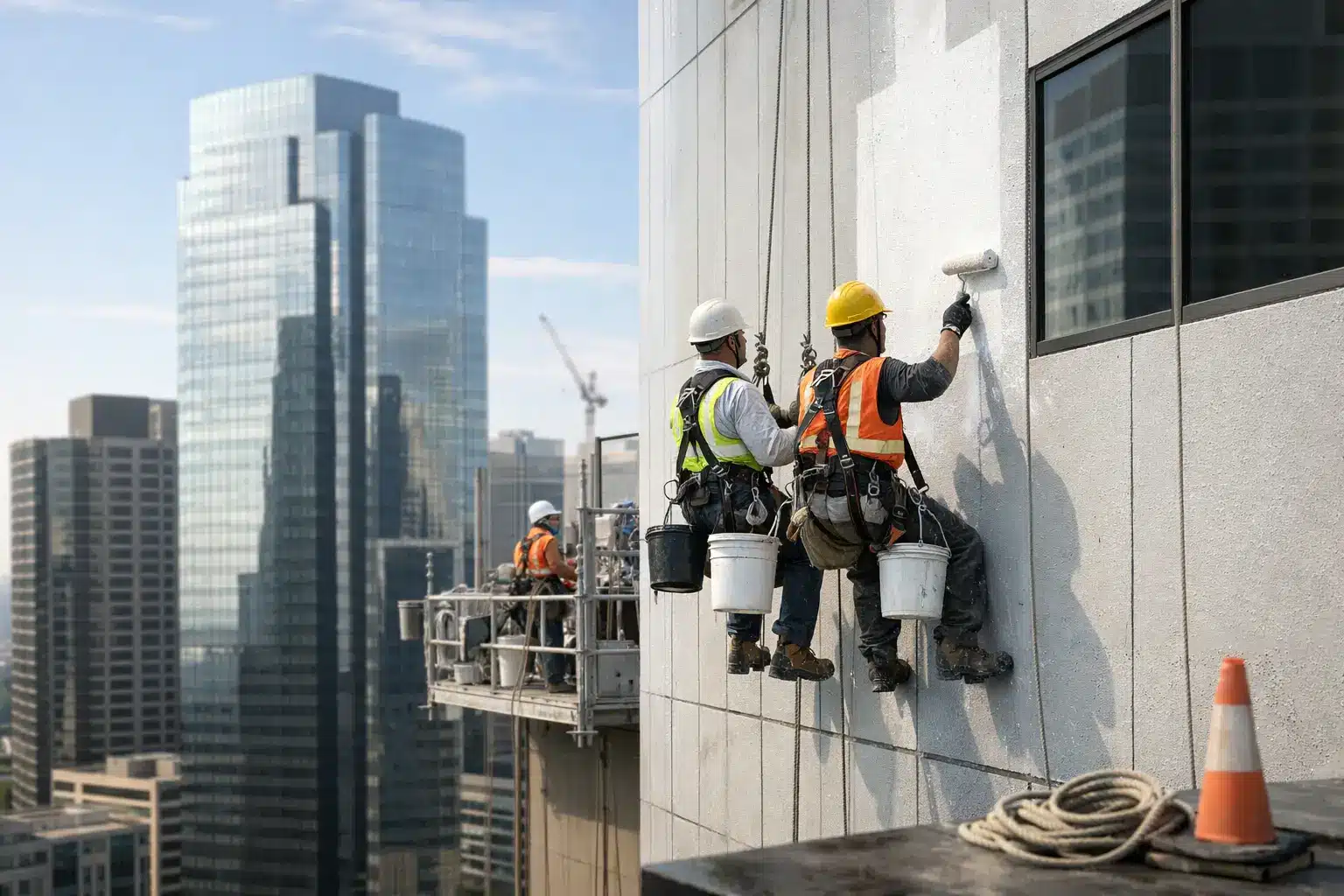

A faded façade is more than an appearance issue. Peeling paint, staining, chalking, and visible patch repairs can affect tenant confidence, property value, and the impression your building makes on clients. To prepare office tower repainting properly, building teams need a plan that addresses access, safety, surface condition, tenant operations, and weather before the first coat is applied.
For a high-rise office building, repainting is not a simple painting job with a larger scaffold. The height, façade material, public areas below, restricted working hours, and operational demands of occupied offices all affect how the project should be planned. Good preparation reduces delays, avoids unnecessary rework, and helps the finished coating perform as intended.
Start With a Detailed Façade Assessment
The first step is to assess what is actually happening on the exterior surface. A building may look uniformly faded from ground level, but closer inspection can reveal different problems across elevations. Sun-facing walls may have severe color loss and chalking, while shaded areas may have algae, water marks, or mold growth. Areas around windows, rooflines, expansion joints, and drainage outlets often need closer attention.
A proper site assessment should identify the façade substrate, existing paint condition, cracks, loose render, failed sealant, corrosion, and signs of water ingress. Painting over an unresolved leak or deteriorating wall surface only hides the problem temporarily. Moisture can push through the new coating, leading to blistering, peeling, and staining well before the expected service life of the paint.
The assessment should also determine whether previous coatings are compatible with the proposed paint system. Some existing coatings may require a bonding primer, while heavily weathered surfaces may need more extensive preparation. This is why a site-specific quotation is more reliable than a price based only on building height or square footage.
Plan Safe Access Before Office Tower Repainting
Access is usually the most critical planning issue when preparing an office tower for repainting. The right method depends on building height, façade shape, roof configuration, setback levels, surrounding space, and the condition of installed building maintenance equipment.
Rope access may be efficient for targeted repairs, narrow elevations, and buildings with suitable roof anchorage. Suspended platforms can be more practical for larger painting zones where crews need to carry materials and work steadily across wider sections. Boom lifts may suit lower levels where there is adequate ground clearance, while scaffolding can be appropriate for entrances, podiums, and detailed façade repairs.
Each method has trade-offs. Rope access can minimize disruption at ground level, but it may not be the fastest option for broad, continuous wall areas. Scaffolding provides a stable work platform but can affect pedestrian routes, tenant access, and the building’s visual presentation during the project. The best approach often combines several access methods rather than forcing the entire job into one system.
Before work begins, confirm roof access, anchor points, loading limitations, electrical hazards, drop zones, and emergency rescue procedures. High-risk access work should be performed by trained personnel using inspected equipment and a documented work plan. This protects workers, tenants, visitors, vehicles, and the property itself.
Protect Ground-Level Operations
Painting work above a busy entrance, driveway, or retail frontage requires careful control. Establish exclusion zones, install warning signage, and schedule overhead work around peak arrival and departure periods where possible. Vehicles should not be parked beneath active work zones, and walkways may need temporary rerouting.
For towers in dense commercial areas, coordination with neighboring properties can also be necessary. Overspray, falling debris, equipment placement, and access vehicles should be controlled before they become a complaint or a safety issue.
Complete Cleaning and Repairs First
Paint adheres to a clean, sound surface. Exterior walls should be washed to remove dirt, dust, pollution residue, algae, loose paint, and chalking. In Kuala Lumpur, Selangor, Penang, and Johor, frequent rainfall, humidity, and urban pollution can accelerate surface contamination, particularly on shaded façades and areas near drainage points.
The cleaning method should match the surface condition. High-pressure washing may be suitable for durable concrete or render, but excessive pressure can damage weak plaster, force water into cracks, or disturb loose sealant. Controlled washing, chemical treatment for biological growth, and manual preparation may be needed in sensitive areas.
Once the surface is clean and dry, repair work can begin. This may include removing loose paint, patching cracks, repairing damaged render, treating rust stains, replacing failed sealant, and correcting minor concrete defects. Repairs must be allowed to cure fully before primer or topcoat application. Rushing this stage is one of the most common causes of uneven finish and early coating failure.
Choose a Coating System for the Building Conditions
The lowest paint price does not always produce the lowest lifecycle cost. An office tower is exposed to ultraviolet light, rain, humidity, dirt accumulation, thermal movement, and airborne contaminants. The coating system should be selected for the substrate, exposure level, desired finish, maintenance expectations, and budget.
A breathable exterior coating may be needed where moisture vapor transmission is a concern. Elastomeric coatings can help bridge fine hairline cracks, but they are not a substitute for proper structural or render repair. Anti-fungal and dirt-resistant properties may be valuable on elevations that remain damp or shaded. For metal features, the specification should include appropriate rust treatment and primers rather than relying on a single finish coat.
Color selection deserves operational consideration as well. Dark colors can absorb more heat and may show fading differently over time. Very light colors may highlight runoff staining near windows or air-conditioning discharge points. A small sample area or mock-up helps building managers review the finish in real daylight before approving the full project.
Coordinate With Tenants and Building Operations
An occupied office tower cannot be treated like an empty construction site. Property and facility teams should notify tenants early about the project scope, expected duration, access restrictions, noise, odors, and any temporary closure of balconies, loading areas, or entrances.
Window-adjacent work can be disruptive for occupants, especially where painters are using suspended platforms or rope access outside occupied floors. Clear communication prevents unnecessary alarm and reduces complaints. Inform tenants when windows should remain closed and identify a contact person for operational concerns during the project.
Daily coordination matters. Security teams need to know who is entering the building and when. Parking management may need to reserve areas for equipment or material deliveries. Cleaning schedules may need adjustment where dust control or ground protection is in place. If the tower has retail or food and beverage tenants at podium level, work above those areas may need to be timed outside business peaks.
Build a Realistic Schedule Around Weather and Curing
Exterior painting depends on weather. Rain can wash away fresh coating, high humidity can slow drying, and wet surfaces can prevent adhesion. A repainting schedule should include realistic allowances for weather interruptions, surface drying, repairs, primer curing, and final inspection.
Do not measure progress only by how many floors have been painted. The project sequence should account for washing, repair approvals, masking, priming, coating application, touch-up work, and removal of protections. A contractor that rushes to cover large areas before inspecting repairs may create more work later.
Where possible, paint in manageable zones. This allows the building team to review workmanship early, address concerns before they are repeated across the tower, and maintain better control over tenant communication. It also helps crews respond to changing weather without leaving too much prepared surface exposed.
Set Clear Quality Checks for the Repainting Work
Quality control should begin before application, not after the last coat has dried. Confirm that surfaces are clean, dry, repaired, and properly primed. During application, check coverage, wet film consistency, edge treatment, masking, and color uniformity. Particular attention should be given to corners, parapets, window surrounds, service ledges, and areas where water runoff is common.
Final inspection should be carried out from appropriate access points, not only from the ground. A façade can look acceptable from a distance while still having missed patches, paint runs, weak coverage, or incomplete repairs at close range. Document completed areas, approved touch-ups, and any recommendations for future maintenance.
A capable contractor should also leave the site clean and operational. That includes removing protective coverings, clearing materials, restoring access routes, and ensuring no paint debris or equipment remains in tenant-facing areas.
For building managers, the best time to prevent repainting problems is before work starts. A thorough site visit, practical access plan, and properly sequenced scope give the project a stronger foundation. Urban Solutions Services Sdn Bhd can assess high-rise access requirements and help property teams plan repainting work that protects the building, its occupants, and its long-term appearance.