

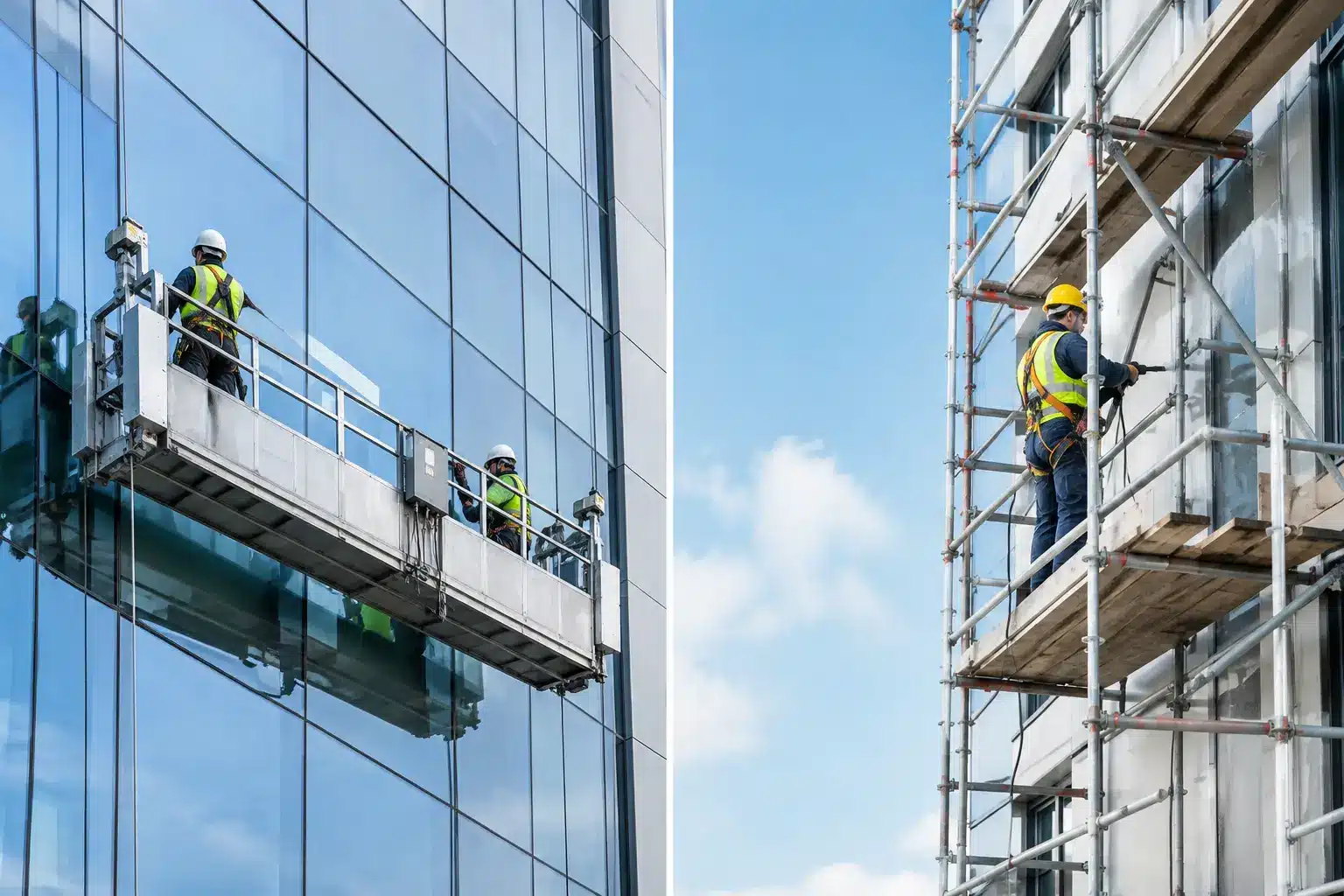

A dirty high-rise facade is not only an appearance issue. Staining, airborne deposits, algae growth, and neglected glazing can affect tenant perception, hide developing defects, and make planned maintenance harder to manage. The decision between gondola versus scaffold cleaning determines how safely and efficiently that work can be completed.
For commercial property managers, the right method is rarely about choosing the lowest initial price. It depends on building height, facade design, the extent of work, ground conditions, public access, and whether cleaning needs to be combined with inspection, painting, repairs, or other maintenance tasks.
Gondola Versus Scaffold Cleaning: The Main Difference
A gondola is a suspended working platform that travels vertically along a building facade. It is usually supported by roof-mounted equipment, such as davits, parapet clamps, or a permanent building maintenance unit. Trained technicians use the platform to reach windows, curtain walls, cladding, and other elevated exterior surfaces.
Scaffolding is a temporary structure erected from the ground or another stable base. It creates fixed working levels around all or part of a building. Unlike a gondola, it remains in position while technicians carry out cleaning, repairs, painting, or installation work.
Both systems can support professional exterior cleaning. The practical difference is access. A gondola is designed for vertical reach and movement across tall facades. Scaffolding provides broad, stable access where workers need to remain close to a surface for extended, detailed work.
When Gondola Cleaning Is the Better Choice
Gondola cleaning is often the preferred solution for high-rise office towers, hotels, residential developments, and commercial buildings with extensive glazing. It allows cleaning teams to work floor by floor without constructing a full ground-up access structure.
For recurring window and facade cleaning, gondolas can reduce setup time and minimize disruption around the property. This matters in busy business districts, where ground-level space may be limited and pedestrian routes, drop-off zones, or retail entrances must remain usable.
A gondola also gives technicians close access to difficult external areas, including curtain wall systems, aluminum panels, glass canopies, and upper-level ledges. Because the platform can be positioned at the working elevation, the team can apply cleaning methods with greater control than they could from ground-based equipment.
Benefits of gondola access
The biggest advantage is efficiency on tall, vertical elevations. Once the system has been properly installed and inspected, technicians can cover large facade areas in a planned sequence. A suspended platform also carries personnel, water-fed tools, cleaning equipment, and selected maintenance materials without repeated trips up and down the building.
Gondolas can be especially cost-effective when the building already has a certified permanent maintenance system. Even when temporary equipment is required, it may still be more practical than scaffolding for a short-term facade cleaning project on a high-rise structure.
There are limits. Roof access must be suitable, the suspension points must be assessed, and weather conditions must be monitored closely. Strong winds, lightning, heavy rain, and unsafe roof conditions can delay suspended work. Gondola cleaning is also not the best choice for every irregular facade, recessed elevation, or large repair scope.
When Scaffold Cleaning Is the Better Choice
Scaffold cleaning is typically more suitable when access is needed across a broad section of the building for a longer period. This may include low-rise commercial blocks, industrial facilities, podium areas, masonry facades, external walls requiring paint preparation, or buildings with architectural features that prevent a suspended platform from reaching the surface effectively.
A scaffold provides a fixed and stable work area. That stability is valuable when cleaning is only one part of a larger maintenance package. For example, technicians may need to remove heavy buildup, inspect cracks, replace sealant, carry out localized repairs, prepare surfaces for painting, and complete final cleaning from the same platform.
Scaffolding is also useful where roof access is unavailable or unsuitable for suspended equipment. Buildings with weak roof structures, restricted rooftops, complex rooflines, or no approved anchorage arrangement may require an alternative access plan.
Benefits of scaffold access
With scaffold access, workers can stay close to the facade for detailed manual work. This is useful for stubborn staining, textured cladding, decorative exterior elements, signs, and areas where repairs demand stable positioning and longer task duration.
Scaffolding can also allow several trades to work in the same zone. For a project involving facade cleaning, waterproofing, painting, or replacement of minor external components, one access structure may help coordinate the work and avoid repeated mobilization.
The trade-off is time and site impact. Scaffolding takes longer to install and dismantle than a gondola system. It may require permits, barriers, covered walkways, traffic management, and additional planning around tenants or public areas. On a tall building, the material, labor, and duration involved can make scaffold access significantly more expensive.
How Building Design Affects the Decision
The visible height of a building does not tell the full story. A 10-story property with setbacks, deep recesses, canopies, and restricted ground access may be more complicated than a straightforward 25-story glass tower.
Facade material matters as well. Smooth glass and aluminum panels are generally well suited to gondola-based cleaning. Older concrete surfaces, brickwork, textured coatings, and painted external walls may need more intensive washing methods and detailed inspection. In those cases, scaffolding may offer better access and control.
The building’s roof arrangement is another critical factor. A suitable roof must be able to support the selected suspended access system, and access points must allow equipment to be installed and operated safely. A site inspection should confirm parapet condition, anchor locations, available clearances, and safe routes for moving equipment.
Ground conditions cannot be overlooked. Scaffold installation needs adequate space and stable bearing conditions. If the property sits beside a narrow driveway, active loading bay, public walkway, or landscaped perimeter, the access plan must protect people, vehicles, and building operations throughout the project.
Safety Is Not an Add-On to Access Planning
High-rise cleaning should never begin with a method selected solely on speed or cost. Both gondola and scaffold work require competent planning, trained personnel, proper equipment checks, and a clear rescue and emergency response process.
For gondola operations, the contractor should assess the roof setup, suspension equipment, platform condition, fall-protection arrangements, operating limits, and weather exposure. Technicians need to understand load limits, safe communication procedures, emergency lowering arrangements, and exclusion zones below the work area.
For scaffolding, safety starts with correct design, erection, inspection, bracing, guarded platforms, safe access ladders or stair systems, and proper ties to the building where required. The work area below must be managed to prevent unauthorized entry and protect occupants from falling debris or cleaning runoff.
Professional cleaning teams also consider the surface being cleaned. Incorrect chemical selection, excessive pressure, or poor water management can damage coatings, seals, stone, glass, and surrounding landscaping. A safe method protects the people on site and the building itself.
Cost: Look Beyond the Initial Quote
Gondola and scaffold cleaning costs are shaped by more than square footage. Height, access complexity, facade condition, equipment mobilization, working hours, safety controls, water availability, and the type of cleaning required all affect the final price.
Gondola access may offer better value for a high-rise facade that needs periodic cleaning over a short, defined schedule. Scaffold access may be more economical when several maintenance activities must be completed from the same fixed platform, particularly on lower or complex buildings.
The most useful quotation is site-specific. It should identify the access method, work scope, expected duration, exclusions, safety provisions, and any operational requirements from the building management team. A vague price without an access assessment can create delays and variation costs after work has started.
Choosing the Right Method for Your Property
Choose gondola cleaning when the building is tall, the facade is largely vertical, roof access is suitable, and the main scope is window or facade cleaning. It is often the practical option for routine high-rise maintenance with minimal footprint at ground level.
Choose scaffold cleaning when technicians need long-duration, hands-on access for cleaning plus repairs, painting, waterproofing, or detailed work. It may also be necessary where suspended equipment cannot safely reach the target areas.
In some projects, the best answer is a combination. A gondola may handle the main tower facade while scaffolding serves the podium, entrance canopy, recessed elevation, or repair zone. This approach can balance efficient coverage with proper access where the architecture becomes more complex.
A professional site visit is the right place to make that decision. Urban Solutions Service Sdn. Bhd. assesses the building, work scope, access conditions, and safety requirements before recommending a practical cleaning plan. The right access method should leave your facade spotless while keeping tenants, visitors, technicians, and daily operations properly protected.