

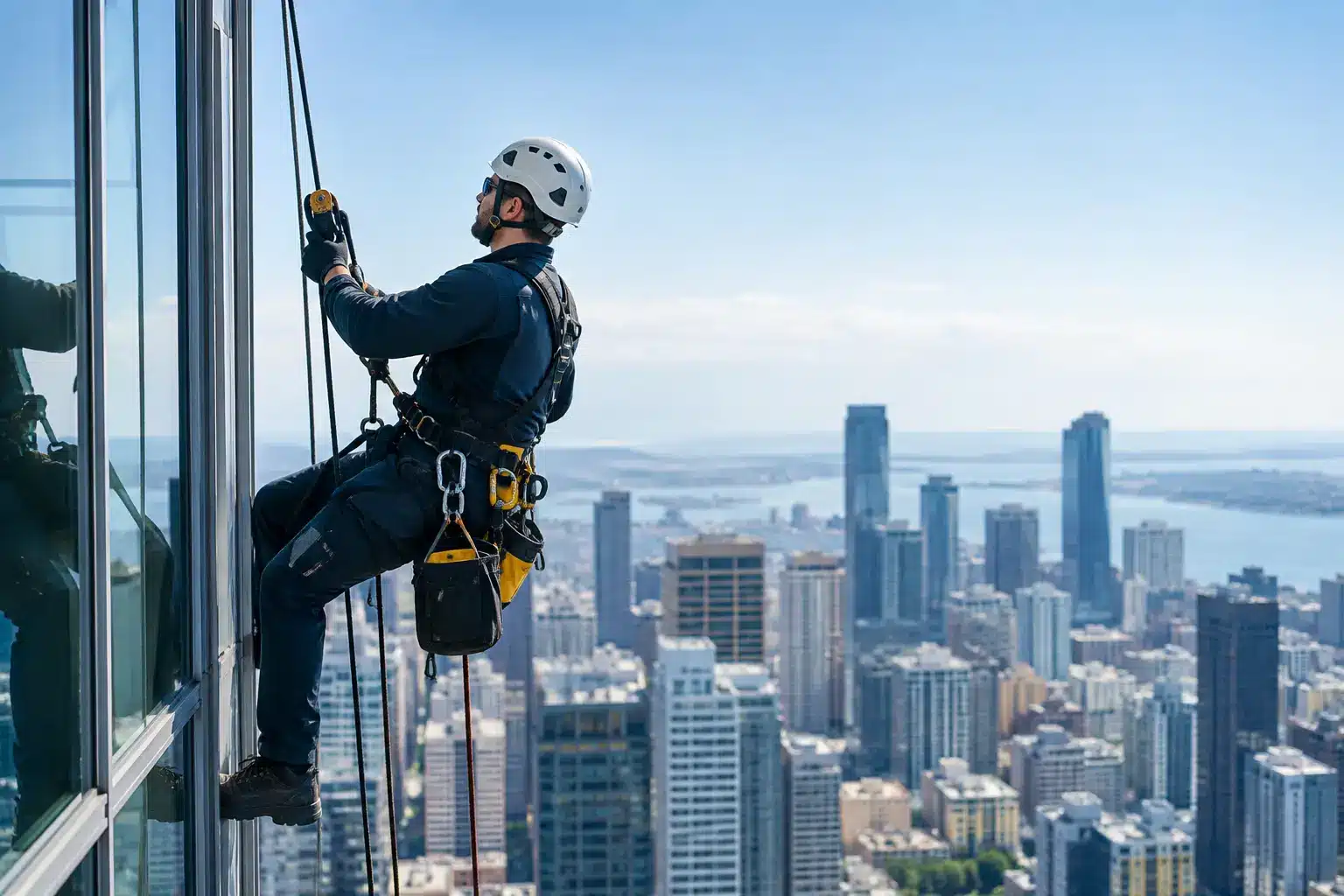

A stained curtain wall, blocked roof gutter, or leaking façade joint can become a visible and costly problem long before a building manager can arrange a crane, scaffold, or boom lift. Rope access gives commercial properties a practical way to reach elevated and difficult areas without turning routine maintenance into a major site disruption.
For high-rise offices, retail buildings, industrial facilities, and mixed-use developments, the value is not simply reaching height. It is completing cleaning, inspection, and maintenance work with controlled access, properly trained technicians, and a method suited to the building’s actual constraints.
What Is Rope Access?
Rope access is a work-at-height method that uses ropes, harnesses, anchor systems, and specialized equipment to position trained technicians safely on building exteriors and other hard-to-reach structures. Technicians descend, ascend, or move laterally along a façade while remaining connected to independent safety systems.
It is commonly used where ground-based equipment cannot reach, where access is restricted, or where scaffolding would be excessive for the scope of work. On a commercial site, rope access can support high-rise window cleaning, façade washing, exterior inspections, painting preparation, gutter clearing, and selected maintenance tasks.
This does not mean every elevated job should be done by rope. The right access method depends on the work area, building height, surface condition, anchor availability, public exposure, weather, and the equipment required. A dependable contractor assesses these factors before work begins rather than treating rope access as a one-size-fits-all solution.
Why Rope Access Matters for Commercial Buildings
Building exteriors are exposed to rain, airborne dust, traffic pollution, algae, bird droppings, and construction residue. In humid climates, these conditions can quickly affect glass, cladding, gutters, roofs, and drainage points. Delayed maintenance may lead to permanent staining, blocked water flow, corrosion, moisture intrusion, or an exterior that no longer reflects the standard of the property.
Traditional access methods can be effective, but they may require road closures, large setup areas, extended rental periods, or disruption to tenants and visitors. Rope access often reduces the footprint required on the ground. This is especially useful in dense commercial areas where loading zones, parking areas, pedestrian paths, and neighboring structures limit equipment placement.
The main operational benefit is targeted access. A technician can reach a specific panel, window line, gutter section, or façade feature without installing access equipment across the full building. For a focused inspection or localized repair, that can save time and reduce unnecessary site activity.
Cost efficiency is also a factor, although it should not be the only decision point. A lower setup requirement may make rope access more economical for certain jobs. However, extensive restoration work, heavy materials, broad surface replacement, or long-duration projects may still be better suited to suspended platforms, scaffolding, or mechanical lifts.
Common Rope Access Services
High-Rise Window and Façade Cleaning
Exterior glazing and façade finishes shape the first impression of a commercial property. Rope access allows cleaners to work across upper floors, recessed sections, and architectural features that are difficult to reach from the ground.
Professional cleaning is more than removing visible dirt. The right approach considers the surface material, previous coatings, water quality, cleaning solution, drainage, and the risk of leaving streaks or residue. Glass, aluminum composite panels, stone, metal cladding, and painted surfaces may each require different cleaning methods.
Roof Gutter and Drainage Maintenance
High-level gutters and roof drainage channels are easy to overlook until water overflows during heavy rain. Leaves, debris, sediment, and nesting materials can block drainage points and cause water to travel where it should not.
Rope access can help technicians reach roof edges, difficult gutter runs, and elevated drainage sections where conventional access is impractical. Clearing the blockage is only part of the job. Technicians should also observe visible damage, loose sections, standing water, and drainage conditions that may require further maintenance.
Façade Inspection and Maintenance Support
Not every exterior issue requires immediate large-scale repair. A focused rope access inspection can help identify cracked sealant, loose fittings, deteriorated coatings, failed joints, staining patterns, or areas affected by water ingress.
This gives facilities teams clearer information for maintenance planning. It can also prevent small issues from becoming larger repair projects, particularly when the building’s exterior is inspected before the wet season or after nearby construction activity.
Commercial Painting and Surface Preparation
Exterior painting at height requires more than reaching the wall. Surface preparation, cleaning, protection of nearby areas, material handling, drying conditions, and finish consistency all affect the result.
For targeted exterior painting and touch-up work, rope access can provide a controlled way to reach elevated sections without building-wide scaffolding. The method is particularly useful for localized deterioration, signage zones, feature walls, and areas around windows or façade transitions.
Safety Starts Before Technicians Go Over the Edge
High-risk access work should never begin with a generic plan. Every commercial property has different roof layouts, anchor arrangements, façade geometry, tenant activity, and ground-level risks. The safest approach begins with a site assessment.
Before work starts, the contractor should evaluate access and anchor points, the condition of the work surface, potential falling-object hazards, exclusion zones, weather exposure, rescue arrangements, and how the work will affect occupants and visitors. A clear method statement and risk assessment help define how technicians will perform the task and how the site will be managed.
Weather deserves particular attention. Wind, lightning, rain, and wet surfaces can change the risk level quickly. High-rise work may need to be delayed when conditions are unsuitable. This can be inconvenient for scheduling, but it is the right decision when safety and quality cannot be maintained.
Ground control matters as much as roof access. Even a small dropped object can pose a serious hazard below. Work areas may need barricades, signage, spotters, or timed access restrictions depending on pedestrian flow and the nature of the task.
How to Choose a Rope Access Contractor
Commercial decision-makers should look beyond a price quote. Rope access is specialized work, and the contractor’s planning and site discipline directly affect safety, building protection, and project outcomes.
Start by confirming that the contractor can explain the proposed access method in practical terms. They should identify how technicians will reach the work area, what safety controls will be used, whether the building has suitable anchors, and how public areas will be protected. Vague assurances are not enough for high-risk work.
Experience with similar building types also matters. A contractor familiar with high-rise offices may approach a glass curtain wall differently from an industrial warehouse, hotel tower, or factory structure. The cleaning method, equipment selection, access route, and work schedule should reflect the property’s operational needs.
Ask how the quote has been developed. A professional quotation normally considers building height, total work area, surface condition, labor requirements, access complexity, equipment, and the scope of cleaning or maintenance. A site visit is often the most reliable way to establish these details.
Finally, consider coordination. The best contractor works effectively with building management, security personnel, tenants, and operations teams. Clear scheduling, notification procedures, work-zone control, and post-work reporting reduce disruption and give the property team confidence that the job has been completed properly.
When Rope Access Is Not the Best Option
Rope access is highly adaptable, but there are limits. It may not be suitable where the building has no viable anchor solution, where technicians need to transport heavy equipment, or where the work requires a large stable platform for an extended period. Some areas may be better served by a boom lift, building maintenance unit, scaffold system, or a combination of methods.
The condition of the structure also matters. Damaged roof edges, uncertain anchor integrity, fragile cladding, or unsafe access routes must be addressed before any technician begins work. A responsible provider will recommend another method when rope access does not offer the appropriate level of control.
For properties across Kuala Lumpur, Selangor, Penang, and Johor, a site-specific review helps determine the access method that best fits the building, the maintenance scope, and daily operations. Urban Solutions Service Sdn. Bhd. approaches high-rise work with that practical standard: assess the site first, plan the work carefully, and carry out the task with the right people and equipment.
A clean, well-maintained exterior is easier to protect when access is planned before problems become urgent. Arrange a site assessment early, especially for elevated areas that are rarely inspected, and your maintenance team can make decisions based on actual building conditions rather than guesswork.