

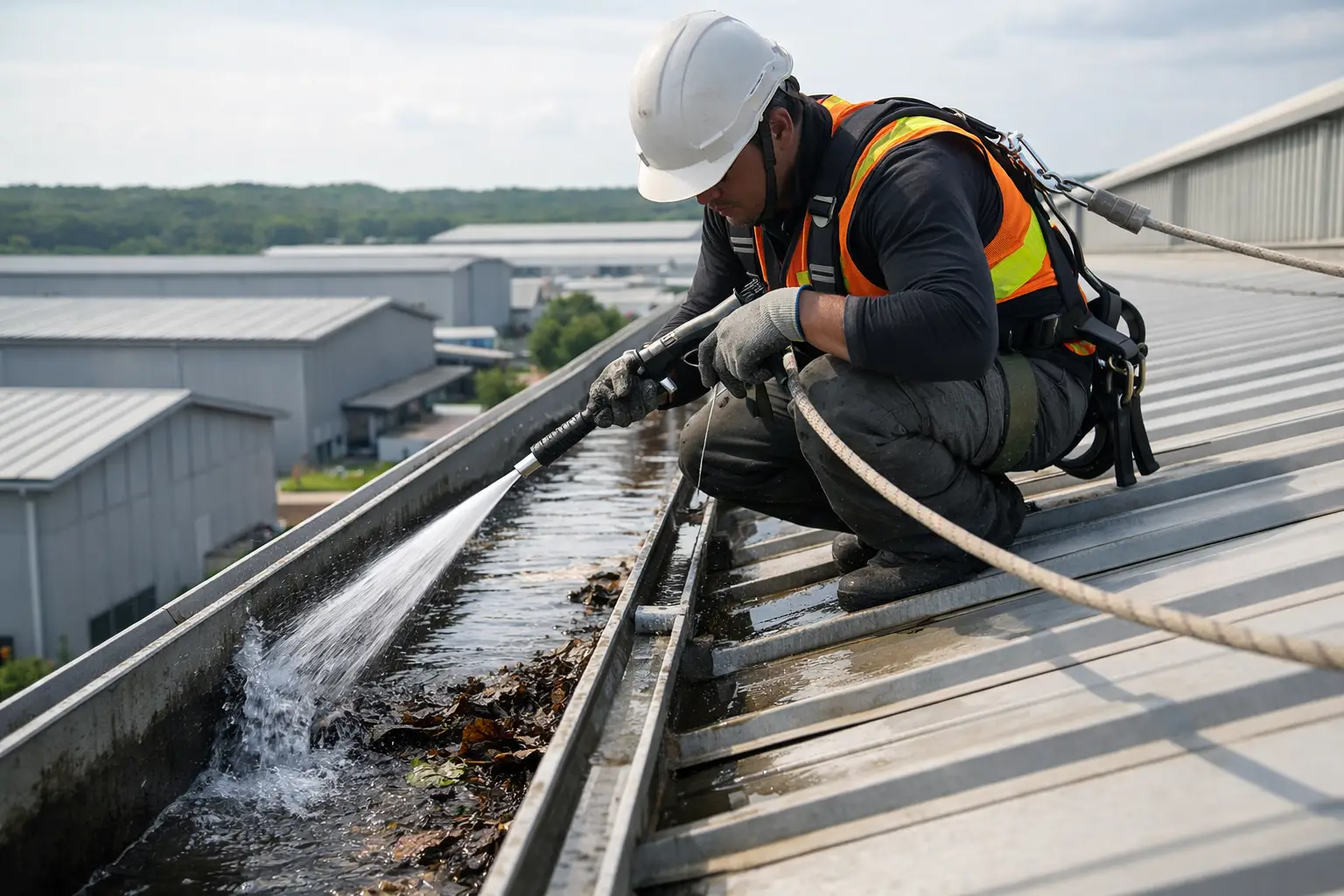

A blocked gutter can turn a short Johor downpour into a costly maintenance issue. For factories, warehouses, workshops, and commercial buildings, industrial roof gutter cleaning Johor is not a cosmetic task. It is preventive maintenance that helps protect roof systems, walls, loading areas, electrical equipment, stock, and day-to-day operations.
Industrial roofs collect more than leaves. Dust from production areas, loose roofing material, bird nests, plastic waste, sediment, and vegetation can build up inside gutters and downpipes over time. When water cannot drain as designed, it can overflow into places where it does not belong.
Why industrial roof gutters need professional attention
A gutter system is designed to move large volumes of rainwater away from the roof quickly. In an industrial setting, the system may run across long roof spans, connect to high-level downpipes, and sit near fragile roof sheets, skylights, cable routes, or equipment. Cleaning it properly requires more than sending a worker up with a scoop and a hose.
Overflowing gutters can stain exterior walls, saturate fascia boards, weaken seals around roof edges, and create persistent damp areas. Water that backs up beneath roof flashing may eventually appear as an internal leak, even when the roof surface itself is still in reasonable condition. This can lead to damaged insulation, ceiling panels, inventory, machinery, and electrical fittings.
There is also an operational risk. Water pooling near entrances, loading bays, walkways, or work areas can create slip hazards. If drainage discharge is blocked, heavy rain may disrupt access around the property at exactly the time your team needs safe movement through the site.
Regular cleaning costs far less than emergency repairs after a major storm. The right frequency depends on the building’s surroundings, roof design, and exposure to debris. A warehouse beside mature trees requires more attention than a building in a clear industrial park, while sites close to construction activity may experience faster dust and sediment buildup.
What is involved in industrial roof gutter cleaning in Johor?
A professional service begins with a site assessment. The contractor needs to understand the building height, roof access points, gutter layout, roof condition, drainage outlets, and any hazards around the work area. This is especially important for factories with restricted operational zones, overhead services, fragile roof sections, or busy vehicle movement.
The cleaning process usually includes removal of accumulated debris from gutters, valley channels, roof drains, and downpipe inlets. Technicians then check whether water can travel freely through the drainage system. Where appropriate, controlled flushing may be used to identify slow-moving lines or blockages further down the pipe.
The service should not treat every blockage as the same issue. A gutter filled with dry leaves can often be cleared quickly. A downpipe packed with compacted silt, waste material, or root growth may need more targeted work. Likewise, standing water in a gutter can indicate a blockage, but it may also point to poor gutter alignment, insufficient fall, damaged brackets, or deformation caused by previous loading.
A capable contractor records visible defects while cleaning. Cracked joints, rusted sections, loose brackets, damaged sealant, and roof edge deterioration should be brought to the facility team’s attention. Cleaning removes the immediate obstruction, but identifying the source of repeated drainage problems helps management plan repairs before the next severe weather event.
Safe access is the deciding factor
The biggest difference between routine cleaning and industrial roof work is access. Many gutters are located at heights where falls, weak roof surfaces, and limited access routes create serious risk. A safe work plan must account for how technicians reach the area, how they remain protected while working, and how debris is removed without creating hazards below.
Depending on site conditions, access may involve roof access systems, mobile elevated work platforms, rope access, scaffolding, or other suitable equipment. There is no single method that fits every building. A low warehouse with stable access may require a different approach from a multi-story manufacturing facility with narrow perimeter space or restricted ground-level access.
The fastest-looking method is not always the safest or most cost-effective. For example, a lift may provide efficient access where there is clear working space, but it may be impractical where landscaping, parked vehicles, overhead lines, or production traffic limit positioning. Rope access can reduce disruption in certain high-level areas, but it requires appropriate anchor points and a detailed assessment. A site-specific quotation is necessary because labor, equipment, height, access complexity, and work duration all affect the scope.
Before work begins, the contractor should establish safe exclusion areas below, coordinate with the facility representative, and manage debris responsibly. This matters at active sites where staff, contractors, forklifts, and delivery vehicles continue moving through the property.
Signs your gutters need cleaning sooner
Facility teams should not wait until a ceiling leak appears. The most useful warning signs are usually visible after rainfall. Water spilling over gutter edges, staining on external walls, dripping from unexpected locations, or water collecting around downpipe outlets all deserve attention.
Other signs are less obvious. Plants growing from gutters, bird activity around roof edges, sagging gutter runs, recurring damp marks near the top of internal walls, and frequent roof drain backups indicate that inspection is overdue. If your maintenance team has cleared the same downpipe more than once, the issue may be further within the drainage line or related to a gutter defect rather than loose debris alone.
For industrial properties, it is also wise to inspect after nearby construction work, major storms, or roof repair projects. These events can introduce dust, offcuts, fasteners, packaging material, and other debris into drains and gutter channels.
Setting a practical maintenance schedule
Most industrial properties benefit from planned inspections at least twice a year, with additional cleaning based on site conditions. The best schedule is not simply a calendar reminder. It should reflect what is happening around the building.
Sites near trees, undeveloped land, coastal exposure, or construction zones may need more frequent attention. Buildings with wide roofs and large catchment areas should also be monitored closely because even a small blockage can affect a significant volume of stormwater. Facilities with known drainage issues may require inspection before and after periods of heavier rainfall.
Planned maintenance allows work to be arranged around production, tenant activity, and vehicle access. It also gives building managers a clearer record of roof drainage conditions over time. This is useful when preparing maintenance budgets, reporting to ownership, or deciding whether repairs should be included in future capital work.
What to expect from a professional contractor
When engaging a contractor for industrial roof gutter cleaning in Johor, look beyond the quoted cleaning price. The scope should clearly state the work areas, access method, debris removal approach, safety controls, and whether downpipes or roof drains are included. Ambiguous scopes can leave critical parts of the system untouched.
Experience with high-risk exterior work is equally important. Industrial roof cleaning can involve working near skylights, uneven roof surfaces, live operations, and difficult drainage points. The contractor should have trained personnel, suitable access equipment, and a work plan that fits the actual building rather than a generic checklist.
Urban Solutions Services Sdn Bhd approaches roof gutter work as part of practical building maintenance support. A site visit helps determine the safest access method, the likely labor requirement, and whether visible drainage or roof-edge defects need separate attention. This gives facility managers a more accurate basis for planning work and avoiding surprises on site.
Keep small blockages from becoming major disruptions
Industrial Roof Gutter Cleaning Johor: Practical Takeaways
Where the work involves roof or elevated access, property teams should also review DOSH guidance on working at height when planning access, supervision and fall-prevention controls.
For a site-specific scope, review our roof and gutter services and arrange an assessment before confirming access, timing and cost.
Gutters are easy to ignore because they sit out of sight, until they fail during heavy rain. Scheduling inspection before damage appears gives your team control over timing, cost, and site safety. A well-planned site assessment is a sensible first step when your roof drainage system has not been checked recently or shows signs of overflow.