

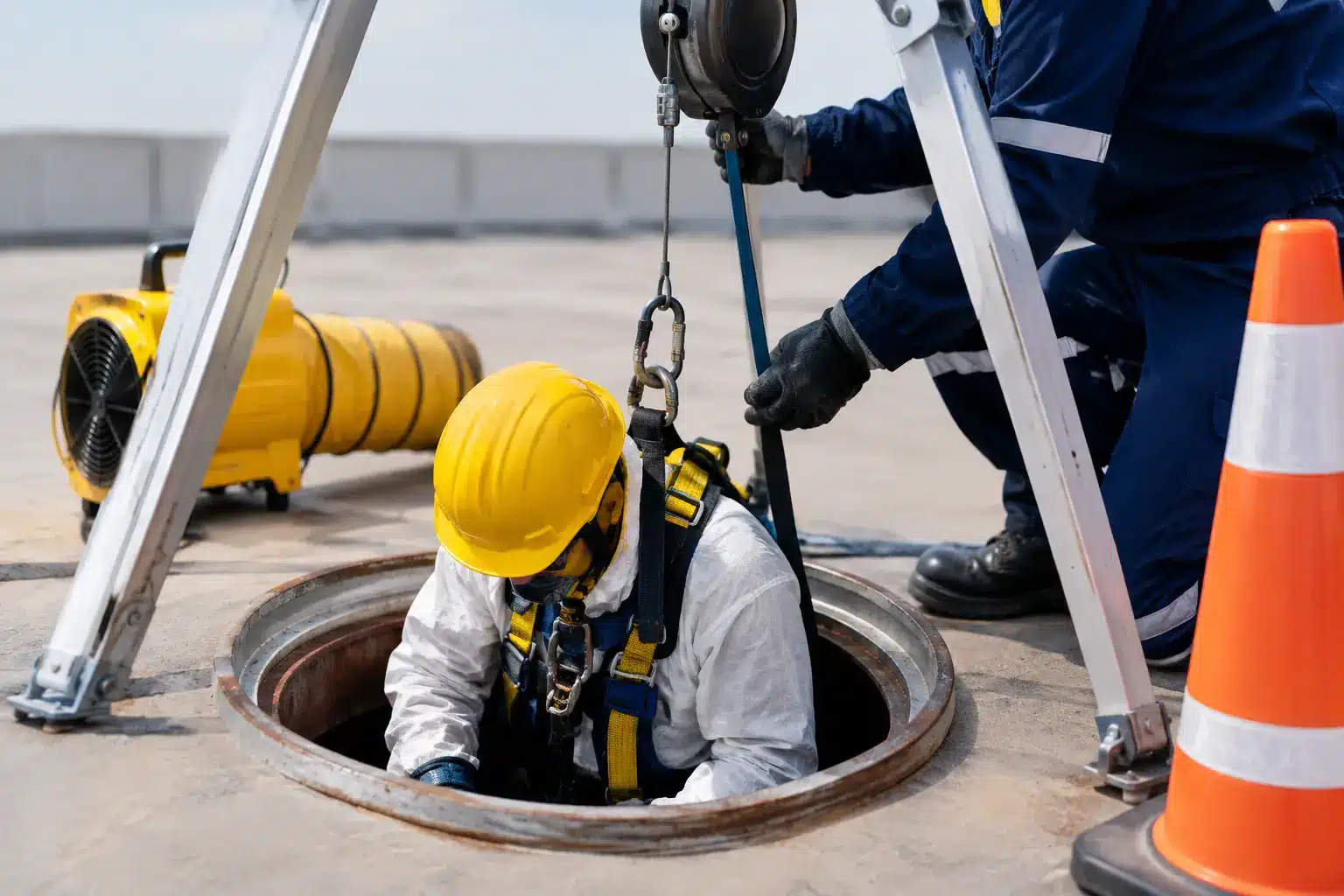

A drain chamber, water tank, duct shaft, sewer line, or service pit can look like a straightforward cleaning job from outside. Once a worker enters, confined space risks change the job completely. Poor air quality, restricted movement, limited visibility, and difficult rescue access can turn a routine maintenance task into a life-threatening emergency within minutes.
For property and facility teams, the right question is not whether an area is dirty or hard to reach. It is whether the work can be completed safely without entry, and if entry is necessary, whether the site has the controls, competent personnel, equipment, and rescue arrangements required for the conditions.
What Makes a Space Confined?
A confined space is not simply a small room. It is an enclosed or partially enclosed area that is not designed for continuous occupancy and has limited access for entry or exit. The risk rises when the space can contain hazardous gases, lack enough oxygen, flood unexpectedly, trap heat, or make evacuation difficult.
Common examples in commercial and industrial properties include underground tanks, septic systems, grease traps, manholes, lift pits, culverts, enclosed ducts, silos, and certain plant rooms. Conditions can also change from one visit to the next. A chamber that was safe to inspect last month may contain hazardous vapors after rainfall, chemical discharge, biological activity, or nearby maintenance work.
That is why a visual check at the opening is never enough. The atmosphere and physical condition inside the space must be assessed before entry and monitored while work is underway.
The Main Confined Space Risks on a Work Site
The most serious hazard is often an unsafe atmosphere. Oxygen-deficient air can affect judgment, coordination, and consciousness quickly. Oxygen enrichment is also dangerous because materials can ignite more easily. Toxic gases and vapors may be produced by sewage, sludge, cleaning chemicals, fuel residue, corrosion, or decaying organic matter. Some gases have little or no warning odor.
Flammable gas is another major concern. A spark from unsuitable electrical equipment, a static discharge, or hot work can ignite an atmosphere that has reached a dangerous concentration. This is especially relevant around drains, tanks, process areas, and spaces connected to chemical or fuel systems.
Physical hazards deserve equal attention. A worker may face slippery surfaces, falling objects, sharp edges, unstable ladders, moving equipment, engulfment by liquid or loose material, extreme heat, or rising water. Restricted access also makes a simple slip or medical event far more serious because emergency responders may not be able to reach the person immediately.
Communication can fail underground or behind thick concrete walls. If the entrant cannot speak clearly with the attendant outside, the team loses an essential safety control. In many incidents, a second person is injured after entering impulsively to help a collapsed colleague. Rescue must be planned before entry, not improvised after something goes wrong.
Start With the Question: Is Entry Necessary?
The safest confined-space entry is the one avoided altogether. Before scheduling cleaning or maintenance, assess whether the task can be completed from outside using remote inspection equipment, vacuum systems, extension tools, flushing methods, mechanical cleaning devices, or camera surveys.
This is not always practical. Heavy deposits, blockages, structural defects, and internal repairs may require trained personnel to enter. But avoiding entry where possible reduces exposure, simplifies operations, and minimizes disruption to the property.
Where entry is necessary, the work scope should be defined clearly. “Clean the tank” is not a sufficient instruction. The team needs to know the type of contamination, access dimensions, depth, connected services, potential chemical residues, water sources, nearby operations, and the condition of ladders, covers, and internal structures. A proper site assessment gives the contractor and facility representative the information needed to select the right controls.
Controls That Must Be in Place Before Entry
Safe entry depends on a planned system of work, not individual confidence. The exact requirements depend on the site and task, but several controls should be treated as fundamental.
First, isolate the space from anything that can introduce a hazard. This may include shutting off and locking out pumps, valves, electrical systems, mechanical equipment, chemical lines, or incoming water. If another department can restart equipment or discharge material into the space, coordination is essential.
Second, test the atmosphere using suitable calibrated gas-monitoring equipment. Testing should check oxygen levels, flammable gases, and relevant toxic gases. Measurements may need to be taken at different levels because gases do not all settle in the same place. If conditions are unsafe, ventilation and reassessment are required before work can proceed.
Third, establish a formal entry authorization process. The documentation should identify the space, work activity, hazards, isolations, atmospheric test results, PPE, communication method, entry duration, responsible persons, and emergency arrangements. It should also state when work must stop, such as changing gas readings, heavy rain, loss of communication, equipment failure, or a medical concern.
Finally, use a competent entry team. This normally includes an authorized entrant and a dedicated attendant outside the space. The attendant must remain focused on monitoring conditions and communicating with the entrant. They should not be assigned unrelated cleaning, security, or delivery duties at the same time.
Equipment Is Only Effective When It Fits the Plan
Personal protective equipment is necessary, but it is not a substitute for hazard control. A respirator, for example, only works when the correct type is selected, fitted, maintained, and used within its limits. It cannot make an oxygen-deficient atmosphere safe unless the equipment and procedure are specifically designed for that condition.
Depending on the risk assessment, an entry team may require a full-body harness, retrieval line, tripod or davit system, breathing protection, intrinsically safe lighting, protective clothing, non-sparking tools, gas detectors, mechanical ventilation, and reliable radio or hardwired communication. Access equipment must also suit the opening and internal configuration. A ladder that is adequate for a shallow pit may be unsuitable for a deep vertical shaft.
There are trade-offs. Ventilation can improve air quality, but poorly positioned equipment may create trip hazards, restrict the opening, or fail to reach dead-air zones. A retrieval system can support rescue, but only if the path is clear and the setup can safely lift the entrant. The equipment selection must follow the actual site conditions, not a standard checklist used for every location.
Rescue Planning Cannot Be an Afterthought
Calling emergency services is not a complete rescue plan. Site teams must consider how quickly responders can access the property, locate the space, remove covers, assess the atmosphere, and retrieve an injured worker. For some spaces, a trained rescue team and dedicated retrieval equipment may be needed on site before entry begins.
The rescue plan should address likely scenarios, including an unconscious entrant, a fall injury, a gas alarm, flooding, and equipment failure. It should identify who will raise the alarm, who will prevent unauthorized entry, where emergency vehicles can access the site, and how the space will be made safe during the response.
No one should enter a confined space to attempt a rescue unless they are trained, equipped, and authorized to do so. This discipline can feel slow in an emergency, but uncontrolled rescue attempts are a common reason one casualty becomes several.
What Facility Managers Should Confirm With a Contractor
A capable confined-space contractor should be able to explain its approach before work starts. Ask how the space will be assessed, what monitoring equipment will be used, how hazards will be isolated, who will act as attendant, and what rescue provisions apply. Request clarity on the scope, access method, workforce competency, insurance requirements, and any conditions that could affect cost or schedule.
A free site visit is often valuable for difficult spaces because drawings and verbal descriptions rarely reveal every access issue. Entry opening size, parking for equipment, roof or basement access, live building operations, drainage connections, and nearby tenants can all influence the work plan.
For cleaning and maintenance in commercial or industrial environments, selecting a contractor with high-risk access experience helps reduce gaps between planning and execution. The same discipline used for difficult exterior access should be applied below ground, inside tanks, and in restricted service areas.
Keep Records That Support Future Work
Confined spaces should not be treated as unknown locations every time maintenance is needed. Keep records of previous assessments, entry permits, atmospheric readings, cleaning methods, photos where appropriate, equipment used, defects found, and changes to the surrounding systems.
These records help facility teams schedule preventive cleaning, identify recurring contamination, and prepare more accurate scopes for future contractors. They also make it easier to spot when conditions have changed, such as a damaged cover, increased sludge buildup, a new chemical process, or a drainage issue after renovations.
A well-managed confined-space job protects people first, but it also protects operations. When the work is planned properly, cleaning and maintenance can be completed with less disruption, clearer accountability, and greater confidence in the condition of critical building infrastructure.
Before authorizing the next tank, pit, or chamber cleaning job, pause at the opening and require a site-specific plan. That single decision gives your team the best chance to complete necessary maintenance without turning a hard-to-reach area into an avoidable emergency.