

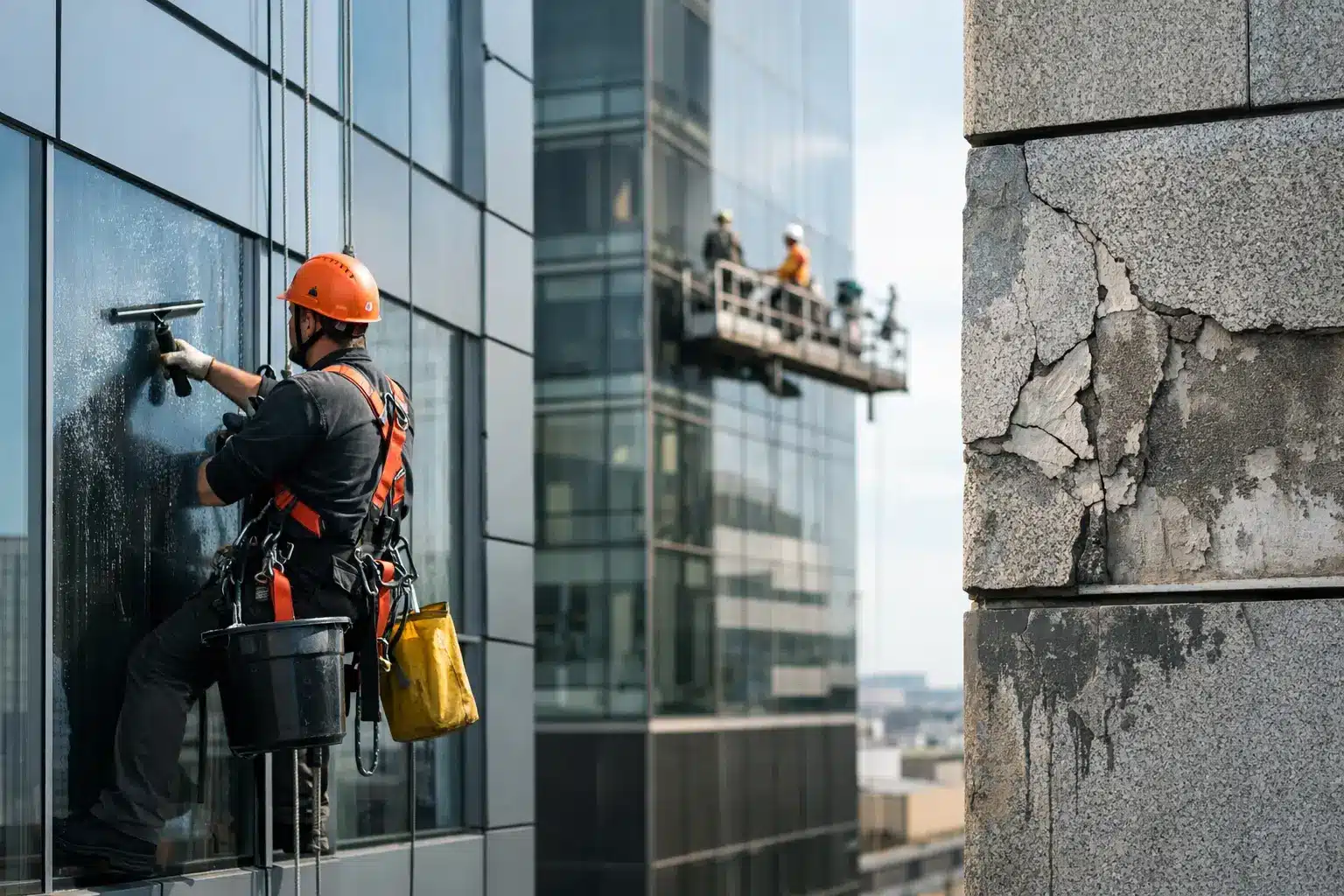

A stained glass curtain wall, rust marks below brackets, or water marks around cladding joints can quickly change how tenants, visitors, and clients view a commercial property. The top facade maintenance mistakes rarely begin as major failures. More often, they start with delayed cleaning, overlooked sealant damage, or access decisions made without a proper site assessment.
For property managers and facilities teams, facade maintenance is not simply a cosmetic task. It affects public safety, building performance, tenant confidence, and the long-term cost of ownership. The right maintenance plan protects the exterior before minor deterioration turns into a disruptive repair project.
Why Facade Maintenance Requires a Specialist Approach
A facade combines different materials, connection points, drainage paths, glazing systems, coatings, and sealants. Each responds differently to heat, rain, airborne pollutants, moisture, and cleaning chemicals. A method that is appropriate for painted concrete may damage aluminum composite panels, leave marks on glass, or weaken aging sealant.
High-rise and hard-to-access facades add another layer of risk. Cleaning and inspection work must be planned around safe access, anchor points, weather, occupied areas below, and the building’s specific configuration. Selecting a contractor solely on a basic cleaning rate can overlook the access equipment, trained labor, supervision, and safety controls needed to do the work properly.
1. Waiting Until the Facade Looks Dirty
One of the most common top facade maintenance mistakes is treating visible dirt as the only reason to schedule cleaning. By the time staining becomes obvious, contaminants may have been sitting on the surface for months. Traffic film, mineral deposits, algae, bird droppings, construction dust, and industrial pollutants can bond to facade materials and become harder to remove.
Regular cleaning helps maintain appearance, but it also gives technicians an opportunity to spot loose fittings, cracked panels, failed sealant, blocked drainage points, and early corrosion. The appropriate frequency depends on the building’s height, facade material, exposure to rain, nearby traffic, and surrounding construction activity. A tower beside a busy roadway or active development may need closer attention than a sheltered low-rise office building.
2. Using One Cleaning Method for Every Surface
A facade is rarely made from one material. Glass, stone, metal, painted surfaces, concrete, ceramic finishes, and composite panels may all appear on the same elevation. Applying the same chemical, pressure setting, brush, or water temperature to every area is an avoidable risk.
Excessive pressure can force water into joints or damage coatings. Incorrect detergents may leave streaks, discolor finishes, or react with metal surfaces. Abrasive tools can scratch glass and polished stone. Even purified-water cleaning, which is highly effective on many glass surfaces, must be used with a process suited to the building’s condition and access method.
Before work begins, the contractor should identify facade materials, inspect existing defects, and test the proposed cleaning approach in an inconspicuous area where appropriate. The goal is not just a clean finish on the day of service. It is protecting the surface condition over repeated maintenance cycles.
3. Treating Water Stains as a Cleaning Problem Only
Water marks, streaking, mold growth, and discoloration often point to more than surface dirt. They may indicate blocked gutters, leaking joints, failed sealant, poor drainage, damaged flashings, or water entering through a roof-level detail. Repeatedly washing the affected area without identifying the moisture source only delays the real repair.
This is particularly relevant at parapets, window perimeters, expansion joints, ledges, and transitions between facade systems. During inspections, facilities teams should record where staining occurs, whether it returns after rainfall, and whether it is linked to a particular floor or drainage route. That information helps distinguish ordinary environmental buildup from an active building-envelope issue.
Cleaning is still useful because it reveals the true condition beneath the stains. However, cleaning and maintenance support need to work together. If the source remains unresolved, the same marks will return and the underlying damage may continue.
4. Ignoring Sealant, Joints, and Small Cracks
Facade sealant is easy to overlook because it is not always visible from ground level. Yet it plays a major role in managing water movement and allowing different materials to expand and contract. Sealant that has cracked, separated, hardened, or pulled away from the joint can create a route for water intrusion.
Small cracks in render, concrete, or coating systems deserve attention as well. Not every hairline crack requires immediate major work, but every crack should be assessed in context. Is it stable? Is moisture present? Is it widening? Is there corrosion staining nearby? Has the same condition appeared in multiple locations?
A documented inspection process prevents teams from relying on memory or reacting only when an internal leak is reported. Photographing defects, recording their location, and comparing their condition over time makes maintenance decisions more accurate and defensible.
5. Neglecting Roof Gutters and Drainage at the Top of the Building
Facade damage often begins above the facade itself. Roof gutters, downpipes, outlets, and drainage channels collect leaves, debris, sediment, and loose material from surrounding trees or construction activity. When water cannot drain properly, it may overflow down exterior walls, stain surfaces, saturate joints, or enter areas not designed for standing water.
Gutter maintenance should be scheduled before periods of heavy rainfall, not after an overflow has already affected the building. High-level drainage work can involve difficult access and should be handled by trained personnel with the right equipment and site controls. It is also an opportunity to inspect nearby roof edges, flashings, and facade transitions.
6. Choosing Access Methods Based Only on Convenience
Rope access, boom lifts, suspended platforms, ladders, and water-fed poles all have a place in facade maintenance. None is automatically the best choice. The right method depends on building height, facade geometry, ground conditions, obstruction points, work scope, anchor arrangements, and the need to protect occupants and pedestrians.
A shortcut in access planning can create safety exposure, incomplete cleaning, or damage to landscaping and lower-level finishes. For example, a boom lift may provide excellent reach on an open site but be impractical where vehicle access is limited. Rope access can reach complex elevations efficiently, but it requires suitable anchor systems, trained technicians, and clear exclusion zones below.
A proper site visit should determine how every area will be reached before a quotation is finalized. This avoids unexpected variation costs and prevents inaccessible sections from being left untreated.
7. Separating Cleaning From Inspection and Minor Maintenance
When cleaning crews, maintenance teams, and repair contractors operate independently, small exterior defects can fall between scopes. A cleaning team may notice loose sealant or corroded fittings but have no process for reporting them. A maintenance team may receive a tenant complaint but not have recent high-level images showing the exterior condition.
The better approach is to make inspection part of planned facade service. Technicians should report visible concerns with clear photographs and locations, while property teams should decide whether the issue needs monitoring, minor repair, or further specialist assessment. This does not mean every mark or imperfection requires an urgent project. It means decisions are based on evidence rather than assumptions from ground level.
For commercial properties with multiple exterior needs, combining facade cleaning, window cleaning, gutter servicing, and targeted maintenance support can also reduce repeated access setup and disruption to operations.
8. Delaying Work Because Occupied Buildings Are Difficult to Manage
Occupied office buildings, retail sites, and industrial facilities do require coordination. Work may need to avoid peak arrival times, loading activities, public entrances, sensitive production areas, or tenant events. But postponing exterior maintenance indefinitely usually increases the eventual scope and cost.
The solution is not to accept disruption. It is to plan it. A professional contractor should establish work zones, schedule access carefully, protect surrounding areas, communicate site requirements, and maintain clear safety controls throughout the project. For buildings in Kuala Lumpur, Selangor, Penang, and Johor, this planning is especially valuable where weather conditions, dense surroundings, and active sites can affect the work program.
Build a Maintenance Plan Before Problems Become Visible
The most effective facade programs are based on condition, risk, and access realities rather than a fixed one-size-fits-all schedule. Start with a site assessment, identify material types and recurring trouble spots, then set cleaning and inspection intervals that reflect the building’s exposure. Keep records after each service so changes can be identified early.
Top Facade Maintenance Mistakes: Practical Takeaways
Where the work involves roof or elevated access, property teams should also review DOSH guidance on working at height when planning access, supervision and fall-prevention controls.
For a site-specific scope, review our façade cleaning services and arrange an assessment before confirming access, timing and cost.
A well-maintained facade does more than look spotless. It signals that the property is managed with care, protects the building envelope, and gives facilities teams fewer urgent problems to explain later. When exterior work is technically demanding, choosing skilled specialists and addressing issues early is the practical way to protect both the building and its reputation.