

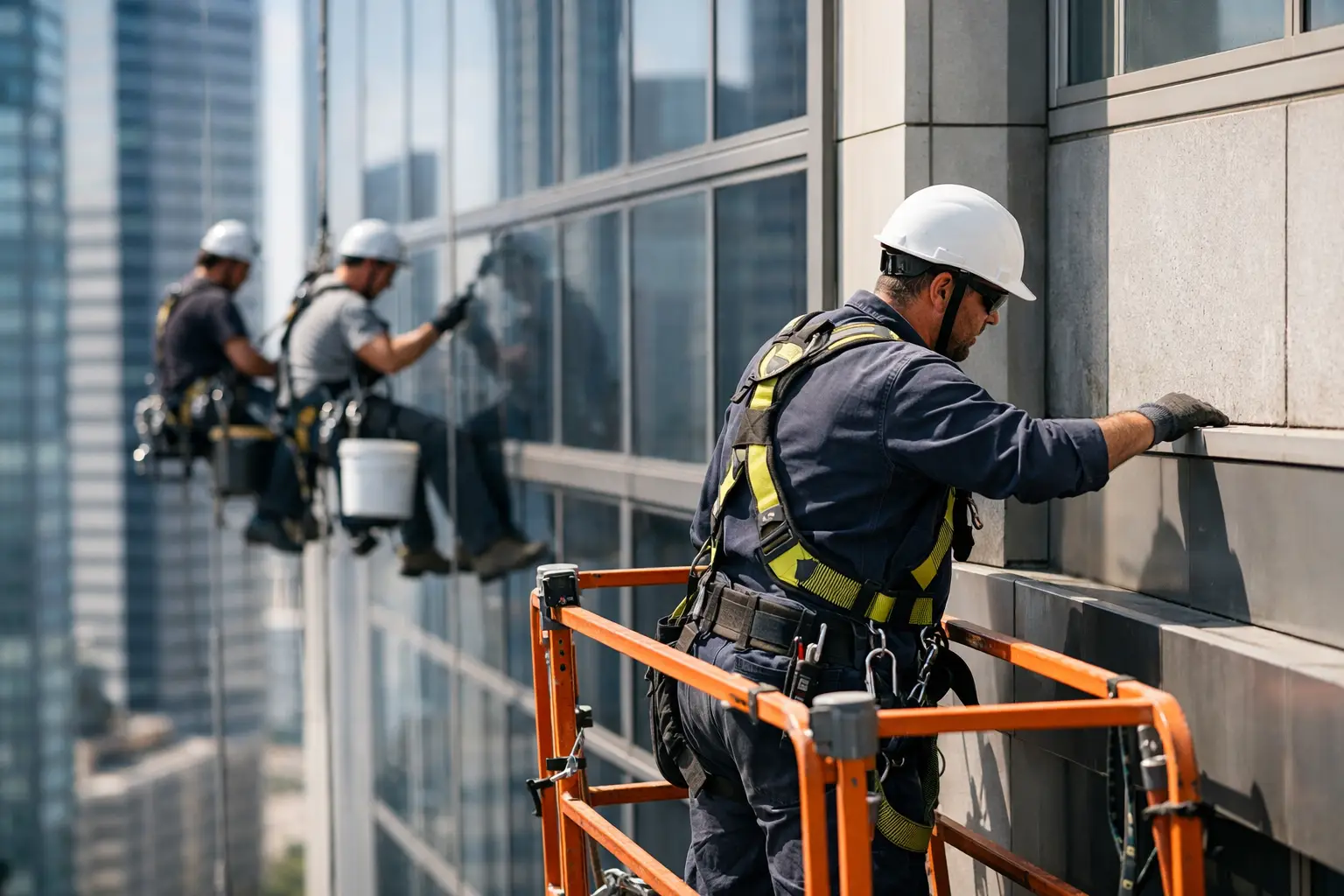

A stained facade or blocked roof gutter is rarely just a cosmetic issue. In commercial buildings, hard-to-reach maintenance problems tend to spread quietly until they affect safety, tenant experience, and repair costs. That is why safe access building maintenance matters – not as a box to check, but as a practical way to keep high-rise, commercial, and industrial properties operating without unnecessary risk.
For property managers and facilities teams, the challenge is rarely deciding whether maintenance is needed. The real question is how to reach difficult areas safely, efficiently, and without disrupting the rest of the site. Windows at height, external facades, rooftops, gutters, and confined spaces all require different access methods, different crew skills, and different controls. Treating them the same is where problems start.
What safe access building maintenance really means
Safe access building maintenance is the planned use of proper access systems, trained personnel, and site controls to carry out cleaning, inspection, and repair work in areas that are difficult or hazardous to reach. That may involve rope access, gondolas, scaffolding, boom lifts, ladders for limited tasks, or confined space entry procedures, depending on the building and the job scope.
The key point is that access is not separate from maintenance. Access is part of the work. If the access method is wrong, the job becomes slower, less consistent, and more exposed to accidents, property damage, or incomplete results. A clean facade achieved through poor access planning is not a successful outcome.
This is especially true for office towers, commercial complexes, warehouses, and industrial facilities where exterior surfaces, high-level glass, rooftop drainage, and service voids can affect both appearance and building performance. The maintenance standard is only as good as the ability to reach the work area correctly.
Why access strategy affects cost, speed, and risk
A common mistake in commercial maintenance is assuming the cheapest access option is the most practical one. In reality, the lowest upfront price can create delays, repeat visits, and more risk exposure if the crew cannot work efficiently at height or in restricted spaces.
For example, facade cleaning on a mid-rise building may be manageable with mobile elevated work platforms if the ground conditions allow it. On a taller structure with limited perimeter access, rope access or a gondola system may be the better choice. One is not always better than the other. It depends on height, layout, obstructions, work duration, and the condition of the building itself.
The same goes for roof gutter maintenance. If debris is removed inconsistently because access is awkward or unsafe, water overflow can still damage walls, ceilings, and drainage lines even after a service visit. Proper access supports complete work, not partial work.
When access is planned well, there are practical benefits beyond safety. Downtime is easier to manage. Work areas are controlled more effectively. Fewer reworks are needed. Facility teams also spend less time coordinating multiple vendors for separate high-risk tasks.
Safe access building maintenance for different property types
Not every site needs the same approach. A corporate office tower, a retail complex, and an industrial plant each create different access demands.
In high-rise office buildings, the focus is often on exterior glass, facade presentation, and routine rooftop maintenance. Appearance matters because tenants, visitors, and clients see those surfaces every day. Access planning here must balance visual results with minimal disruption to building operations.
In commercial properties such as malls or mixed-use developments, public safety and traffic management become more important. Access equipment cannot interfere with pedestrian flow, loading areas, or tenant operations more than necessary. Timing and site coordination are part of the service, not an afterthought.
In industrial facilities, the risk profile shifts. Structures may include confined spaces, high ledges, service platforms, tanks, ducts, or process-related buildup. Here, access is closely tied to hazard control. Cleaning and maintenance crews need the right permits, procedures, and technical discipline to work safely around operational constraints.
The access methods should fit the job
A professional contractor should not force every project into the same method. The access solution should follow the site conditions and maintenance objective.
Rope access is often effective for high-rise exterior work where speed and flexibility are important, especially when ground space is limited. It reduces the footprint at ground level and can be highly efficient in the hands of trained technicians. That said, it is not suitable for every task or every facade condition.
Gondola systems are useful for planned facade and window cleaning on buildings designed for suspended access. They can support consistent coverage over large vertical surfaces, but they depend on the building’s installed systems being in proper condition.
Boom lifts and scissor lifts can work well for lower elevations, atriums, and structures with clear access routes. Their limitation is simple: if the machine cannot be positioned where it needs to go, productivity drops fast.
Scaffolding has its place for longer-duration works or when crews need stable access for painting, repairs, or detailed facade tasks. It takes more setup and usually affects the site more visibly, so it makes sense when the project scope justifies it.
Confined space work is its own category. Tanks, ducts, shafts, and enclosed service areas require controlled entry, atmospheric testing, rescue readiness, and trained personnel. This is not standard cleaning with extra paperwork. It is specialized maintenance support with serious safety obligations.
What facility teams should expect from a qualified contractor
If a contractor talks only about cleaning results and not about access planning, that is a gap. In high-risk maintenance, the method matters as much as the finish.
A qualified provider should assess building height, structural layout, anchorage points where relevant, ground conditions, restricted zones, weather exposure, and the actual maintenance objective. They should also be clear about crew competency, equipment suitability, work sequencing, and site protection.
That does not mean every client needs a technical lecture. It means the contractor should be able to explain, in practical terms, how the work will be done and what constraints may affect timing or pricing. Site-specific quotations are important for this reason. Two buildings with the same number of floors can require very different access plans.
For many property teams, there is also value in working with a provider that can handle more than one hard-to-reach service. Window cleaning, facade cleaning, roof gutter clearing, confined space cleaning, and exterior painting often overlap in the same building lifecycle. Coordinating them through one capable contractor can reduce friction and improve scheduling.
Common problems caused by poor access planning
Most building maintenance failures are not dramatic at first. They show up as recurring issues that should have been solved the first time.
You may see facade areas left untreated because the crew could not reach awkward sections. Gutters may still hold debris near corners or behind rooftop equipment. Glass cleaning may look inconsistent because access angles were limited. In more serious cases, there may be damage to surfaces, unsafe work behavior, tenant complaints, or delays that push the job into unsuitable weather windows.
Poor access planning also affects reporting. If crews cannot inspect the full area safely, building managers are left making decisions without a clear picture of the actual condition. That creates risk for budgeting and long-term maintenance planning.
Why site visits matter before quoting
In safe access building maintenance, remote estimates only go so far. Photos help, but they rarely show every obstruction, elevation change, anchor limitation, or service restriction that affects execution.
A proper site visit allows the contractor to assess the real access complexity, identify potential hazards, and match the right equipment and manpower to the work. It also gives the client a more realistic quotation based on height, building size, access difficulty, and labor needs rather than a generic rate.
For commercial buyers, this is not just about pricing accuracy. It is about avoiding scope gaps. If the access requirements are underestimated at the start, the project usually becomes slower and more expensive later.
Urban Solutions Services Sdn Bhd approaches high-risk exterior and hard-to-reach maintenance this way because demanding buildings need more than standard cleaning support. They need crews who understand access, safety, and execution as one job.
Choosing a maintenance partner for long-term reliability
The best maintenance partner is not simply the one who can get to the work area once. It is the one who can do it consistently, safely, and with enough operational discipline to support your property over time.
That means looking beyond price alone. Ask whether the contractor regularly handles high-rise or difficult-access projects. Ask how they assess site conditions. Ask what changes when weather, height, facade design, or confined conditions make the original plan less suitable. The answers should be direct and practical.
Where the work involves roof or elevated access, property teams should also review DOSH guidance on working at height when planning access, supervision and fall-prevention controls.
For a site-specific scope, review our high-rise window cleaning services and arrange an assessment before confirming access, timing and cost.
When safe access is built into the maintenance process from the start, the results are easier to trust. The work gets done properly, the building presents better, and your team spends less time managing avoidable problems. If your site has areas that are hard to reach, that is exactly where the maintenance standard needs to be highest.