

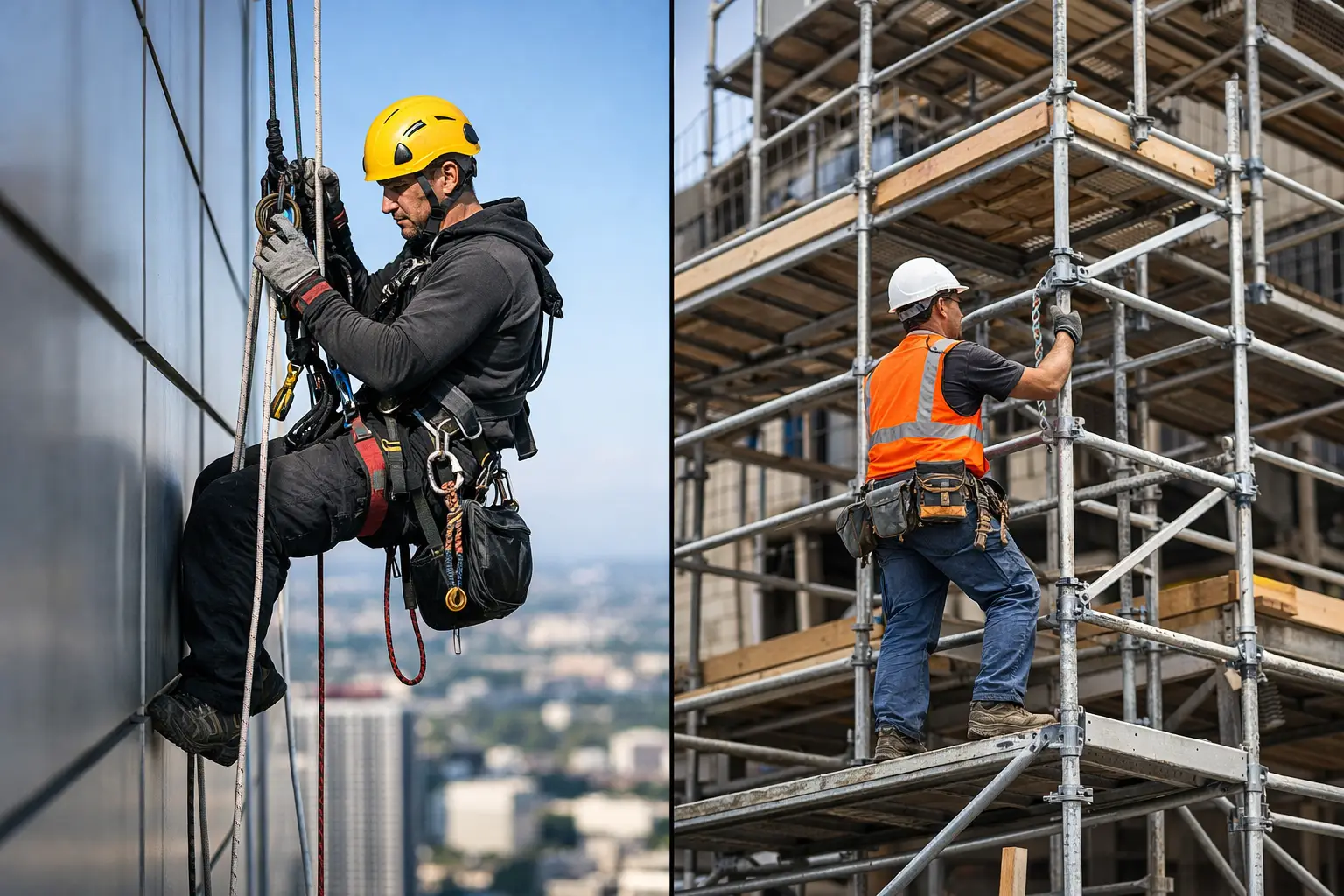

When a facade needs cleaning, sealant work, painting, or inspection, the access method shapes the entire job. In the rope access vs scaffolding decision, most property and facility teams are not asking which method sounds better on paper. They are asking which option gets the work done safely, efficiently, and with the least disruption to building operations.
That answer depends on the building, the scope, and the site conditions. Rope access can be faster and more flexible for targeted high-level work. Scaffolding can be the better choice for long-duration projects, heavier repair activity, or situations where workers need a stable platform across a wider area. Choosing the right method is less about preference and more about fit.
Rope access vs scaffolding for commercial buildings
For commercial and industrial properties, access is rarely a minor detail. It affects job cost, setup time, tenant disruption, safety planning, and the quality of execution. On high-rise buildings especially, access can be the main factor that determines whether maintenance is completed on schedule or postponed because the logistics are too cumbersome.
Rope access uses trained technicians, certified equipment, and anchored rope systems to reach elevated or difficult areas. It is commonly used for high-rise window cleaning, facade cleaning, inspections, minor repairs, and localized maintenance. Because the setup is relatively light, crews can often mobilize quickly and work on specific elevations without occupying large ground areas.
Scaffolding creates a fixed working platform around part or all of a structure. It gives workers continuous access to a broader surface area and allows tools, materials, and personnel to remain at height for longer periods. This is useful when the job requires extensive hands-on work across multiple sections, repeated passes, or heavier materials.
Neither method is automatically superior. The right call comes down to what the building needs and what the site can support.
Where rope access makes more sense
Rope access performs well when speed and targeted access matter. If a building needs exterior glass cleaning, facade washing, spot repairs, or inspection work on a tower with limited ground space, it often provides a clear operational advantage. There is less equipment to bring in, less footprint at ground level, and usually less interference with parking, walkways, and tenant movement.
This matters for occupied office towers, commercial blocks, and mixed-use developments where downtime and obstruction create immediate problems. A rope access team can often focus on the exact area that needs attention instead of building a full access structure around the facade.
It also makes sense when access points are irregular. Architectural fins, setbacks, recessed facades, atriums, and rooftop drops can make conventional platform access less practical. Experienced rope access technicians can reach areas that are difficult to serve with standard scaffold layouts.
Cost can be another reason, especially for shorter-duration work. Since there is usually less material, less transport, and less setup involved, rope access can reduce the total project cost for cleaning and light maintenance. That said, cost is not universal. If the work expands significantly or requires repeated visits to the same large area, the equation can change.
When scaffolding is the better option
Scaffolding becomes more practical when the job needs a stable work platform over time. If crews are carrying out extensive painting, replacement work, facade restoration, or repairs that require tools and materials to stay in place, scaffolding often supports better productivity.
It is also the stronger option for projects that cover a large continuous surface. If workers need to move laterally across an elevation for days or weeks, a fixed platform may be more efficient than repeated rope positioning. The same applies when multiple trades need access to the same work zone.
For some repair scopes, worker posture and hands-on control matter as much as access. Surface preparation, crack treatment, coating application, and detailed restoration can benefit from a platform that allows crews to work steadily with both hands free and materials immediately available.
Scaffolding may also be required where site risk assessments, work methods, or engineering constraints make rope access less suitable. Every building has its own limits, and a proper recommendation should reflect actual site conditions rather than a one-size-fits-all sales pitch.
Cost is not just the quote
One of the biggest mistakes in the rope access vs scaffolding comparison is looking only at the headline price. The access method affects several hidden costs that matter to building owners and facility teams.
Scaffolding often carries higher upfront costs because of transport, assembly, dismantling, and the amount of material involved. It may also require more ground control, more coordination, and longer occupation of external areas. On a busy commercial property, that can affect traffic flow, loading zones, tenant access, and public-facing appearance.
Rope access usually has lower setup costs for short, specialized work. But if the job is broad, repetitive, or heavily material-dependent, those savings may narrow. A lower initial quote is only useful if the method supports efficient completion of the actual scope.
The better question is not which method is cheaper in isolation. It is which method delivers the required result with the lowest total operational impact.
Safety depends on planning, not just the method
Property teams often ask which option is safer. The honest answer is that both can be safe when designed, supervised, and executed properly. Both can also create problems if the planning is weak.
Rope access relies on technician competence, anchor planning, rescue procedures, equipment inspection, and strict method statements. It demands a high level of training and discipline because the work is specialized and site variables change quickly.
Scaffolding has its own safety controls, including structural design, erection standards, platform integrity, tie-ins, loading limits, and safe use over the full project period. Because it remains on site, it also introduces exposure related to unauthorized access, weather, and ongoing site interaction.
For commercial building owners, the practical point is this: safety should be judged by the contractor’s systems, certifications, supervision, and site-specific risk management, not by assumptions about the access type alone.
Building disruption and tenant impact
In occupied properties, disruption often decides the method as much as technical access does. Rope access generally creates less obstruction at ground level and can be deployed with a smaller operational footprint. That can be a major advantage for premium office buildings, retail frontage, hotels, and active commercial sites.
Scaffolding can be more intrusive. It may block sections of the facade, affect natural light, limit use of walkways, or require cordoned-off zones for longer periods. In some cases that is acceptable because the work scope justifies it. In others, especially where image and access matter daily, the disruption becomes a serious drawback.
This is why site visits matter. What works on an industrial block with open perimeter space may not suit a city-center tower with tight access, active tenants, and limited staging areas.
How to choose the right access method
The best decisions start with the scope of work, not the access equipment. If the task is high-rise window cleaning, facade washing, localized sealing, or inspection, rope access is often the more efficient option. If the project involves major repairs, broad-surface treatment, or long-duration trade activity, scaffolding may deliver better working conditions.
A contractor should assess the building height, roof access, drop lines, facade layout, ground conditions, work duration, material handling needs, and public interface. That is the only reliable way to recommend the right system.
At Urban Solutions Services Sdn Bhd, this is exactly why site-specific quotations matter. Access planning is part of the job, not an afterthought. The right recommendation protects safety, controls disruption, and helps maintenance teams complete technically demanding work without unnecessary delays.
Where the work involves roof or elevated access, property teams should also review DOSH guidance on working at height when planning access, supervision and fall-prevention controls.
For a site-specific scope, review our high-rise window cleaning services and arrange an assessment before confirming access, timing and cost.
If you are weighing rope access against scaffolding, the most practical move is to assess the building and the work together. The right method is the one that fits the site, supports safe execution, and gets your property back to clean, presentable condition with the least friction possible.