

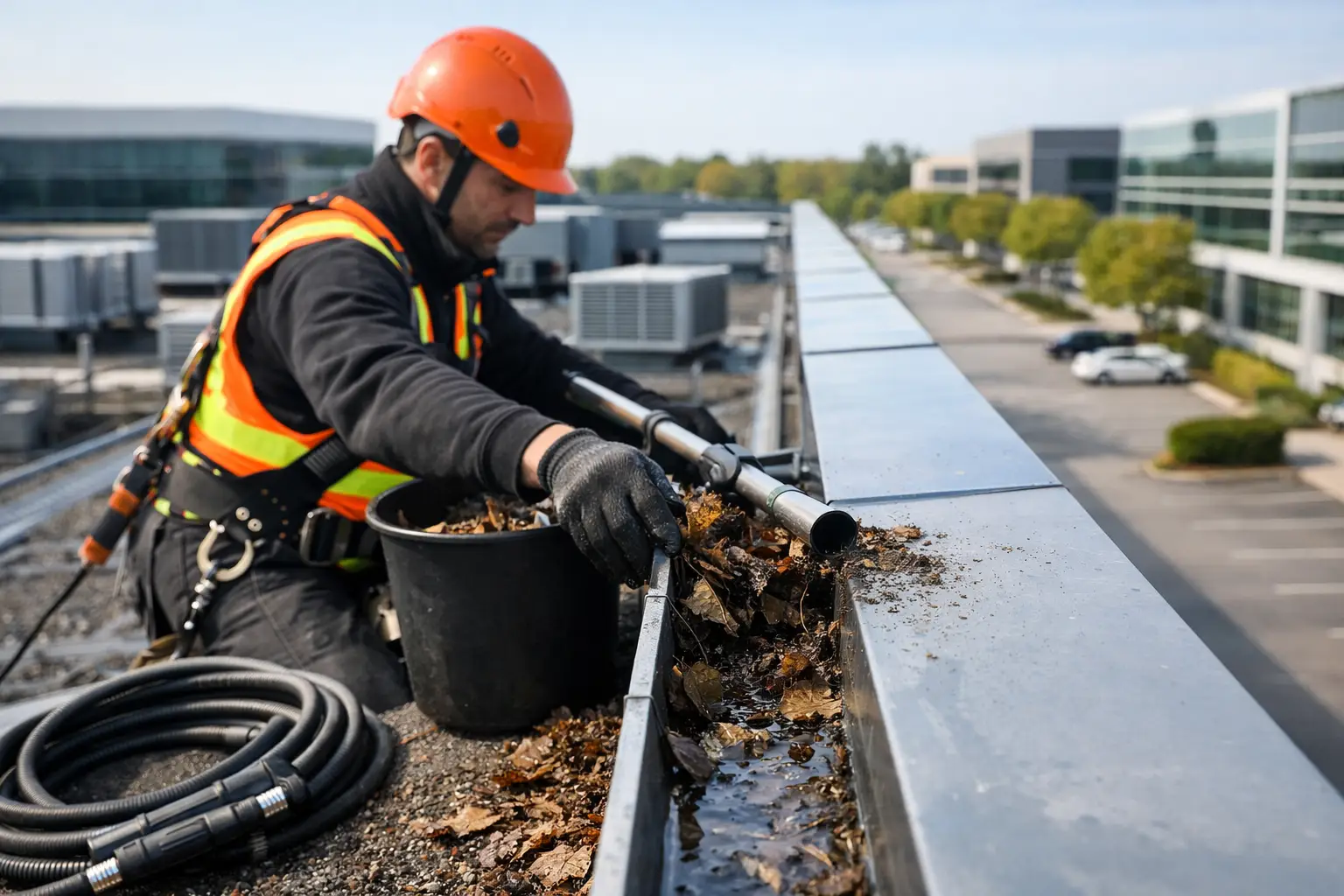

When a commercial roof drainage system fails, the first signs often show up far from the gutter line. Water stains on interior ceilings, overflow near entrances, erosion around the building perimeter, and tenant complaints during heavy rain usually point back to one issue – blocked or poorly maintained gutters. Roof gutter cleaning for commercial buildings is not cosmetic work. It is preventive maintenance that protects the roof, façade, walkways, drainage flow, and day-to-day operations.
For property managers and facility teams, the real cost of neglect is rarely limited to debris removal later. It can mean water intrusion, damaged finishes, slip hazards, premature roof deterioration, and unplanned repair budgets. On commercial and industrial properties, especially multi-story sites or buildings with restricted roof access, gutter cleaning also becomes a safety and execution issue. The work must be done properly, with the right access method and site controls.
Why roof gutter cleaning for commercial buildings matters
Commercial gutters handle more water volume than many people realize. Large roof spans, multiple downpipes, internal box gutters, and drainage points all depend on a clear path for stormwater. Once leaves, silt, nesting material, plastic waste, or rooftop debris build up, water starts to back up and overflow.
That overflow can damage more than the gutter itself. Water may run behind cladding, soak insulation, stain exterior walls, or pool on flat roof sections. In office and industrial settings, even a small drainage failure can interrupt operations if water enters electrical areas, loading zones, corridors, or tenant spaces.
There is also a timing issue. Gutters usually fail under heavy rain, which means the problem becomes urgent at the worst possible moment. Emergency callouts are more disruptive and more expensive than planned maintenance. A scheduled service approach gives building teams better control over risk, cost, and access arrangements.
What commonly blocks commercial roof gutters
The cause depends on the building type and surroundings. Office buildings near trees often collect leaves and seed pods. Industrial sites may deal with dust, packaging debris, and windblown waste. On some properties, birds create nesting material that blocks outlets and downpipes. Construction residue is another common issue, especially after roofing work, façade upgrades, or nearby renovation.
Flat and low-slope commercial roofs are especially vulnerable because debris does not always wash away on its own. Internal gutters and concealed drainage channels can hide buildup until overflow becomes visible. High-rise buildings add another complication – parts of the gutter system may be difficult to inspect from the ground, so the problem grows unnoticed.
In practice, the blockage is often a mix of materials. Wet leaves combine with dirt and sediment, forming compact sludge that is harder to remove than dry debris. Once that material settles around outlets, normal rainwater flow slows down quickly.
The business risks of delayed gutter maintenance
A blocked gutter is easy to underestimate because it sits out of sight. For commercial properties, the consequences are broader than a housekeeping issue.
Water damage is the most obvious risk. Overflow can affect ceilings, wall finishes, glazing interfaces, canopies, and landscaping. If the building has external signage, façade lighting, or sensitive entry areas, the damage can spread beyond the roof line.
Safety is another concern. Overflow near building entrances, fire escapes, service yards, or parking zones creates slip hazards for staff, tenants, and visitors. On industrial properties, standing water around operational areas can interfere with movement and create additional housekeeping and safety issues.
Then there is asset life. When water regularly backs up, roof edges, membranes, fasteners, and support elements are exposed to unnecessary stress. Repeated wetting shortens service life and increases the chance of structural or waterproofing defects. A relatively small maintenance task can prevent much larger remedial works later.
How commercial gutter cleaning should be handled
Commercial gutter cleaning is not the same as clearing a residential gutter with a ladder and a bag. The scale, access requirements, and safety controls are different. On many sites, especially high-rise or large-footprint buildings, the contractor must assess roof design, working-at-height risks, load points, access restrictions, drainage layout, and debris disposal before work begins.
A proper service usually starts with site inspection. This helps identify the gutter type, the level of blockage, and whether the issue is limited to surface debris or extends into downpipes and drainage outlets. It also helps determine the safest access method, which may involve roof access systems, ladders, scaffolding, boom lifts, or rope access depending on the building.
Cleaning itself should go beyond scooping visible debris. Technicians need to clear outlets, check flow paths, remove accumulated sludge, and inspect for signs of damage such as joint separation, corrosion, sagging sections, or standing water. On some commercial roofs, it also makes sense to review nearby debris sources so recurring problems can be reduced.
Access and safety are part of the job
For many commercial clients, vendor selection comes down to one question: can this contractor do the work safely without creating more operational problems? That is the right question.
Gutter cleaning on office towers, shopping lots, factories, warehouses, and mixed-use properties often involves high-risk access. Roof edges, fragile roofing materials, narrow service zones, and active building traffic all need to be managed carefully. This is why experience matters. The cleaning work may be straightforward in theory, but safe execution is what separates a routine service from a liability.
A capable contractor should plan for access equipment, technician competency, site isolation where needed, and coordination with building management. In occupied properties, timing also matters. Early scheduling, low-disruption work windows, and clear communication with facilities teams help keep the site running normally while the maintenance is completed.
How often should commercial gutters be cleaned?
There is no single schedule that fits every building. It depends on roof design, nearby vegetation, weather exposure, and the type of debris the site collects. Many commercial properties benefit from inspection at least twice a year, with cleaning scheduled before and after heavy rain periods. Buildings near trees or in debris-prone environments may need more frequent service.
For industrial and logistics sites, frequency may also depend on dust levels and operational waste exposure. For high-rise properties, regular inspection is especially useful because drainage problems can go unnoticed until they affect lower levels or interior spaces.
The best approach is preventive rather than reactive. If a building has already experienced overflow, staining, or drainage complaints, waiting for the next visible issue is usually a poor strategy. A site-based maintenance schedule is more reliable than a generic calendar reminder.
What affects the cost of roof gutter cleaning for commercial buildings?
Pricing is usually based on the actual site conditions, not a flat rate. Building height is one factor, but it is not the only one. The total gutter length, roof layout, access difficulty, debris volume, and whether downpipes also need clearing all affect labor and equipment requirements.
A low-rise warehouse with open access may be simpler than a smaller office building with restricted roof entry and tight perimeter conditions. Internal gutters, fragile roof areas, and high-risk access can increase the scope because they require more planning and specialized execution.
This is why site-specific quotations are standard for commercial work. They allow the contractor to assess the real conditions rather than guess from building type alone. For clients, that usually means more accurate pricing and fewer surprises once work starts.
Choosing the right contractor
Commercial buyers do not need a general cleaner who occasionally works at height. They need a specialist who understands drainage systems, safe access, and the realities of active commercial properties. The right contractor should be able to inspect the site, explain the scope clearly, and carry out the work with minimal disruption.
It also helps to work with a provider that handles other exterior and hard-to-access maintenance services. That can simplify vendor management when gutter cleaning is part of a broader roof, façade, or building upkeep plan. Urban Solutions Services Sdn Bhd works with commercial and industrial clients that need exactly that kind of practical, high-access support.
Where the work involves roof or elevated access, property teams should also review DOSH guidance on working at height when planning access, supervision and fall-prevention controls.
For a site-specific scope, review our roof and gutter services and arrange an assessment before confirming access, timing and cost.
If your building only gets attention after overflow starts, the maintenance plan is already late. A clean gutter system is one of the simplest ways to protect the roof, control water, and avoid preventable disruptions. The smart time to inspect it is before the next storm tests it for you.