

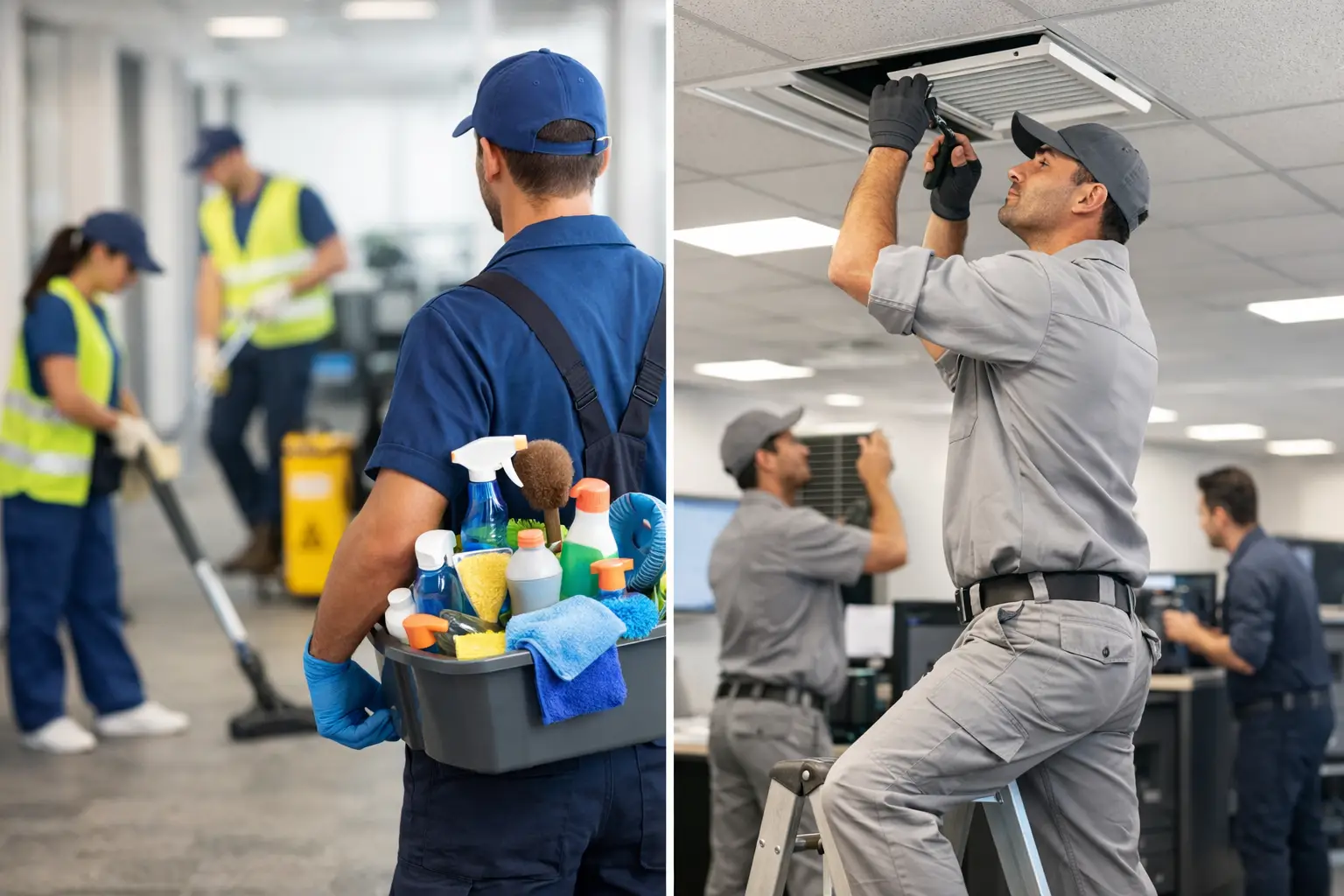

When a building starts showing signs of neglect, the issue is rarely the visible dirt alone. It is the missed roof gutter clearing before a storm, the stained facade that weakens tenant perception, the hard-to-reach glass that keeps getting postponed, or the confined area no one on the internal team is equipped to handle. That is where the real decision around outsource cleaning vs inhouse maintenance starts – not with preference, but with risk, capability, and operational fit.
For commercial properties, offices, industrial sites, and high-rise buildings, this is not a simple staffing choice. It affects safety, service quality, budgeting, response time, and how much responsibility your team carries day to day. The right model depends on the type of work required and how specialized that work really is.
Outsource cleaning vs inhouse maintenance: what changes in practice?
Inhouse maintenance usually means your company hires and manages its own personnel for regular building upkeep. That can include janitorial cleaning, basic repairs, simple inspections, and routine maintenance tasks. The advantage is direct oversight. Your team is on site, familiar with the property, and available for day-to-day needs.
Outsourced cleaning or maintenance means a third-party contractor handles part or all of the work under a service agreement or project scope. In standard office settings, that may cover general cleaning. In more demanding environments, it often includes high-rise window cleaning, facade washing, roof access work, confined space cleaning, or exterior maintenance that requires trained technicians and dedicated equipment.
The difference becomes more obvious when the work goes beyond mopping floors and emptying bins. Once access height, safety systems, or specialized tools are involved, inhouse teams often reach their practical limit.
Cost is not just about payroll
Many decision-makers assume inhouse maintenance is cheaper because salaries appear more predictable than contractor invoices. On paper, that can look true for basic recurring work. But payroll is only one part of the equation.
An internal team comes with recruitment time, supervision, training, leave coverage, insurance considerations, equipment purchases, chemical storage, safety documentation, and replacement planning when staff turnover happens. If the job includes elevated access, exterior glass, facade cleaning, or rooftop work, the cost rises further because the tools, certifications, and safety controls are not optional.
Outsourcing shifts much of that overhead to the service provider. You are paying for labor, yes, but also for expertise, scheduling, access planning, and the ability to execute work without building an internal capability from scratch. For project-based or high-risk work, that often makes outsourcing more cost-efficient than trying to maintain a specialist team inhouse.
That said, outsourcing is not automatically cheaper in every case. If your site needs constant low-skill support across a fixed daily schedule, an inhouse team may deliver better long-term value. The key is to separate routine maintenance from technical cleaning work. They should not be budgeted as if they are the same thing.
Control matters, but so does execution
One of the strongest arguments for inhouse maintenance is control. Facility managers can assign tasks directly, inspect performance in real time, and adjust priorities without renegotiating scope. That is useful in properties where requirements change daily.
But control only helps if the team can actually perform the work to the required standard. A building manager may have full authority over an internal crew, but that does not solve a lack of rope access capability, facade cleaning experience, or confined space readiness. In those cases, direct control can create a false sense of security.
Outsourced providers introduce another layer of coordination, but strong contractors reduce that friction with clear scopes, site assessments, supervision, and documented work methods. For specialized cleaning and maintenance tasks, execution quality usually matters more than having personnel on your own payroll.
Safety is often the deciding factor
This is where outsource cleaning vs inhouse maintenance becomes less of a preference issue and more of a duty-of-care decision. High-rise glass cleaning, external facade work, roof gutter maintenance, and confined space cleaning carry real exposure. A mistake is not just a service failure. It can become a safety incident, property damage event, or compliance problem.
Internal maintenance teams are often capable with routine building tasks, but high-risk access work demands a different standard. It requires trained technicians, correct anchoring systems, access equipment, job-specific risk assessments, and supervisors who understand the environment. These are not areas where improvisation is acceptable.
For commercial and industrial properties, outsourcing high-risk work to a specialist contractor is usually the safer and more defensible approach. It lowers the burden on your internal team and reduces the chance of assigning technical tasks to staff who were never meant to carry that level of risk.
Service quality depends on the type of property
An office tower, warehouse, retail block, and manufacturing site do not need the same maintenance structure. The more complex the building envelope and access conditions, the stronger the case for outsourcing specialist work.
A low-rise office with straightforward daily cleaning needs may do well with a mostly inhouse model supported by occasional external services. A high-rise commercial property with curtain wall glass, elevated signage, rooftops, drainage points, and visible facade surfaces usually benefits from a specialist contractor. The same goes for industrial environments where grime buildup, restricted access, or shutdown-sensitive maintenance work require a more technical approach.
Appearance also matters differently by property type. In premium office buildings and customer-facing commercial sites, exterior presentation affects brand perception, tenant confidence, and visitor experience. If the facade or windows are part of the asset’s value, service quality should be measured against outcome, not just task completion.
A hybrid model often works best
For many facilities, the real answer is not choosing one side completely. It is using each model where it performs best.
An inhouse team can manage daily responsiveness, basic upkeep, minor repairs, and routine monitoring. A specialist contractor can handle scheduled deep cleaning, high-level access work, exterior surfaces, roof gutters, confined spaces, and technically demanding maintenance support. This structure gives you day-to-day control without forcing your internal team into tasks outside their training or equipment range.
It also improves planning. Instead of overloading internal staff with occasional specialist jobs, you bring in the right crew when the scope requires it. That usually leads to better quality, less disruption, and fewer delays caused by limited internal capacity.
How to decide for your building
If you are evaluating outsource cleaning vs inhouse maintenance, start by looking at the work itself rather than the organizational chart. Ask which tasks are repetitive and low-risk, which are seasonal or project-based, and which involve technical access, safety exposure, or specialized tools.
Then review the hidden management load. If your team is spending too much time arranging permits, sourcing equipment, training staff for occasional tasks, or correcting inconsistent results, the cost of keeping work inhouse may be higher than it appears.
It also helps to look at failure points. Which tasks are most likely to be delayed, skipped, or done to a lower standard? In many buildings, the answer is exterior and hard-to-reach work. Those are exactly the areas where specialist outsourcing tends to bring the most value.
For properties in dense urban areas such as Kuala Lumpur or Selangor, access complexity can add another layer. Traffic coordination, tower height, limited work windows, and public-facing environments all make experience and execution discipline more important.
When outsourcing is the better call
Outsourcing usually makes more sense when the work is high-risk, technically demanding, visually important, or difficult to staff consistently. It is also the better option when your internal team is strong in general maintenance but not built for elevated exterior cleaning, facade restoration, or confined access support.
That does not mean inhouse maintenance lacks value. It remains useful for speed, familiarity, and daily operational coverage. But it should be set up around what internal teams can sustain safely and consistently.
Urban Solutions Services Sdn Bhd works with commercial and industrial clients facing exactly this gap – where routine maintenance can stay internal, but high-access and hard-to-reach cleaning needs a specialist approach backed by trained crews and the right equipment.
Where the work involves roof or elevated access, property teams should also review DOSH guidance on working at height when planning access, supervision and fall-prevention controls.
For a site-specific scope, review our high-rise window cleaning services and arrange an assessment before confirming access, timing and cost.
The better question is not whether outsourcing is better than inhouse, or the reverse. It is whether the people doing the work are equipped for the building in front of them. When the scope involves safety, access, and asset appearance, choosing the right delivery model protects more than your budget. It protects the building, the people on site, and the standard your property is expected to hold.