

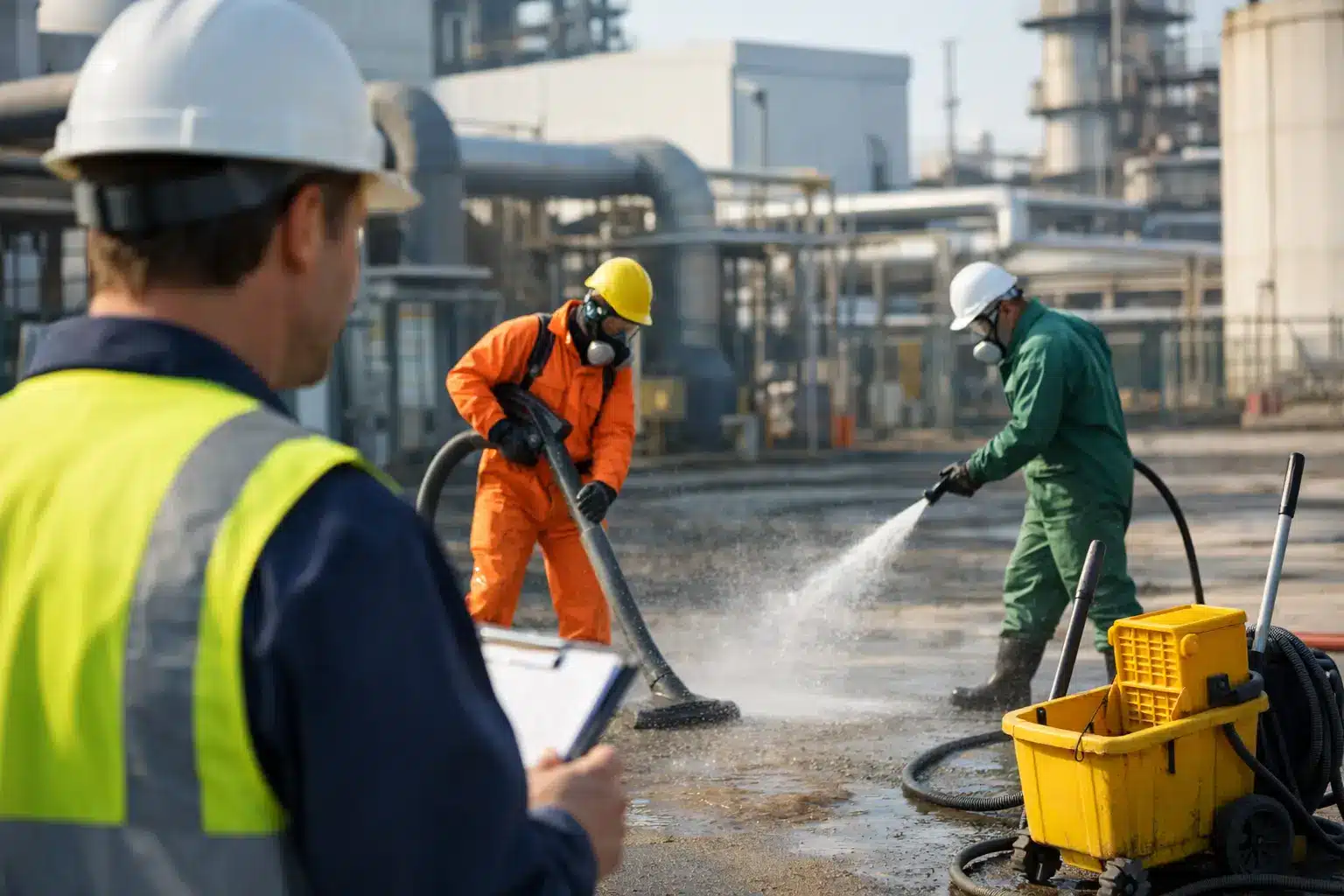

A cleaning crew can arrive with the right equipment and still create an unsafe site if access routes, production activity, energy sources, and work boundaries have not been planned. This industrial site cleaning safety guide is designed for facility managers and operations teams who need cleaning completed without exposing workers, occupants, or assets to avoidable risk.
Industrial cleaning is rarely a simple washdown. Work may take place near moving machinery, loading areas, elevated structures, chemical storage, drainage systems, hot surfaces, or restricted-access spaces. The safest outcome starts before anyone unloads equipment.
Start With a Site-Specific Risk Assessment
A generic checklist is not enough for an active factory, warehouse, plant room, or logistics facility. Every site has different access constraints, operating hours, contaminants, and traffic patterns. A proper assessment should be completed before the work scope, crew size, cleaning method, and access equipment are finalized.
The assessment should identify what is being cleaned, why it needs cleaning, and what can be affected by the work. For example, degreasing an elevated structure above an active production line requires different controls than cleaning dust from warehouse rafters during a shutdown. The same task may require a different method when there are sensitive electrical panels, food-related operations, finished goods, or public areas nearby.
A capable contractor will inspect access points, floor conditions, anchor locations, overhead obstructions, drainage, emergency exits, and nearby operations. They should also confirm who controls the work area and who can authorize isolation, shutdowns, or changes to the schedule.
Define the Work Boundary
Cleaning activities need a physical and operational boundary. Barricades, warning signs, spotters, and controlled entry points prevent employees, visitors, and vehicle operators from entering a hazard zone without realizing it.
The size of that zone depends on the task. High-level cleaning may create falling-object risks. Pressure washing can spread water, debris, and chemicals across walking surfaces. Equipment such as boom lifts, scaffolding, or vacuum systems may block aisles, loading bays, and fire access routes. The work boundary must account for these secondary hazards, not just the immediate cleaning area.
Match the Cleaning Method to the Hazard
The fastest cleaning method is not always the safest or most cost-effective. Water pressure, chemical strength, manual scraping, industrial vacuuming, dry ice blasting, and mechanical access each have limits. The right choice depends on the contaminant, surface material, location, and exposure risk.
Industrial vacuuming is often preferable for dry dust where washing could send contaminants into drains or create slip hazards. Wet cleaning may be necessary for grease, residue, or outdoor surfaces, but runoff has to be contained and managed. Chemical cleaning can be effective on stubborn buildup, yet it requires compatibility checks for coatings, seals, metals, and adjacent equipment.
Before work begins, the cleaning team should review product labels, Safety Data Sheets, dilution ratios, ventilation requirements, and first-aid actions. Chemicals must never be mixed unless the manufacturer specifically permits it. Storage, transfer, and disposal procedures should be agreed on before materials are brought onto the site.
Control Access Risks Before Work Starts
Hard-to-reach cleaning work is where planning has the greatest safety value. Façades, roof gutters, high windows, overhead steelwork, tanks, ducts, and confined spaces cannot be treated like routine janitorial tasks. They require trained personnel, inspected equipment, and an access method suitable for the site.
Common access options include mobile elevated work platforms, scaffolding, rope access, ladders for limited low-risk tasks, and purpose-built platforms. Each option has a trade-off. A lift may provide a stable working position but needs adequate ground bearing capacity and clearance. Rope access can reduce disruption on complex exteriors but demands qualified technicians, reliable anchor systems, and a rescue plan. Scaffolding may suit extended work areas but can affect site movement and take time to erect safely.
Ladders should not become the default choice because they appear convenient. They are only appropriate where the task is brief, the work can be performed safely with stable footing, and workers do not need to overreach, handle heavy tools, or use both hands continuously.
Inspect Equipment and Fall Protection
All access equipment must be inspected before use, with records available where required. This includes harnesses, lanyards, connectors, ropes, anchors, platforms, lift controls, guardrails, and outriggers. Damaged or questionable equipment should be removed from service immediately.
Fall protection is more than issuing a harness. The system must be compatible from end to end: a properly fitted harness, approved connection points, suitable lanyard length, adequate clearance, and a rescue procedure that can be carried out quickly. A worker suspended after a fall may face serious medical risk, so the rescue plan cannot be an afterthought.
Weather also affects elevated work. Rain, lightning, high winds, poor visibility, and extreme heat can turn a manageable task into an unsafe one. Supervisors should have clear stop-work authority and use it when conditions change.
Coordinate With Operations and Maintenance Teams
Cleaning work often overlaps with production, deliveries, maintenance, security, and tenant activity. Poor communication is a common cause of preventable incidents. The site team and contractor should agree on work hours, access routes, vehicle controls, emergency contacts, and the procedures for stopping work.
Where cleaning is performed near machinery or electrical installations, confirm whether lockout and tagout, electrical isolation, or equipment shutdown is necessary. No cleaner should enter a guarded area, reach behind equipment, or work near moving parts on the assumption that someone else has made it safe.
If the work could affect alarms, sensors, drainage, ventilation, or fire protection equipment, those systems need to be identified in advance. Temporary impairment procedures may be needed, along with notification to the appropriate responsible persons. The goal is not to avoid cleaning difficult areas. It is to complete them without compromising the building’s critical systems.
Treat Confined Spaces as High-Risk Work
Tanks, pits, ducts, sumps, vessels, sewers, and certain plant rooms may meet the definition of a confined space. These areas can contain low oxygen, toxic gases, flammable vapors, engulfment hazards, restricted movement, or poor rescue access.
Confined space cleaning should only proceed under a documented permit process. This normally includes atmospheric testing, ventilation, entry controls, communication methods, standby personnel, retrieval equipment, and a rescue plan specific to that location. A worker should never enter simply because the space looks empty or because a previous entry was completed without incident.
Conditions can change during cleaning. Sludge disturbance, chemical use, welding nearby, or changes in ventilation may alter the atmosphere quickly. Continuous monitoring may be necessary depending on the assessment and applicable site requirements.
Keep Housekeeping Part of the Safety Plan
A clean site is safer, but cleaning itself can temporarily make conditions worse if waste, hoses, wet floors, and equipment are left unmanaged. Good housekeeping during the job protects both the crew and the people working around them.
Hoses and cables should be routed to reduce trip hazards and protected where vehicles may cross. Wet areas need visible warning signs and should be dried or reopened only when safe. Waste must be collected, labeled where necessary, and removed through approved disposal channels. Do not wash residues into drains without confirming what the material is and where the drainage system leads.
At the end of each shift, supervisors should inspect the work area for loose tools, blocked exits, leaks, damaged surfaces, and remaining barriers. A handover with the facility representative confirms what was completed, what remains restricted, and whether follow-up work is required.
Choose Competence Over a Low Initial Price
An industrial cleaning quotation should reflect the real conditions of the job. Building height, contamination type, access complexity, required permits, work hours, labor, equipment, and safety controls all affect cost. A lower quote may exclude the planning, access system, supervision, or containment that makes the job safe.
Ask contractors how they assess site risks, train personnel, inspect equipment, manage chemicals, and respond to emergencies. For high-risk work, also ask who will supervise the crew on site and what rescue arrangements apply. Clear answers are a practical indicator of whether a contractor understands the responsibility involved.
Urban Solutions Service approaches high-risk cleaning as a site-specific maintenance task, not a standard cleaning visit. That distinction matters when your property requires safe access to elevated, restricted, or operationally sensitive areas.
Industrial Site Cleaning Safety Guide: Practical Takeaways
Site teams should align their risk controls with Malaysia’s Occupational Safety and Health Act when planning the work.
For a site-specific scope, review our high-rise window cleaning services and arrange an assessment before confirming access, timing and cost.
Before scheduling the next industrial cleaning project, walk the work area with the people responsible for operations, maintenance, and safety. The few minutes spent identifying access limits and operational hazards can prevent downtime, damage, and a serious incident later.