

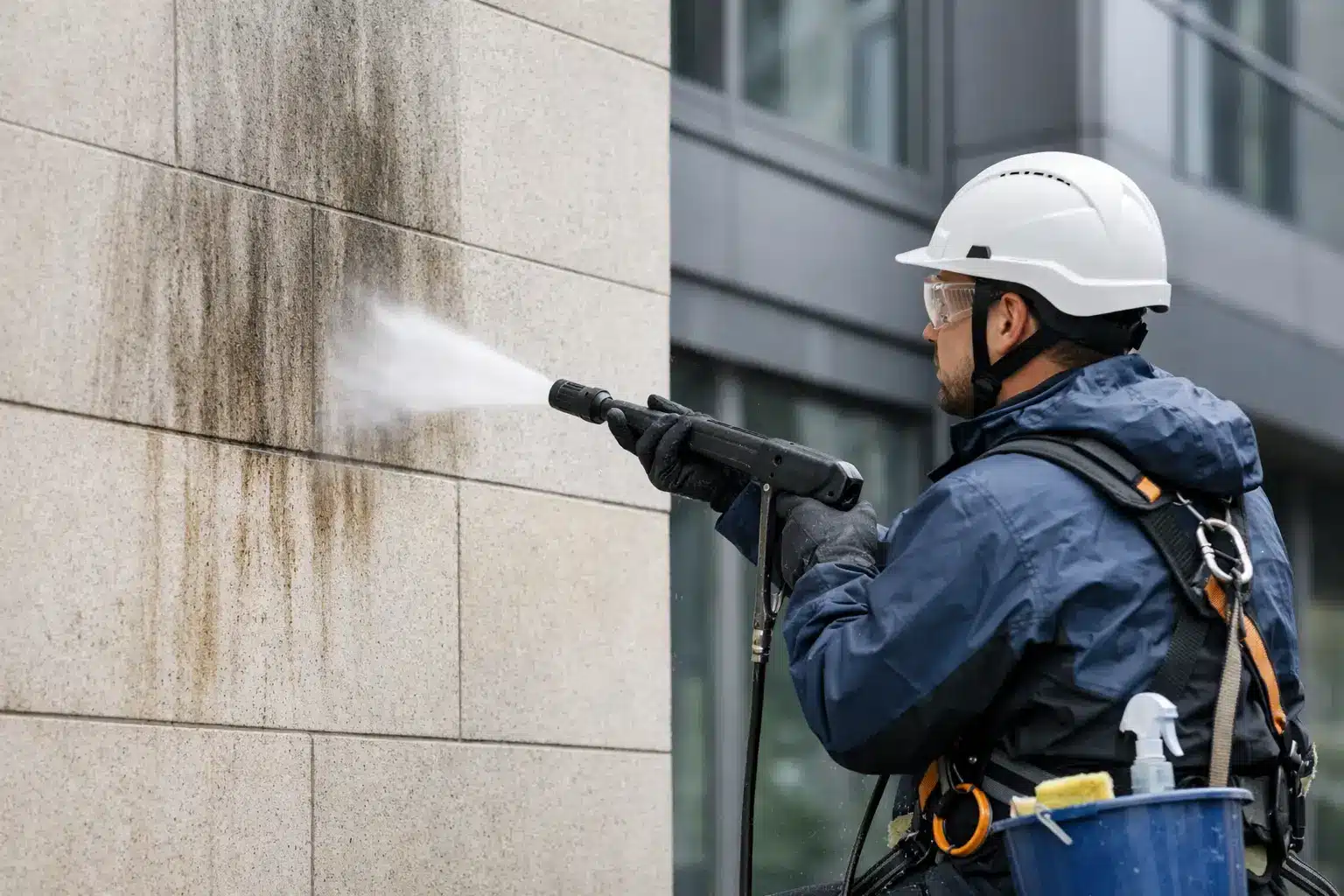

A stained facade does more than hurt curb appeal. On office towers, retail buildings, and industrial properties, visible streaks, runoff marks, algae, and pollution buildup can make a site look poorly maintained long before there is any structural issue. The challenge is that to remove facade stains safely, you need more than detergent and water. You need the right diagnosis, the right cleaning method, and the right access plan for the building.
For commercial properties, that matters because the wrong approach can etch glass, fade coatings, damage sealants, force water into joints, or create avoidable safety risks at height. A facade cleaning job should improve the building, not create a maintenance problem three months later.
Why facade stains happen in the first place
Most facade staining is not random. It usually follows water flow, air pollution patterns, material porosity, or maintenance gaps. On high-rise and mid-rise buildings, rainwater often carries dirt, metal oxides, and airborne contaminants down the face of the structure. Over time, that creates dark streaking below ledges, around window frames, and near drainage points.
Organic growth is another common cause. In shaded or damp sections, algae, mold, and mildew can take hold, especially on textured surfaces or areas that stay wet longer after rain. In industrial settings, you may also see grease film, exhaust residue, and particulate buildup that bonds more aggressively to the substrate.
Different materials stain in different ways. Painted surfaces, ACM panels, glass, concrete, stone, and plaster finishes do not respond the same way to moisture, chemicals, or pressure. That is why stain removal starts with identification, not just cleaning.
Remove facade stains safely by matching the method to the surface
The safest cleaning plan is always surface-specific. What works well on one facade can permanently mark another.
Glass and metal panels usually respond best to controlled washing with the correct detergent strength, soft agitation where needed, and a purified water rinse if spotting is a concern. Painted surfaces need more caution. Strong chemicals or aggressive pressure can lift the coating, dull the finish, or expose patchy weathering.
Concrete and stone are more complicated than they look. They can handle some pressure, but they are also porous. If the stain has penetrated below the surface, a simple wash may only lighten it temporarily. In those cases, the cleaner may need a specialty product designed for rust, mineral deposits, carbon staining, or organic growth. Even then, testing is essential because some acids and bleach-based products can alter the appearance of masonry.
This is where many maintenance teams run into trouble. A stain may look similar from the ground, but the source could be runoff from sealants, oxidation from metal fixtures, environmental staining, or biological growth. If the cause is misread, the treatment often fails or causes collateral damage.
Why pressure washing is not always the answer
Pressure washing has its place, but it is not a universal solution for facade cleaning. On commercial buildings, uncontrolled pressure can drive water behind cladding, damage expansion joints, strip paint, and scar softer finishes. It can also create inconsistent results, where some areas clean up and others become visibly rougher or lighter.
The safer question is not whether pressure can remove the stain. It is whether pressure is the least risky way to remove it.
Low-pressure soft washing, controlled chemical application, or hand-detail cleaning may take longer, but they often protect the building far better. On high-rise facades, that matters because repairs to coatings, sealants, and panel systems usually cost far more than the original cleaning job.
A qualified contractor will typically assess water pressure, nozzle selection, chemical compatibility, dwell time, rinse control, and drainage before work starts. That planning is part of safe stain removal, not an extra.
Access is part of the cleaning method
On commercial properties, facade cleaning is rarely just a cleaning issue. It is an access issue.
If stains are located on upper elevations, recessed sections, architectural fins, canopy edges, or narrow service gaps, the method used to reach them affects both safety and cleaning quality. Rope access, boom lifts, gondolas, scaffolding, and water-fed pole systems each suit different building types. The right choice depends on height, facade layout, surrounding obstructions, anchor points, ground conditions, and how localized the staining is.
Trying to cut corners on access usually creates two problems. First, technicians cannot clean thoroughly if they cannot position themselves correctly. Second, the risk level rises when work is improvised.
For that reason, experienced facade contractors treat access planning and cleaning planning as one scope. On high-rise buildings, especially, stain removal should be handled by teams trained to work safely at height and adjust methods to the exact sections being cleaned.
Remove facade stains safely with testing before full-scale work
A proper test patch is one of the most valuable steps in the process. It confirms whether the proposed method removes the stain, whether the surface reacts well, and whether the final appearance is acceptable once dry.
This matters because many facade materials change appearance while wet. A wall can look fully clean during washing and still dry with shadowing, chemical bloom, or uneven contrast. Testing helps avoid disputes, rework, and unplanned damage.
For building managers and facilities teams, a test patch also provides something practical: a realistic basis for the work scope and quotation. If a stain lifts quickly, the job may be straightforward. If multiple treatments are needed, or if access is complex, that should be known before the project starts.
Common stain types and what they usually require
Not all staining needs the same level of intervention. Dirt film and atmospheric pollution often respond to a general facade wash. Algae and mildew usually need a treatment that kills organic growth, not just a rinse that removes the visible surface layer.
Rust stains are more specific. They often come from corroding fixtures, water runoff from metal components, or exposed reinforcement issues. These stains typically need a targeted chemical approach, and the source should be addressed as well or the staining will return.
Efflorescence and mineral deposits point to moisture movement through the material. Cleaning can improve the appearance, but if water ingress or drainage problems continue, the facade will likely stain again. Oil, grease, and industrial residue can be more stubborn because they bond to the surface differently and may spread if the wrong cleaner is used.
That is why stain removal should not be separated from a broader maintenance review. In many cases, the visible stain is only the surface symptom.
What commercial property teams should look for in a contractor
If the building is occupied, high-rise, or architecturally complex, facade cleaning should be treated as a specialist scope. The contractor should be able to explain how they identify the stain, how they protect the material, what access system they will use, and how they control risk around pedestrians, vehicles, and tenant activity.
It also helps to ask practical questions. Will they test first? Can they handle elevated or restricted-access areas without splitting the work across multiple vendors? Do they understand how coatings, sealants, glass, and cladding systems behave under different cleaning methods? Are they quoting based on building height, access difficulty, and labor intensity, rather than giving a flat price with little detail?
For many commercial sites, reliability matters as much as technique. The work needs to be scheduled properly, carried out safely, and completed without creating disruption or a second round of corrective cleaning. That is where a contractor with real high-rise and exterior maintenance experience adds value.
When stain removal should happen
There is no perfect calendar for every property, but waiting too long usually increases cost and complexity. Fresh staining is generally easier to remove than buildup that has baked into the surface over multiple seasons. Organic growth also spreads if damp areas are ignored.
A good rule is to inspect facades after heavy rain periods, visible runoff staining, nearby construction dust exposure, or signs of biological growth. Buildings in dense urban and industrial zones may need more frequent attention because airborne contaminants settle faster and more heavily.
In Malaysia’s climate, frequent moisture and heat can accelerate facade staining, especially on shaded elevations and water-prone detailing. That makes preventive cleaning a practical maintenance decision, not just a cosmetic one.
Where the work involves roof or elevated access, property teams should also review DOSH guidance on working at height when planning access, supervision and fall-prevention controls.
For a site-specific scope, review our façade cleaning services and arrange an assessment before confirming access, timing and cost.
Safe facade cleaning is about judgment. The right contractor does not start with the strongest chemical or the highest pressure. They start with the building, the stain, and the safest way to get a lasting result. If your facade needs attention, the best next step is a site review that looks at both the surface condition and the access requirements before anyone starts washing.