

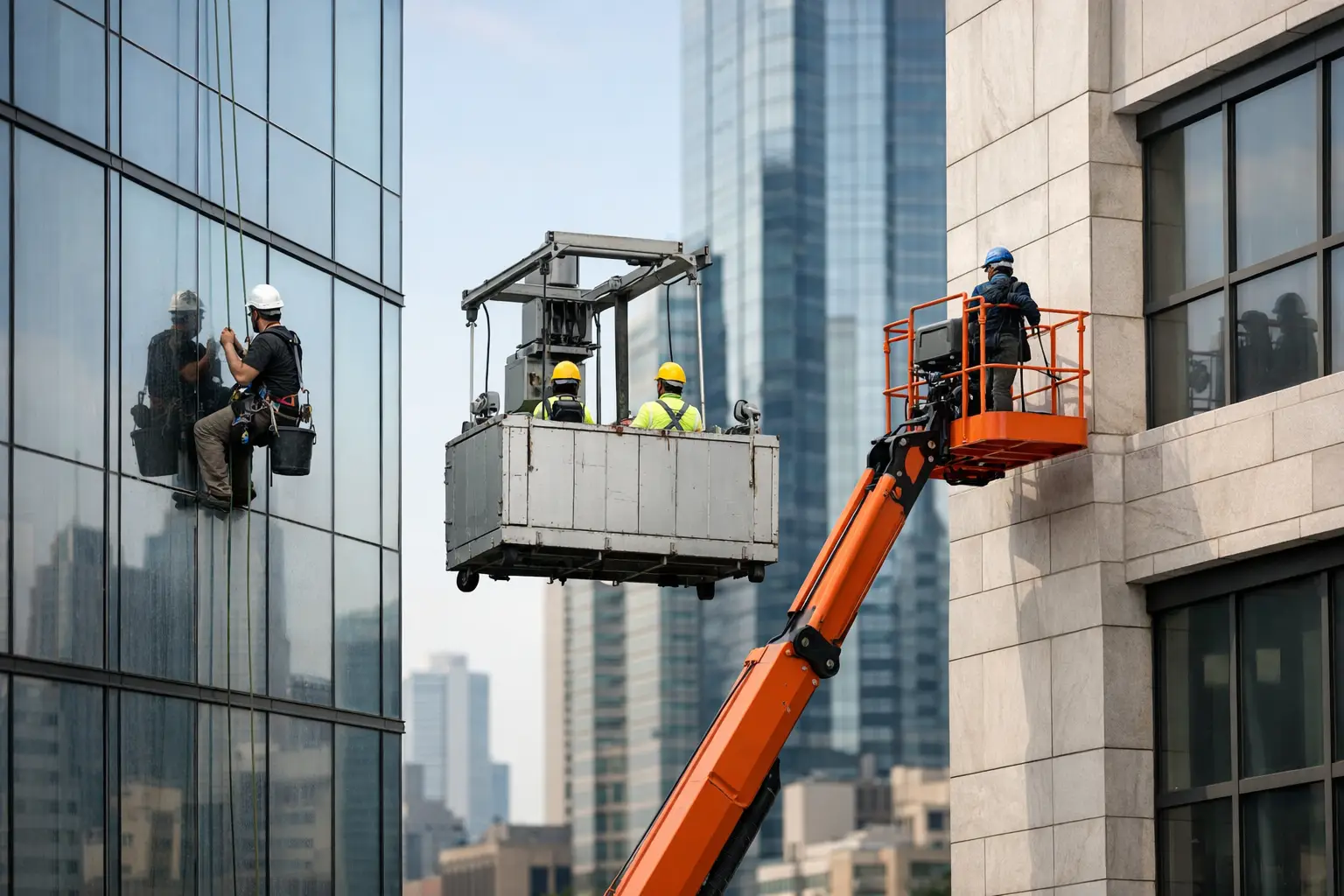

A facade cleaning or repair job can look straightforward from ground level, then become a major planning issue once the team reaches the upper floors, recessed windows, roof edges, or narrow service areas. Knowing how to choose facade access method before requesting quotations helps building managers control risk, avoid delays, and select a solution that suits the property rather than forcing the property to fit the equipment. Understanding how to choose facade access method is essential for effective project management.
The right method is rarely determined by building height alone. The facade material, roof structure, surrounding space, maintenance frequency, public access, and nature of the work all affect the decision. A rope access team may be the most efficient option for one tower, while a boom lift, suspended platform, or building maintenance unit may be the safer and more practical choice for another.
The understanding of how to choose facade access method is crucial in determining the best approach for each unique situation.
Start With the Actual Scope of Work
How to Choose Facade Access Method
Access planning begins with what needs to be done. Cleaning exterior glass is different from repairing sealant joints, removing stains from cladding, repainting wall surfaces, clearing gutters, or inspecting damaged facade panels. Each task requires a different amount of time at the work area, different tools, and different levels of material handling.
Whether it’s cleaning or repairs, knowing how to choose facade access method can save time and resources.
For short-duration work at multiple points, rope access can be highly effective. Technicians can reach targeted areas without setting up large equipment on the ground or blocking extensive sections of a driveway. This is often useful for localized stain treatment, inspection work, minor facade repairs, and cleaning areas that conventional access equipment cannot reach.
When assessing the project, remember how to choose facade access method to streamline your operations.
For work that requires technicians to remain in one area for extended periods, carry heavier equipment, or complete broad surface coverage, a suspended platform or building maintenance unit may be more suitable. These systems provide a more stable working platform and can improve productivity across large facade sections.
For large projects, professionals often need to discuss how to choose facade access method to ensure efficiency.
A clear scope also prevents a common mistake: choosing access based only on the lowest initial price. An access method that appears economical may take longer, require repeated repositioning, or limit the tools technicians can use. The better choice is the one that allows the job to be completed safely, efficiently, and to the required finish standard.
Being informed about how to choose facade access method can lead to a more favorable outcome for the project.
Assess the Building’s Height, Shape, and Facade Design
Every commercial property has its own access challenges. A rectangular office tower with a flat roof may allow straightforward suspended access. A building with stepped floors, curved elevations, deep overhangs, podium roofs, architectural fins, skylights, or recessed windows requires more detailed planning.
Consulting experts on how to choose facade access method can provide additional insights.
The key question is not simply, “Can the equipment reach the top?” It is whether the access method can safely reach every work zone. Some areas may be hidden behind ledges, set back from the main facade line, or located above structures that restrict equipment movement below.
Roof Conditions Matter
Roof access points, anchor locations, parapet height, load capacity, and available clearance should be inspected before a method is confirmed. Rope access requires properly assessed anchor arrangements and a suitable rescue plan. Suspended platforms and building maintenance units depend on compatible roof systems and structural provisions.
If a roof does not have permanent access infrastructure, temporary solutions may still be possible, but they need to be properly engineered and assessed for the project. No contractor should make assumptions about roof strength, existing anchor points, or access routes without a site review.
Temporary solutions also require a firm grasp of how to choose facade access method to ensure safety and compliance.
Ground Conditions Matter Too
Mobile elevated work platforms, including boom lifts and scissor lifts, need sufficient operating space at ground level. A boom lift may offer excellent reach, but it may not be practical if the building is surrounded by narrow roads, landscaped areas, overhead cables, basement slabs with loading restrictions, or continuous vehicle traffic.
Ground conditions heavily influence how to choose facade access method, especially in urban settings.
Ground-level conditions also affect public safety planning. Equipment placement may require barricades, traffic control, or work scheduling outside peak operating hours. For active offices, retail properties, warehouses, and industrial facilities, this operational impact should be part of the decision from the beginning.
Compare Common Facade Access Methods
Reviewing common methods will enhance understanding of how to choose facade access method.
There is no single best method for every building. The following options are commonly considered for commercial facade cleaning and maintenance.
Rope Access
Rope access uses trained technicians working from rope systems secured to suitable anchor points. It is especially useful for high-rise buildings, irregular facade profiles, narrow elevations, and areas where heavy access equipment cannot be positioned.
Rope access is an excellent example of how to choose facade access method for specific challenges.
Its main advantage is flexibility. Rope access can often be mobilized with less disruption than scaffolding or large lifting equipment, and it is well suited to targeted cleaning, inspection, sealant repairs, and difficult-to-reach exterior work. However, it may not be the most productive option for large, repetitive facade areas or work requiring heavy materials and long stationary tasks.
Suspended Platforms and Building Maintenance Units
Suspended platforms, sometimes called cradles, travel vertically along a facade from roof-level support systems. A building maintenance unit is a permanent or semi-permanent system designed into certain high-rise properties for facade maintenance.
For broader access needs, understanding how to choose facade access method allows for better planning.
These methods are practical for broad vertical facade areas, regular window-cleaning programs, and work requiring a stable platform. They can support efficient coverage on buildings with suitable roof infrastructure. The trade-off is that setup, roof compatibility, system condition, and facade geometry must all be carefully verified.
Mobile Elevated Work Platforms
Boom lifts and scissor lifts provide a platform for technicians working from the ground upward. Boom lifts can reach around obstacles and access elevated areas with a degree of horizontal outreach. Scissor lifts are generally better for direct vertical access on stable, level ground.
In addition, knowing how to choose facade access method can help mitigate risks during operations.
These platforms work well for lower-rise and mid-rise buildings, warehouse exteriors, podiums, covered walkways, and isolated repairs. Their limitations are access space, ground bearing capacity, height range, and the need to maintain exclusion zones while equipment is operating.
Scaffolding
Scaffolding provides a stable, continuous work surface and is often selected for major painting, restoration, repair, or refurbishment projects. It can be appropriate where crews need extended access over days or weeks and require regular movement of materials.
When engaging in major works, always consider how to choose facade access method to optimize safety.
The disadvantage is time and space. Scaffolding requires erection and dismantling, can affect tenant access and building appearance, and may take up valuable ground space. It is generally not the first choice for routine window cleaning, but it remains valuable for substantial facade works.
Water-Fed Pole Systems
For lower projects, how to choose facade access method can simplify the cleaning process.
For accessible low-rise areas, purified-water pole systems can clean glass and certain facade surfaces from ground level. This method reduces work-at-height exposure and can be efficient for entrance canopies, low-rise office blocks, shopfronts, and internal courtyards.
Its reach and cleaning capability are limited. It is not a replacement for high-rise access where upper-level detailing, stain removal, repair work, or complex facade features are involved.
Put Safety Before Convenience
In high-stakes jobs, remember how to choose facade access method when evaluating risks.
A method that is quick to deploy is not automatically the right method. Safe facade access requires more than equipment selection. It includes competent technicians, equipment inspection, secure anchor or support arrangements, weather monitoring, exclusion zones, communication procedures, and an emergency rescue plan.
For high-risk work, the contractor should assess foreseeable issues before mobilization. These may include falling-object risks, nearby electrical hazards, fragile roof surfaces, pedestrian traffic, wind exposure, restricted loading areas, and conflicts with building operations.
Building management should also provide accurate site information. Share available roof drawings, access restrictions, working-hour rules, known structural limitations, and details of any existing facade access systems. Early information allows the contractor to recommend a method based on facts rather than assumptions.
Consider Frequency and Long-Term Maintenance
Discussing how to choose facade access method with the team ensures comprehensive planning.
The most cost-effective access choice can change depending on how often facade work is required. A one-time stain removal project may justify a temporary rope access or lift solution. A high-rise office tower that requires scheduled exterior cleaning throughout the year may benefit from a planned approach using its building maintenance unit or a recurring rope access program.
Regular maintenance also protects facade materials. Dust, traffic residue, algae growth, mineral deposits, and airborne pollutants can affect the appearance of glass, metal panels, stone, and painted surfaces. Planned cleaning makes it easier to identify issues such as failed sealant, damaged panels, blocked gutters, or water staining before they become larger maintenance problems.
Request a Site-Specific Recommendation
Ultimately, knowing how to choose facade access method will lead to more tailored solutions.
A reliable quotation should not treat every facade as the same. The contractor needs to understand building height, total work area, access complexity, surface condition, equipment needs, labor requirements, and expected duration. Photographs can help at an early stage, but a site visit is often necessary for complex high-rise or industrial properties.
Ask the contractor to explain why a particular method is recommended and what limitations apply. You should understand where the team will access the roof, how ground areas will be protected, whether operations need to be scheduled around tenants or traffic, and what preparation is required from building management.
Urban Solutions Services Sdn Bhd evaluates these practical conditions before carrying out high-rise cleaning and exterior maintenance work. This site-specific approach helps commercial property teams choose access arrangements that support safe execution and a clean, presentable result.
Where the work involves roof or elevated access, property teams should also review DOSH guidance on working at height when planning access, supervision and fall-prevention controls.
For a site-specific scope, review our façade cleaning services and arrange an assessment before confirming access, timing and cost.
The best facade access method is the one that reaches every required area without creating unnecessary disruption or avoidable risk. Give the access assessment the same attention as the cleaning or repair scope, and the work is far more likely to proceed on schedule, protect the property, and meet the standard your building requires. Always prioritize how to choose facade access method to enhance project outcomes.