

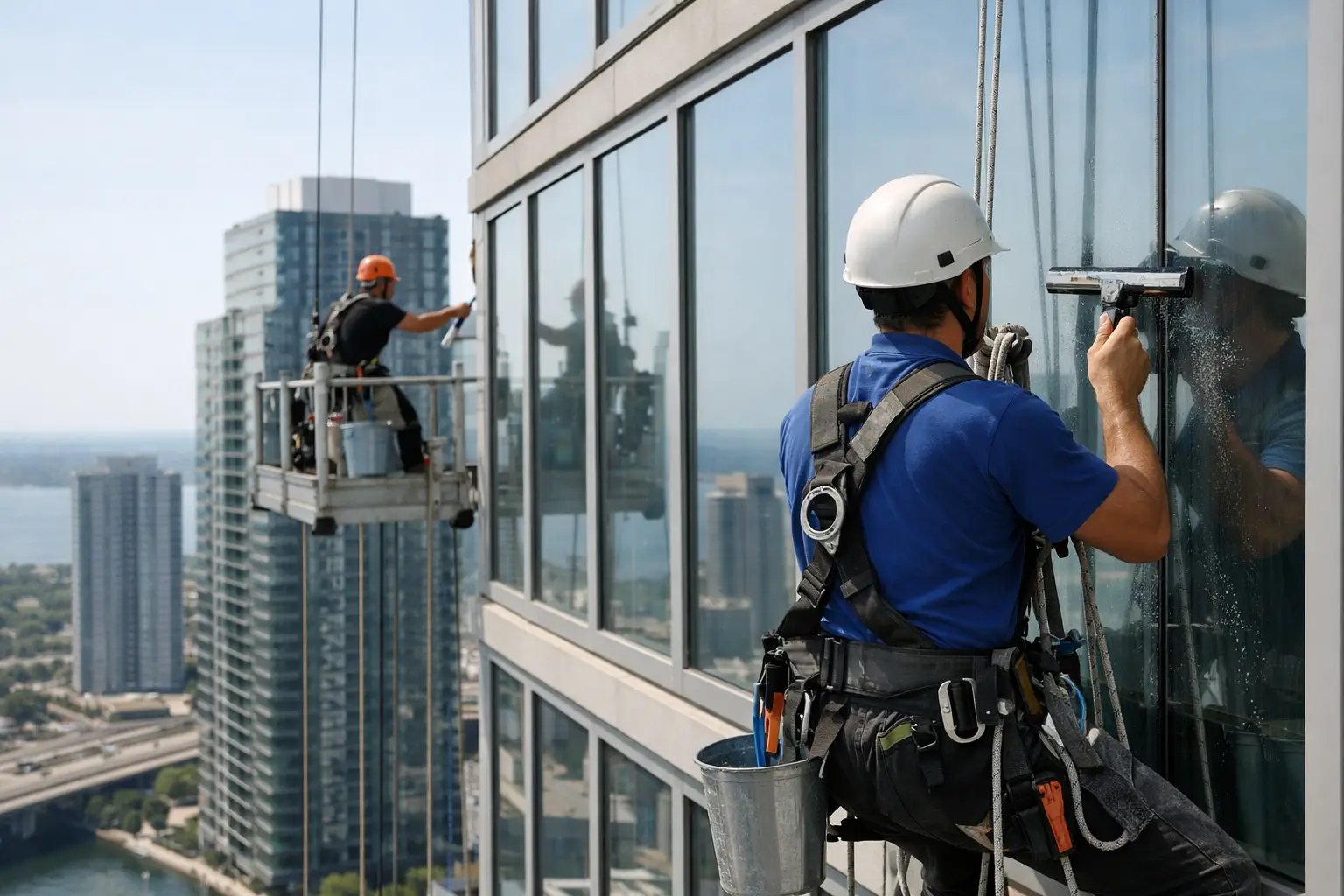

A streaked glass facade does more than affect appearance. For office towers, commercial buildings, and mixed-use properties, dirty exterior windows can make the entire asset look neglected. That is usually when facility teams start asking the practical question: how does high rise window cleaning work, and what is actually involved behind the scenes? To understand how does high rise window cleaning work, we must consider all aspects of the process.
The short answer is that it combines specialized access systems, trained technicians, strict safety procedures, and a cleaning method matched to the building itself. High-rise window cleaning is not just washing glass at height. It is a controlled maintenance operation planned around access points, facade design, weather conditions, public safety, and the needs of an occupied building.
How does high rise window cleaning work on commercial buildings?
On most commercial properties, the process starts long before any technician leaves the ground. The building is assessed to understand its height, facade layout, window type, access limitations, and risk points. A tower with flat curtain wall glass is very different from a building with recessed windows, decorative fins, ledges, signage, or uneven elevations.
From there, the contractor determines the safest and most efficient access method. This may involve rope access, gondola systems, boom lifts, scaffolding, or a mix of methods across different sections of the building. The right choice depends on what the structure allows, how quickly the work needs to be completed, and whether certain elevations are harder to reach than others.
The actual cleaning itself usually follows a straightforward sequence. The team prepares the site, secures the work zone, inspects equipment, accesses the facade, and cleans each glass panel using professional tools and purified water or suitable cleaning solutions. Afterward, they check for missed spots, rinse if needed, and move systematically across the elevation.
That sounds simple on paper, but the complexity is in execution. Every floor, edge, anchor point, and weather shift can affect how the work is carried out.
The access methods used in high-rise window cleaning
The choice of access methods is critical when discussing how does high rise window cleaning work, as it can greatly influence efficiency and safety.
The public usually notices the workers suspended outside the glass. What they do not always see is that the access method is the foundation of the whole job.
Rope access
Rope access is common for high-rise buildings with suitable anchor points and facades that allow technicians to descend safely. Workers are secured by a main working line and an independent backup line. This method is efficient on tall buildings because it allows technicians to move vertically with minimal disruption at ground level.
It is especially useful where fixed platforms are unavailable or where the building design makes mechanical access less practical. It also tends to be faster to mobilize than larger suspended systems. The trade-off is that rope access requires highly trained personnel and may not be ideal for every facade type, especially where deep setbacks or heavy obstructions are involved.
This method is one of the many ways to illustrate how does high rise window cleaning work effectively in various conditions.
Gondolas or building maintenance units
Some towers are designed with suspended platforms, often called gondolas or BMUs. These systems allow technicians to stand on a powered platform while cleaning broader sections of glass. For large commercial facades, this can improve productivity and reduce repeated repositioning.
Gondolas are another way to explore how does high rise window cleaning work, providing a stable platform for technicians.
Where a building already has a permanent system, cleaning can be more structured and predictable. However, the equipment must still be inspected and operated correctly, and not every facade detail can be reached from a platform alone.
Boom lifts and other mechanical access
For lower elevations, podium areas, atriums, or sections with awkward geometry, boom lifts and other elevated work platforms may be used. These are useful when access from the roof is not possible or when the work is concentrated on a specific zone.
Mechanical access can be effective, but it depends on site conditions. Ground bearing capacity, traffic flow, landscaping, and public access all need to be considered before equipment is brought in.
Safety is the first part of the job, not the last
In high-rise work, cleaning quality matters, but safety is what makes the work possible. A professional contractor does not treat safety as a box to tick after scheduling the job. It shapes the method, manpower, timing, and equipment from the beginning.
Knowledge of how does high rise window cleaning work also plays a significant role in planning and executing safe operations.
Before work starts, the team typically conducts a site risk assessment and method review. This covers roof access, anchor points, drop zones, facade hazards, weather exposure, and how the work affects building occupants and the public below. Barricades or controlled zones may be set up at ground level to keep pedestrians away from active work areas.
Technicians inspect harnesses, ropes, connectors, descenders, helmets, and any mechanical systems being used. Communication procedures are also important. On a live commercial site, coordination with building management helps avoid conflicts with deliveries, tenant access, and peak traffic periods.
Weather is another major factor. High winds, lightning risk, and heavy rain can stop work immediately. That is not a delay caused by poor planning. It is part of responsible execution. In high-rise cleaning, conditions can change quickly at elevation even when the ground seems calm.
What technicians actually use to clean the glass
The equipment used also reflects how does high rise window cleaning work, showcasing the need for specialized tools.
The cleaning side of the job is more specialized than standard janitorial work. The goal is not just to remove visible dirt, but to leave the glass clear, even, and streak-free across large exterior surfaces.
Technicians often use squeegees, applicators, extension tools, scrapers for approved surfaces, microfiber detailing cloths, and water-fed systems where appropriate. Purified water is commonly used because it dries with fewer mineral marks, which matters on glass exposed to direct sunlight. For facades with heavier buildup, approved detergents or specialized cleaning agents may be used to break down grime, pollution residue, bird droppings, or water stains.
Not every stain comes off in one pass. Mineral deposits, oxidization, silicone residue, and construction debris may require restoration work rather than routine cleaning. That is an important distinction for property managers. If the glass has been neglected for too long, the first service may improve it significantly without fully reversing embedded staining.
Why building design changes the whole job
Design influences how does high rise window cleaning work significantly, as each architectural detail affects the cleaning approach.
Two high-rise buildings of similar height can require very different cleaning plans. Design details matter just as much as square footage.
A simple curtain wall facade is generally more efficient to clean than a building with protruding fins, recessed panels, canopies, signage, louvers, and architectural features that interrupt access. Corners, overhangs, and narrow setbacks can increase labor time because technicians need to reposition more often or switch access methods.
Therefore, understanding how does high rise window cleaning work is vital for effective maintenance plans.
The roof layout also matters. If access to anchor points is limited, or if rooftop equipment obstructs setup, the cleaning process becomes slower and more controlled. The same goes for buildings with sensitive tenant operations, restricted loading areas, or public-facing entrances that must remain open throughout the work.
This is why professional contractors usually provide site-specific quotations rather than flat rates. Price is shaped by height, facade condition, risk level, access complexity, and how long the crew will need on site.
How often should high-rise windows be cleaned?
There is no single schedule that suits every property. A premium office tower in a dense urban area may need more frequent cleaning than an industrial building with less visible glass. Buildings near major roads, construction activity, or coastal environments often collect dirt and residue faster.
Factors like location and design can affect how does high rise window cleaning work, potentially requiring adjustments in scheduling.
For many commercial properties, exterior window cleaning is scheduled quarterly, semi-annually, or according to tenant expectations and brand standards. Some buildings need touch-ups on highly visible elevations more often than the rest. Others combine window cleaning with broader facade maintenance to reduce mobilization costs and keep exterior presentation consistent.
A practical approach is to align the cleaning schedule with the building’s exposure, occupancy profile, and image requirements. If clients, tenants, or visitors regularly notice the facade, the cleaning frequency should reflect that.
Aligning expectations with how does high rise window cleaning work will help maintain a building’s image.
What property managers should expect from a professional contractor
A qualified high-rise window cleaning provider should be able to explain not just the cleaning scope, but the access plan, safety controls, manpower, scheduling, and site requirements. That matters because commercial buyers are not simply purchasing a clean facade. They are reducing operational risk and avoiding disruption.
A professional should readily explain how does high rise window cleaning work to clients to ensure transparency and trust.
Clear communication is part of the service. You should expect a site visit where needed, a realistic assessment of what can be cleaned, and a quotation based on actual building conditions. If a contractor cannot explain how they will access the facade safely, that is already a warning sign.
For properties in Kuala Lumpur, Selangor, Penang, or Johor, this is especially relevant on dense commercial sites where building access, public movement, and weather timing can all affect execution. Urban Solutions Services Sdn Bhd approaches this type of work as a technical service, not a generic cleaning task, because that is what high-rise maintenance requires.
This understanding of how does high rise window cleaning work allows for better planning and execution of cleaning tasks.
The clean glass is what people notice. The real value is the planning, control, and skill that made it possible without creating unnecessary risk for your building, your tenants, or the public below. If you are evaluating vendors, start there.
Where the work involves roof or elevated access, property teams should also review DOSH guidance on working at height when planning access, supervision and fall-prevention controls.
For a site-specific scope, review our high-rise window cleaning services and arrange an assessment before confirming access, timing and cost.
Ultimately, knowledge of how does high rise window cleaning work can enhance the overall quality of the service provided.