

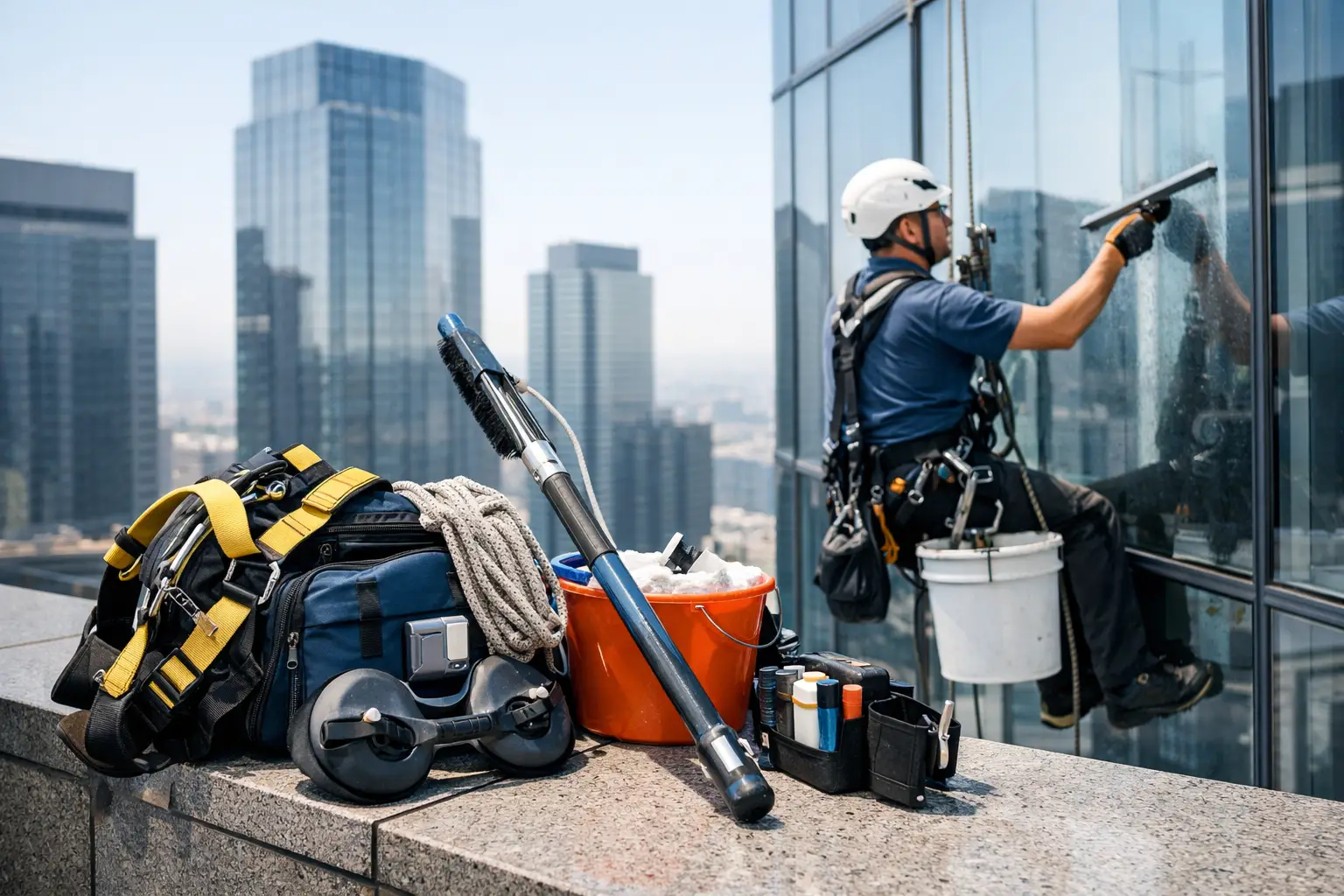

A glass facade can make a commercial building look sharp or neglected in a matter of weeks. That is why high rise window cleaning equipment matters so much for property managers and facilities teams. The right setup affects not just cleaning results, but also safety, scheduling, access planning, and the overall cost of keeping a building presentable.
For most commercial properties, the question is not simply what equipment is used. The real question is which equipment is appropriate for the building, the facade design, the access constraints, and the risk level of the job. A 12-story office block with straightforward elevations requires a very different approach from a tower with recessed windows, decorative fins, rooftop limitations, or hard-to-reach corners.
What high rise window cleaning equipment includes
High rise window cleaning equipment is not one single machine or toolset. It is a coordinated system of access gear, fall protection, cleaning tools, and site-specific support equipment used to reach and clean elevated glass safely.
At the access level, the most common options include suspended platforms, rope access systems, boom lifts, and building maintenance units where the building has permanent infrastructure in place. Each method serves a different purpose. Suspended platforms are often suitable for broad, flat facade sections. Rope access is more flexible for irregular architecture and restricted areas. Boom lifts can work well on lower elevations or where ground access is open and stable. Permanent systems can be highly efficient, but only when the building was designed to support them and they are properly maintained.
The cleaning side of the equipment is just as important. That usually includes water-fed poles for selected areas, squeegees, applicators, scrapers where appropriate, purified water systems, buckets, detailing cloths, and chemical solutions matched to the glass condition. On some buildings, facade dirt is light and routine. On others, mineral staining, traffic film, algae, and construction residue require a more controlled process.
Access equipment drives the method
When commercial clients ask about equipment, they are often really asking how the work will be carried out without disrupting the building or exposing occupants and the public to unnecessary risk. That starts with access selection.
Suspended platforms
Suspended platforms, sometimes called gondolas, are commonly used on high-rise facades with long vertical drops and consistent surfaces. They allow technicians to carry tools and move steadily across large window sections. For repetitive maintenance on standard elevations, this can be efficient and productive.
The trade-off is that platforms need suitable roof rigging, safe suspension points, and enough clearance along the facade. They are less practical when the building has deep setbacks, projecting architectural elements, or narrow zones that prevent stable movement.
Rope access systems
Rope access is often the preferred option for buildings with complex facades or limited access points. Trained technicians descend from certified anchor systems using specialized harnesses, ropes, descenders, backup devices, helmets, and tool lanyards. This approach offers flexibility and can reduce the need for bulky equipment at ground level.
It is not automatically the best choice for every site. Rope access depends heavily on technician competency, rescue planning, anchor suitability, and weather conditions. It can be extremely effective, but only when it is managed by an experienced contractor with proper procedures.
Boom lifts and mobile elevated platforms
For mid-rise buildings, podium areas, atriums, or sections with open ground access, boom lifts and similar elevated work platforms can be practical. They provide stable positioning and can support cleaning and minor facade maintenance in one mobilization.
The limitation is access. If landscaping, traffic flow, basement slabs, overhead obstructions, or soft ground prevent safe placement, a lift may not be possible. In busy commercial sites, the ground-level exclusion zone also needs to be managed carefully.
Cleaning tools are more specialized than they look
Good results on glass depend on technique, but also on tool selection. A basic squeegee and bucket setup may still be part of the process, yet high-rise work usually calls for more controlled systems.
Purified water systems are widely used because they reduce spotting and allow glass to dry with a cleaner finish. This is useful on exterior windows exposed to dust, pollution, and airborne residue. Water-fed poles can also improve efficiency on reachable areas, though they are not a replacement for full high-rise access methods.
Scrapers, pads, and specialty chemicals may be needed for stubborn buildup, but these must be used with care. Not every type of glass or coating can tolerate aggressive cleaning. The wrong method can leave scratches, haze, or damage to sealants and surrounding finishes. For that reason, experienced contractors assess the facade material first rather than treating every surface the same way.
Safety equipment is part of the cleaning equipment
In high-rise work, safety gear is not separate from the job. It is part of the equipment package. Harnesses, helmets, rope grab systems, shock-absorbing lanyards, anchor devices, lifelines, edge protection, barricades, and rescue kits all play a direct role in how the work is executed.
For property teams, this matters because equipment alone does not make a job safe. The equipment must be inspected, compatible with the site, and used by trained personnel under a clear method statement. A well-equipped contractor should also account for wind exposure, drop zones, pedestrian control, and emergency response before work starts.
This is where experienced high-rise service providers stand apart from general cleaning vendors. Exterior access work requires technical planning, not just labor.
How buildings determine the right equipment choice
No building manager wants to overpay for an unnecessarily complex access setup. At the same time, choosing the cheapest method can create delays, safety concerns, or poor cleaning quality. The right decision usually comes down to five factors.
The first is building height. The second is facade design, including ledges, fins, recesses, and rooftop access. The third is the condition of the glass and exterior surfaces. The fourth is site activity, such as public foot traffic, loading areas, and tenant operations. The fifth is frequency. A one-time deep clean may justify a different setup from quarterly maintenance.
That is why site visits are so important. On paper, two commercial towers may seem similar. In reality, one may have straightforward roof access and the other may require a far more technical plan due to restricted anchors, parking limitations, or facade geometry.
Why equipment affects cost and scheduling
Property and facilities teams often ask why quotations vary so much between buildings of similar size. Equipment is a major reason.
If a contractor can use existing building access systems efficiently, the job may be faster and more economical. If the site requires temporary rigging, specialist rope access technicians, public safety barriers, or after-hours scheduling, costs will change accordingly. The same applies when weather exposure is high or when sections of the building need different methods on the same project.
Equipment also influences timing. A platform setup may require more mobilization upfront but clean large areas faster once in place. Rope access may mobilize quickly but progress depends on facade complexity. Boom lifts can be efficient in selected zones but may need traffic management and permits in some commercial environments.
What commercial clients should look for
The best question is not, what equipment do you have? It is, what equipment will you use on this building, and why?
A dependable contractor should be able to explain the access method clearly, identify site constraints, specify the safety controls, and match the cleaning tools to the facade material. They should also be realistic about limitations. If weather, glass condition, or architectural design affects the result, that should be discussed upfront.
For building owners and managers, that level of clarity reduces risk. It also makes budgeting easier because you can see how the quotation relates to actual site conditions rather than a generic cleaning rate.
In Malaysia’s commercial environment, where heat, rain, traffic residue, and urban dust all impact exterior glass, consistency matters as much as the initial clean. A contractor with strong high-rise capability can support that consistency with the right equipment, trained technicians, and a practical maintenance schedule.
Urban Solutions Services Sdn Bhd approaches this kind of work as a site-specific operation, not a one-size-fits-all cleaning task. That is the standard commercial buildings need when appearance, safety, and access complexity all sit on the same job.
Where the work involves roof or elevated access, property teams should also review DOSH guidance on working at height when planning access, supervision and fall-prevention controls.
For a site-specific scope, review our high-rise window cleaning services and arrange an assessment before confirming access, timing and cost.
If you are planning facade or window cleaning for a commercial property, start with the access reality of the building. The right equipment choice usually tells you a lot about the contractor behind it.