

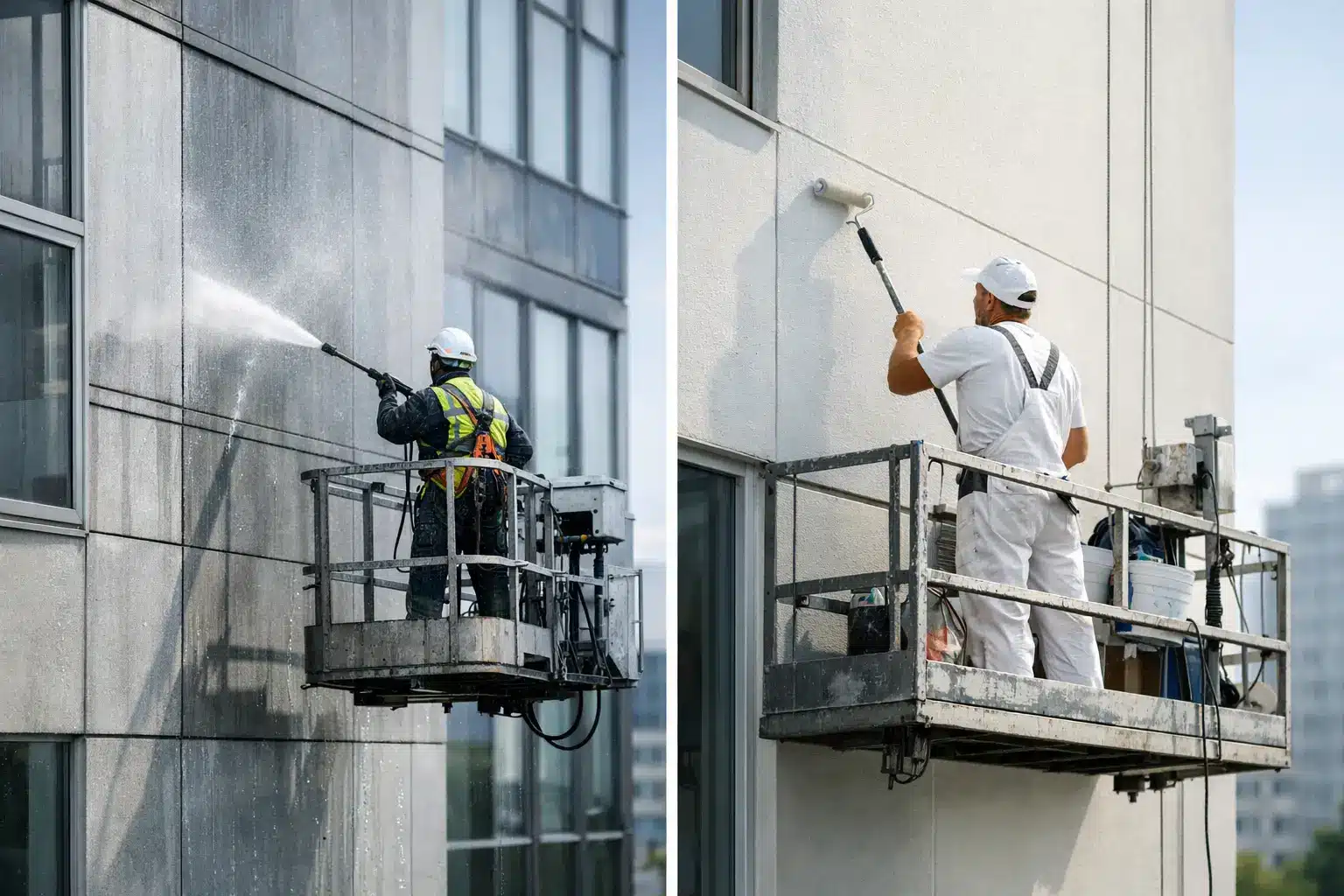

When a commercial building starts looking tired, the first question is usually not whether there is a problem. It is whether the facade actually needs repainting, or if a professional clean will restore the appearance at a much lower cost. That is where facade washing vs repainting becomes a practical maintenance decision, not just a cosmetic one.
For property managers and facility teams, the wrong call can waste budget, disrupt operations, and leave underlying issues untouched. A stained facade does not always mean failed paint. On the other hand, washing a surface with peeling, chalking, or widespread coating breakdown only delays the real repair. The right choice depends on the facade material, the condition of the coating, the type of contamination, and how accessible the building is.
Facade washing vs repainting: the real difference
Facade washing removes surface contaminants. This includes dirt, traffic film, algae, mildew, soot, mineral deposits, and other buildup that dulls the building exterior. It is a cleaning solution, not a corrective coating solution.
Repainting is a surface renewal process. It addresses faded or deteriorated finishes, restores visual consistency, and adds a fresh protective layer to the substrate. In many cases, repainting also requires surface preparation, patching, crack repair, treatment of problem areas, and safe access planning before any paint is applied.
That distinction matters because the same facade can look bad for very different reasons. A concrete or painted exterior may appear discolored simply from pollution and biological growth. Another may look similar from a distance but actually be suffering coating failure. From ground level, the difference is not always obvious, especially on high-rise buildings.
When facade washing is the better option
If the coating is still intact and the main issue is dirt or environmental staining, facade washing is usually the smarter first step. This is common on office towers, mixed-use buildings, and industrial properties exposed to road dust, exhaust, rain runoff, and humidity.
Washing is often the right choice when the facade has dark streaks below ledges, algae growth in shaded areas, bird droppings, dust accumulation around louvers, or patchy staining caused by water runoff. In these situations, the building may look aged without actually needing a new coating system.
A professional wash can improve appearance quickly, with less downtime and lower cost than repainting. It also helps preserve the existing finish by removing contaminants that can degrade surfaces over time. For buildings on cyclical maintenance programs, scheduled facade cleaning can delay the need for repainting by several years.
This is especially relevant for properties where appearance affects tenant perception, client visits, and brand image. A clean building exterior sends the right signal without committing to a full painting project before it is necessary.
When repainting is the better option
Repainting makes more sense when the problem goes beyond surface dirt. If the facade shows peeling paint, blistering, flaking, chalking, uneven fading, exposed substrate, or repeated staining that returns quickly because the coating has degraded, washing alone will not solve it.
You should also lean toward repainting when there are visible repairs needed. Hairline cracks, patched render, previous touch-up marks, and weathered areas often become more obvious after cleaning. In those cases, washing may actually reveal how far the finish has deteriorated.
For older commercial buildings, repainting may also be part of a broader asset protection strategy. A sound coating helps reduce moisture ingress, limits premature surface wear, and supports a more controlled maintenance cycle. If your current paint system is reaching the end of its service life, cleaning it may improve the look temporarily, but the underlying protection is still declining.
The condition check that should come first
The most reliable way to decide between facade washing vs repainting is a proper site assessment. Not a guess from the parking lot, and not a decision based only on how dirty the facade looks from one side.
A technician should assess the type of buildup, the condition of the existing coating, the facade material, and access constraints. Painted concrete, metal cladding, glass, stone, and composite panels all behave differently. Some surfaces respond well to soft washing or controlled pressure cleaning. Others need a more specialized method to avoid damage.
Equally important is access. On a low-rise block, inspection is straightforward. On a high-rise office tower, many facade issues are hidden until the team gets close enough to see failed sealant lines, coating breakdown, trapped dirt around joints, or staining patterns caused by drainage points. Access planning is not a side issue here. It affects inspection quality, work method, safety controls, project duration, and final cost.
Cost matters, but so does timing
In simple budget terms, washing usually costs less upfront than repainting. That is one reason many building owners prefer to clean first if the surface condition allows it. But lower immediate cost does not always mean better value.
If the facade is already failing, repeated washing can become false economy. You spend on access, labor, and equipment, but the building still looks worn because the coating itself is the problem. In that case, repainting may cost more now but deliver a longer service interval and a more durable result.
Timing also matters. If you are preparing for tenant leasing, a compliance inspection, a client-facing relaunch, or year-end building presentation, a wash can be the fastest route to visual improvement. If you are planning capital works or long-term exterior maintenance, repainting may align better with that schedule.
The best decision is usually based on both present condition and maintenance horizon. Ask not only what will make the facade look better this month, but what will keep the property in better shape over the next few years.
Washing first, repainting later
In many commercial buildings, the answer is not one or the other. It is both, in the right order.
A thorough facade wash is often the first stage before repainting because it removes contaminants that interfere with coating adhesion and reveals the true surface condition. Once cleaned, it becomes much easier to identify cracks, hollow areas, failed patches, and sections where the old paint system has broken down.
This approach also supports better budgeting. Instead of committing immediately to a full repaint, you can clean the facade, inspect the exposed condition, and decide whether spot repairs, partial repainting, or complete repainting is justified. For large sites, that staged method can be more practical than making a major decision based on limited visibility.
Risk, safety, and access are part of the decision
For high-rise and hard-to-reach buildings, exterior maintenance is not just about appearance. It is about executing the work safely and efficiently.
Facade washing and repainting both require method statements, access planning, trained technicians, and the right equipment for the building profile. Rope access, gondola systems, boom lifts, and suspended platforms each suit different site conditions. The wrong setup can slow the project, increase risk, or limit how thoroughly the work gets done.
That is why experienced commercial contractors evaluate more than the surface itself. They look at elevation, anchor points, surrounding traffic flow, working hours, pedestrian protection, weather exposure, and how to complete the work with minimal disruption to tenants or operations.
For facility teams, this matters because one capable contractor can often assess the facade, clean it, identify repair needs, and advise whether repainting is necessary without forcing you to coordinate multiple vendors for one exterior problem.
How to make the right call for your building
If the facade is structurally sound and the finish is still holding, washing is often the most efficient way to restore appearance. If the coating is failing, the color has broken down unevenly, or the substrate is starting to show through, repainting is usually the more responsible choice.
If you are unsure, do not choose based on appearance alone. Choose based on inspection. A site visit can identify whether the issue is contamination, coating failure, or a mix of both. That gives you a clearer scope, a more accurate quote, and a better maintenance decision.
Where the work involves roof or elevated access, property teams should also review DOSH guidance on working at height when planning access, supervision and fall-prevention controls.
For a site-specific scope, review our commercial painting services and arrange an assessment before confirming access, timing and cost.
For commercial properties, exterior upkeep is rarely just about making the building look clean. It is about protecting the asset, maintaining professional standards, and handling difficult access work properly the first time. If the facade is telling you something, the smartest next step is to have it assessed before minor surface issues turn into a larger repair cycle.