

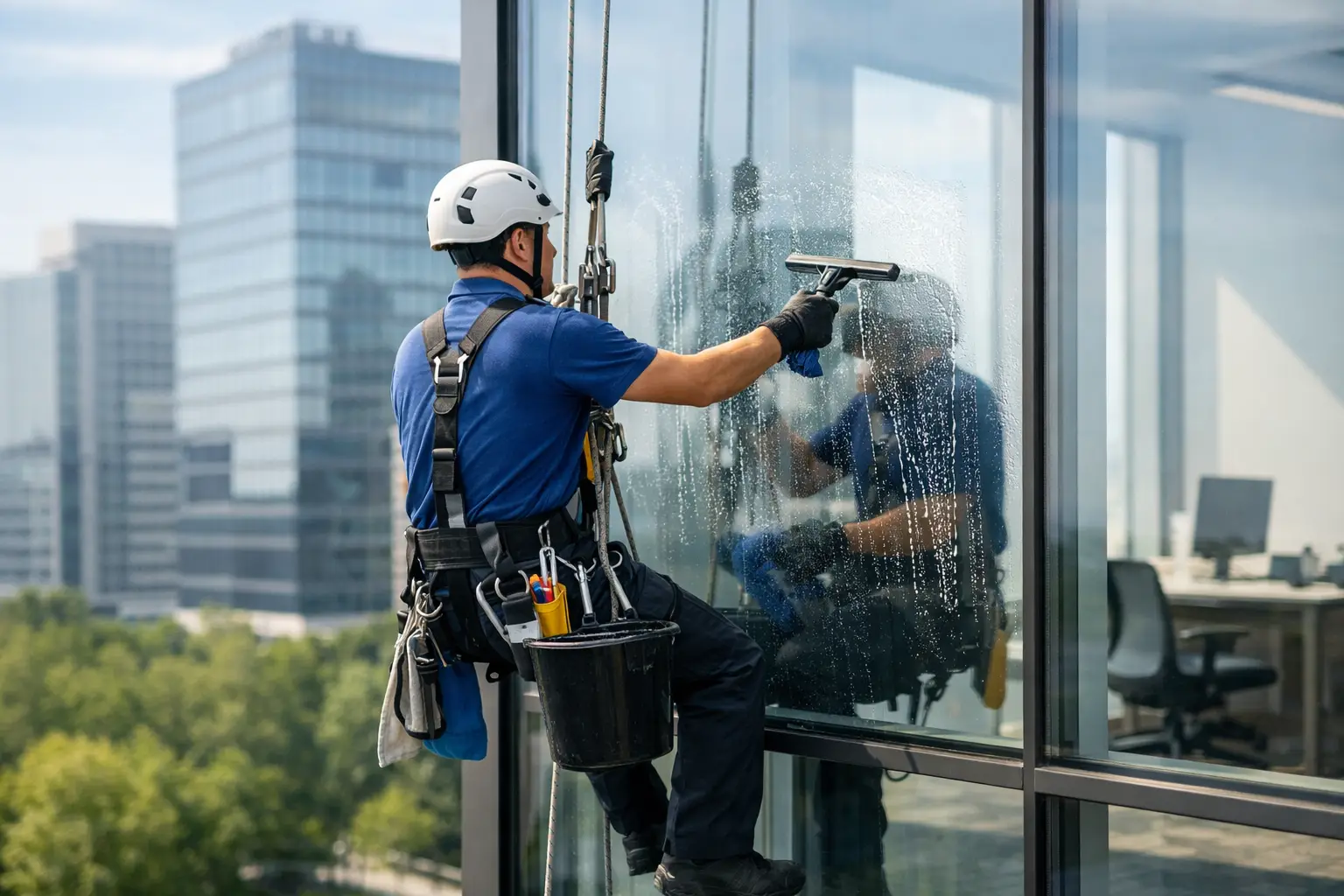

A streaked 20th-floor window says more about a building than most owners would like. Tenants notice it. Visitors notice it. Prospective clients notice it before they ever reach reception. Commercial window cleaning for office buildings is not just about appearance. It affects how a property is perceived, how maintenance issues are spotted, and how safely exterior work is carried out on an active site.
For office properties, window cleaning sits at the intersection of presentation, access, and risk control. Ground-level glass is straightforward. High-rise elevations, recessed panels, curtain walls, atriums, and mixed facade materials are not. That is why choosing the right contractor is less about finding a low headline price and more about finding a team that can assess site conditions properly, use the correct access method, and complete the work without disrupting daily operations.
Why office buildings need a different standard
Office environments have a higher visibility threshold than many other commercial sites. A warehouse can tolerate a few cosmetic flaws without affecting customer confidence. A corporate tower, business park office, or multi-tenant commercial building usually cannot. Glass carries a lot of the visual load in modern office design, so when it is stained, dusty, or water-marked, the whole property can look neglected.
There is also a practical reason to maintain a regular cleaning schedule. Dirt buildup can hide early signs of seal failure, frame deterioration, water ingress, and facade staining. Routine cleaning gives building managers a closer look at the building envelope. In that sense, the service supports both presentation and preventive maintenance.
The required standard also changes with the building profile. A low-rise office with easy perimeter access may need a simple recurring service. A high-rise building with suspended access points, restricted podium areas, and public-facing frontage needs more planning. The cleaning itself may be the visible result, but the real work starts long before the first pane is washed.
What affects commercial window cleaning for office buildings
The biggest pricing and planning factors are rarely visible from the street. Height is one factor, but it is not the only one. Two buildings of similar height can require very different labor, equipment, and timelines depending on facade layout and access restrictions.
Building height and access method
Low-rise offices may be serviced using water-fed poles or elevated work platforms. Mid-rise and high-rise buildings often require rope access, gondola systems, boom lifts, or a combination of methods. The safest and most efficient choice depends on roof anchorage, surrounding obstructions, and the design of the elevation itself.
Rope access can be highly efficient on certain high-rise facades, especially where suspended platforms are not practical. But it is not automatically the right answer for every building. A facade with ledges, irregular geometry, or sensitive architectural features may call for another approach. Good contractors do not force one method onto every site. They match the access plan to the building.
Glass condition and cleaning frequency
Windows cleaned on a regular schedule are faster to restore and easier to keep at a consistent standard. Glass that has been neglected for long periods may have mineral staining, bonded dirt, adhesive residue, or environmental buildup that requires additional treatment. That changes labor time and sometimes requires a more careful cleaning process to avoid scratching or surface damage.
Frequency matters here. A quarterly service plan often costs less over time than sporadic deep cleaning because buildup never gets too severe. Still, there is no universal schedule. Buildings near major roads, construction zones, industrial activity, or coastal conditions may need more frequent service than offices in cleaner environments.
Site operations and public safety
Office buildings are active environments. Entrances stay busy. Drop-off points, walkways, and loading areas may need to remain open while work is underway. This affects how crews are deployed, when work can happen, and what control measures are needed on the ground.
A contractor should account for pedestrian management, restricted zones, signage, equipment staging, and timing around tenant activity. In some cases, early morning or off-peak work is the best fit. In others, phased work by elevation reduces disruption. The right plan depends on the building’s operations, not just the contractor’s availability.
The value of proper site assessment
Commercial window cleaning for office buildings should start with a site visit, especially for mid-rise and high-rise properties. Quoting from photos alone can miss critical details such as limited roof access, underground services affecting lift placement, facade setbacks, or tight perimeter conditions.
A proper assessment helps define scope accurately. It also reduces the chance of delays, access issues, and variation costs after work begins. For building owners and facilities teams, this matters because predictable execution is often more valuable than a low estimate that changes once the crew arrives.
This is also where safety planning becomes real rather than generic. Access points, tie-off requirements, rescue considerations, weather exposure, and work zones should be reviewed against the actual building. On technical sites, experience shows up in the quality of the planning.
Safety is not a box to check
High-rise and exterior access work carries real risk. For office buildings, that means safety should be treated as part of service quality, not as a separate issue. A clean facade means little if the work is carried out with poor controls, incomplete planning, or equipment that does not suit the site.
Experienced contractors approach the job with method statements, trained personnel, access-specific equipment, and clear communication with site management. They understand that the cleaning result and the safety result are tied together. A rushed job may leave marks on glass, interfere with tenants, or create unnecessary exposure around the building perimeter.
Weather is one of the most common variables. Wind, rain, and storm conditions can affect suspended work and elevated access. A dependable contractor will factor that into scheduling rather than trying to push through unsuitable conditions just to meet a date. For office clients, reliability often means knowing when not to proceed.
Choosing the right service partner
The best window cleaning provider for an office building is usually not the cheapest general cleaner. It is the contractor with the access capability, exterior maintenance experience, and operational discipline to handle the site correctly.
Look for a company that can explain how it will access the building, what affects the quotation, what the site preparation will involve, and how the work will be staged. If those answers are vague, the risk usually falls back on the client.
It also helps to work with a provider that understands broader exterior maintenance. Window cleaning often overlaps with facade washing, sealant observations, roof edge access, gutters, and hard-to-reach buildup around architectural features. A specialist contractor can often identify related issues early, which saves time later and reduces the need to bring in multiple vendors for adjacent access work.
For property managers handling multi-site portfolios, that practical advantage matters. A contractor that can support office towers, commercial blocks, and technically demanding exterior areas with one coordinated team creates less administrative friction and more consistent standards.
When to schedule the work
There is no single best month for every office building. Scheduling depends on weather patterns, occupancy, facade exposure, and the image standards expected by tenants or visitors. Many buildings align window cleaning with seasonal maintenance, tenant events, inspections, or annual budgeting cycles.
The more useful question is whether the current schedule matches the building’s condition. If glass is visibly dirty well before the next planned service, the interval is too long. If the building stays in good condition for months after each visit, the frequency may be more than necessary. The right program balances presentation, cost control, and actual environmental exposure.
In dense urban areas such as Kuala Lumpur, where traffic, dust, and weather can affect facade cleanliness quickly, a fixed annual clean is rarely enough for prominent office properties. Regular review makes more sense than assuming one schedule will suit the building forever.
Where the work involves roof or elevated access, property teams should also review DOSH guidance on working at height when planning access, supervision and fall-prevention controls.
For a site-specific scope, review our high-rise window cleaning services and arrange an assessment before confirming access, timing and cost.
A clean office facade does not happen by accident. It comes from proper assessment, the right access method, trained execution, and a maintenance plan that fits the building instead of a generic package. If your office property has height, access restrictions, or hard-to-reach elevations, treat window cleaning as specialized building maintenance work. The result is not just cleaner glass. It is a better-run property.