

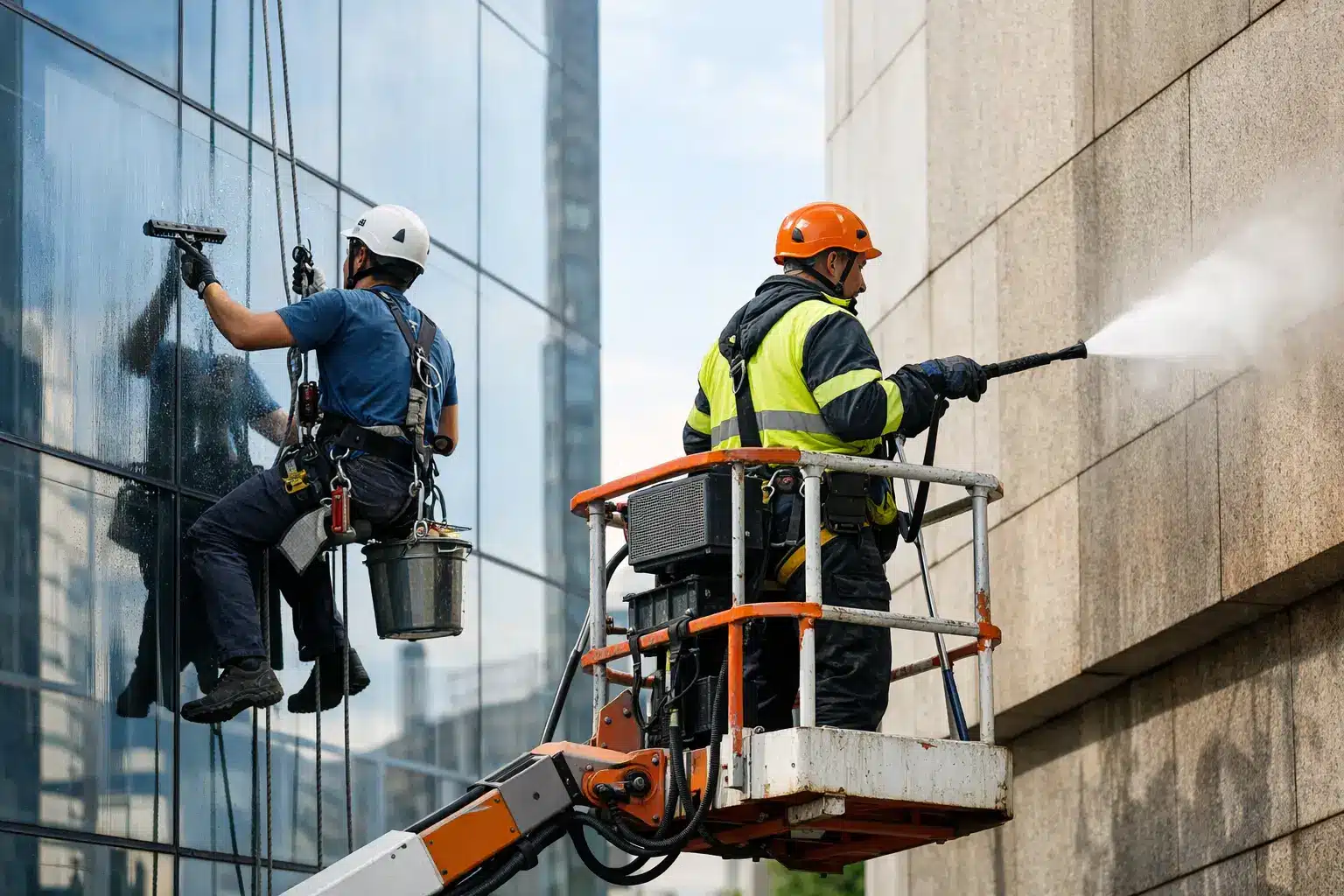

A stained facade changes how a building is perceived long before anyone steps through the entrance. For property managers and facilities teams, that makes facade care more than a cosmetic task. Choosing the best facade cleaning techniques affects tenant impressions, surface life, safety, and the long-term cost of exterior maintenance.
What determines the best facade cleaning techniques
There is no single method that works for every building. The right approach depends on the facade material, building height, access constraints, the type of staining, and how sensitive the surface is to pressure, chemicals, or abrasion.
A low-rise office block with painted concrete may tolerate a very different process than a glass-heavy tower or a stone-clad commercial development. Dust, algae, traffic film, hard water staining, carbon deposits, and post-construction residue also behave differently. If the method does not match the contaminant, the result is either incomplete cleaning or avoidable surface damage.
That is why experienced contractors start with inspection, not equipment. Site conditions matter just as much as the visible dirt. Drainage, pedestrian traffic, rope access points, suspended platforms, and nearby operations all influence what can be done safely and efficiently.
Water-fed cleaning for glass and light exterior soils
For many commercial properties, purified water cleaning is one of the most effective options for glass, frames, and lightly soiled facade sections. This method uses deionized or purified water delivered through extension poles or access systems, allowing technicians to rinse away dirt without leaving mineral spotting behind.
It works especially well on routine maintenance cycles where the goal is to remove dust, light grime, and environmental buildup before it becomes heavy staining. On buildings with large window coverage, it can be a practical choice because it delivers a clean finish without relying heavily on detergents.
The trade-off is that purified water systems are not the answer for every facade problem. They are less effective on heavy grease, thick algae growth, cement residue, or deep staining caused by years of neglect. For high-rise projects, the method also depends on whether access conditions allow safe and consistent coverage.
Soft washing for delicate facade materials
Soft washing is often among the best facade cleaning techniques for surfaces that need a lower-pressure approach. Instead of relying on force, it combines controlled water flow with cleaning solutions designed to break down biological growth, dirt film, and atmospheric staining.
This method suits painted surfaces, coated panels, some rendered walls, and facade areas where aggressive pressure could strip finishes or push water into joints. It is particularly useful when mold, mildew, or algae is part of the problem, since treatment can target the source rather than just washing the surface clean temporarily.
Soft washing still requires judgment. Chemical selection must match the material, dwell time must be controlled, and runoff needs to be managed properly. Used carelessly, even a low-pressure system can create staining, oversaturation, or damage to adjacent finishes.
Pressure washing for durable exterior surfaces
Pressure washing has a place in commercial facade maintenance, but only where the substrate can handle it. Durable concrete, some masonry, service yard walls, and certain industrial exterior surfaces can respond well to pressure-based cleaning when grime is heavy and speed matters.
This technique is effective for removing compacted dirt, road film, surface deposits, and some post-construction residue. It can also be useful on lower-level exterior zones where splash marks, dust, and public-facing buildup accumulate faster.
The mistake is treating pressure washing as a universal solution. Too much pressure can etch stone, damage sealants, strip paint, force water behind cladding, or scar facade finishes. On mixed-material buildings, one section may handle pressure while another requires a completely different process. A good cleaning plan accounts for that instead of applying one method across the entire elevation.
Chemical cleaning for stubborn staining
Some contaminants simply do not release with water alone. Rust streaks, efflorescence, carbon staining, hard water deposits, and post-construction residue often require specialized chemical treatment. In these cases, chemical cleaning can be one of the best facade cleaning techniques when handled by trained technicians.
The important point is precision. The product must be selected for both the stain and the surface. Acidic cleaners, alkaline cleaners, and neutral solutions all have specific uses, and a wrong match can permanently alter the facade.
Testing a small section first is standard practice for good reason. Stone, metal, glass coatings, and architectural finishes can react unpredictably. Chemical cleaning should also include proper dilution, controlled application, dwell monitoring, rinsing, and containment where necessary. For occupied commercial sites, this level of control matters as much as the cleaning result itself.
Manual detailing for corners, joints, and architectural features
Not every facade issue is solved with broad-area washing. Manual detailing remains essential for corners, ledges, sealant lines, signage surrounds, louvers, and decorative features where dirt accumulates unevenly.
These areas are often where a building still looks dirty after a general wash. Fine detailing with the right pads, brushes, and hand-cleaning methods helps restore a consistent appearance across the facade. It also allows technicians to work carefully around vulnerable points such as sealants, coatings, and interface joints.
For premium office towers and customer-facing commercial properties, this step makes a visible difference. It takes more labor, but the finish is noticeably better than a quick rinse-and-go approach.
Access method matters as much as cleaning method
When evaluating the best facade cleaning techniques, access should be part of the same conversation. A method may be technically suitable for the surface but impractical if the building cannot be reached safely and efficiently.
High-rise facades often require rope access, gondolas, boom lifts, or a combination of systems depending on elevation, setbacks, and architectural design. Access planning affects labor time, safety controls, staging, and the consistency of cleaning across the full facade.
For facility managers, this is where contractor capability matters. Exterior cleaning on a tall or complex building is not just about washing surfaces. It is a coordinated operation involving access expertise, technician competence, equipment selection, and site-specific risk control. On buildings with recessed elevations, fins, canopies, or hard-to-reach glass bands, access limitations can determine whether a job is done properly or only partially.
How to choose the right technique for your building
The strongest facade cleaning plans are built around the actual condition of the property, not a fixed package. A routine maintenance clean for a modern office tower may rely mainly on purified water and light detergent support. An older industrial building with atmospheric staining may require pressure cleaning in selected zones and chemical treatment in others. A painted facade with mildew growth may be better suited to soft washing and controlled spot treatment.
Frequency also matters. If the building is cleaned on schedule, lighter methods usually maintain appearance at lower risk. If cleaning is delayed for years, more intensive methods may be needed, and that often increases cost, access time, and the chance of exposing existing defects.
A proper site assessment should consider material types, staining severity, height, access restrictions, drainage, public safety, and nearby operations. That gives building owners and managers a realistic scope instead of a generic quote that overlooks technical details.
Common mistakes that increase cost later
One of the most common mistakes is choosing the cheapest method before confirming whether it fits the surface. That can lead to streaking, incomplete results, coating damage, or repeated cleaning because the original issue was never fully treated.
Another problem is ignoring facade maintenance until stains become embedded. What could have been handled with routine washing may then require chemical restoration, more labor-intensive access, and partial repairs to sealants or finishes.
There is also the issue of fragmented vendor coordination. When one contractor handles windows, another handles high-access work, and another manages external repairs, delays and gaps are common. For commercial properties with height or access challenges, combining cleaning capability with technical exterior support often makes operations smoother.
When professional facade cleaning is the better call
If the building is multi-story, occupied, architecturally complex, or exposed to heavy environmental buildup, facade cleaning should be treated as specialized maintenance. The visible surface may look straightforward from ground level, but facade work at height involves safety systems, access planning, and material-specific cleaning decisions that are easy to get wrong.
For commercial and industrial sites, the goal is not just to make the building look cleaner for a week. It is to protect the asset, maintain presentation standards, and complete the work with minimal disruption to daily operations. That takes a contractor who understands both cleaning performance and the realities of access.
Where the work involves roof or elevated access, property teams should also review DOSH guidance on working at height when planning access, supervision and fall-prevention controls.
For a site-specific scope, review our façade cleaning services and arrange an assessment before confirming access, timing and cost.
The best results usually come from matching the method to the building, not forcing the building to fit the method. If your facade has not been assessed recently, a site visit is often the fastest way to identify what will clean effectively, what needs extra care, and what can be maintained more efficiently going forward. A clean facade is visible proof that the property is being managed properly, and that impression carries further than most maintenance teams are given credit for.