

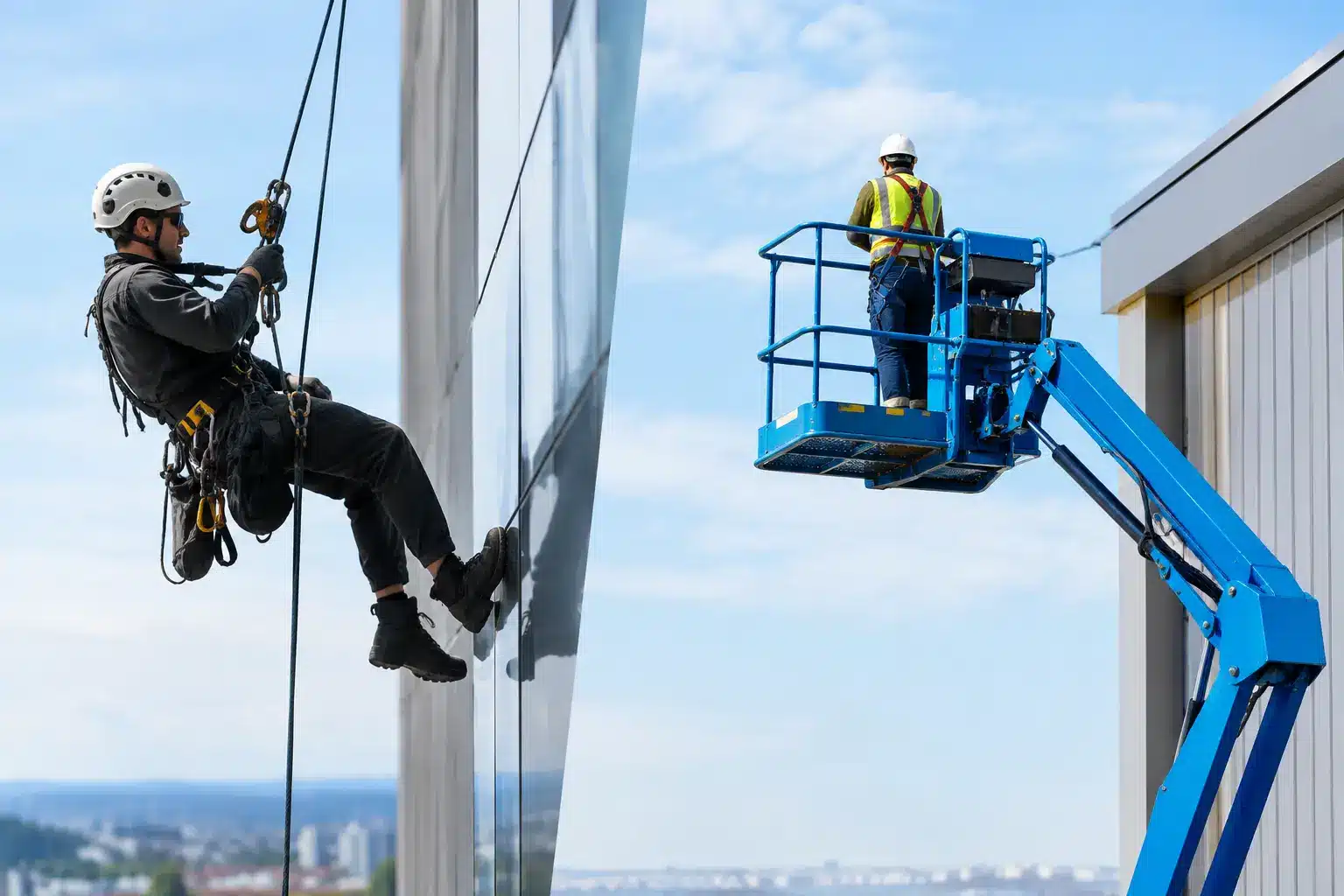

A streaked glass facade on the 28th floor cannot be treated like a ground-level cleaning job. Access affects safety planning, work quality, tenant disruption, project duration, and cost. When comparing abseiling versus boomlifts, the right choice depends less on preference and more on how your building is designed, what work is required, and what conditions exist around the site.
For commercial property managers, the goal is simple: complete high-level maintenance safely, efficiently, and without creating unnecessary disruption below. Rope access and boomlifts can both deliver excellent results, but they solve different access problems.
Abseiling Versus Boomlifts: The Core Difference
Abseiling, also called rope access, positions trained technicians from certified roof anchors or engineered anchor points. Technicians descend along the building exterior using specialized ropes, harnesses, fall-arrest systems, and controlled descent equipment. This method is commonly used for high-rise window cleaning, facade cleaning, external inspections, sealant checks, and targeted maintenance work.
A boomlift is a mobile elevated work platform with an extendable or articulating arm. It lifts workers and equipment from ground level to the required work area. Boomlifts are particularly useful for low- to mid-rise buildings, exterior painting, canopy cleaning, cladding repairs, tree-obstructed elevations, and areas where technicians need to work from a stable platform for longer periods.
The decision is not simply about which option reaches higher. It is about the access path. Rope access comes from above, while a boomlift approaches from below or beside the structure. That distinction determines what each method can reach, how much site preparation is needed, and how the project affects daily operations.
When Abseiling Is the Better Option
Abseiling is often the practical choice for tall buildings with limited ground space. In busy commercial districts, a boomlift may require road access, extensive barricading, traffic control, or the temporary closure of parking bays and entry points. Rope access can reduce these ground-level requirements because equipment is deployed from the roof rather than positioned around the building perimeter.
It is especially effective for narrow setbacks, inner courtyards, podium edges, and upper-level facades where a boomlift cannot be placed close enough to the work area. Technicians can also move vertically along the facade with precision, making rope access efficient for window cleaning and inspections across multiple floors.
For recurring maintenance, abseiling can offer a more cost-effective approach once safe roof access and suitable anchor systems are confirmed. There is no large machine to transport, position, refuel, or relocate around the property. This can shorten mobilization time and help keep common areas, driveways, and loading zones available for tenants.
That said, rope access is not a shortcut. It requires competent technicians, an approved access plan, suitable anchor points, rescue procedures, weather monitoring, and exclusion zones below the work area. A professional contractor assesses these factors before confirming that abseiling is appropriate.
Best uses for rope access
Rope access is well suited to high-rise window cleaning, facade washing, localized facade inspections, waterproofing checks, sign cleaning, gutter work on difficult rooflines, and maintenance on areas that are inaccessible from the ground. It is most efficient when the work is vertical and distributed across a tall elevation.
When a Boomlift Makes More Sense
A boomlift provides a stable work basket, which can be beneficial when technicians need to handle materials, use larger tools, or work continuously on one area. For commercial painting, facade repairs, lighting replacement, signage work, and detailed cleaning of lower elevations, the platform can offer a practical working position.
Boomlifts are also useful where roof anchors are unavailable, unsuitable, or cannot be used for the planned scope. A building may have a flat, accessible roof but no certified anchor system. In that situation, a boomlift can eliminate the need to suspend workers from above, provided the machine can safely reach the required elevation.
Ground conditions are critical. The boomlift must operate on a surface that can support its weight, including the machine, crew, tools, and any required outriggers. Soft landscaping, underground utilities, sloped driveways, narrow access lanes, and basement slabs may limit equipment selection. A site survey should confirm the machine type, reach, turning radius, working envelope, and safe setup location.
A boomlift may also be the stronger option for buildings with deep overhangs, recessed facade sections, or obstacles that prevent a direct vertical rope descent. An articulating boom can reach around certain barriers, although its exact capability depends on the equipment model and available ground position.
Best uses for boomlifts
Boomlifts are effective for low- and mid-rise window cleaning, external painting, facade repair, warehouse exterior maintenance, canopy cleaning, lighting work, and jobs involving repeated handling of equipment or materials. They work best where the property has adequate access and stable ground space.
Safety Is Not a Choice Between Methods
Both access methods involve working at height and require disciplined planning. The safer option is the one that suits the building, the task, and site conditions.
With abseiling, safety depends on certified anchorage, properly inspected equipment, trained rope-access technicians, clear communication, weather controls, and an emergency rescue plan. Wind, lightning, heavy rain, and poor roof conditions can require work to stop or be rescheduled.
With boomlifts, safety relies on correct equipment selection, trained operators, stable ground, barricaded work areas, pre-use inspections, and awareness of overhead hazards. Pedestrian movement, vehicle traffic, power lines, low branches, and uneven surfaces must be managed before the lift is operated.
For either method, the work area below should be controlled to protect occupants, visitors, and vehicles. A professional team plans the exclusion zone, timing, equipment placement, and communication with building management before work begins. This is particularly important at active offices, retail properties, hospitals, factories, and logistics facilities where normal operations cannot simply stop.
Cost Depends on More Than the Daily Rate
Property teams often compare abseiling and boomlifts based on quoted access costs alone. That can be misleading. The lowest daily rate does not always produce the lowest project cost.
Abseiling may reduce costs where a boomlift would require transport, permits, traffic management, road closures, or multiple equipment relocations. It can also be faster for broad vertical cleaning on tall buildings. However, rope access may take longer for tasks involving bulky tools, extensive repairs, or frequent movement across horizontal areas.
A boomlift can be more economical for concentrated work at accessible elevations. If a crew needs to spend several days repairing, painting, or cleaning one section of facade, a stable platform may improve productivity. Yet the final cost can increase if the site requires large equipment, ground protection, permits, or after-hours setup to avoid disrupting tenants.
The most useful quotation identifies the full scope: building height, access restrictions, facade condition, work method, equipment needs, labor, safety controls, and expected project duration. This gives facilities teams a clearer basis for approval than a simple per-day comparison.
Questions to Ask Before Choosing an Access Method
Before approving a contractor, confirm whether your building has certified roof anchors, safe roof access, and sufficient structural information for rope work. If considering a boomlift, ask whether the equipment can enter the property, reach the work area, and operate safely on the available surface.
You should also consider the nature of the work. Is it recurring window cleaning across a full high-rise facade, or a focused repair on a lower section? Does the job require heavy materials? Will access affect tenant parking, delivery routes, entrances, or public walkways? Are there weather-sensitive deadlines or operating-hour restrictions?
These questions turn an access decision into an operational plan. They also help prevent a common problem: selecting a method before anyone has inspected the actual site.
A Site Assessment Produces the Right Answer
There is no fixed winner in abseiling versus boomlifts. Rope access is often the more efficient solution for tall facades, tight urban sites, and recurring vertical maintenance. Boomlifts are often better for accessible elevations, extended repair work, and tasks requiring a stable platform or heavier equipment.
A proper site visit should review roof conditions, anchor points, ground access, building height, facade layout, nearby obstacles, safety requirements, and the type of work to be completed. Urban Solutions Service Sdn. Bhd. uses this practical assessment approach to recommend access that supports safe execution and a clean, presentable result.
The best next step is to evaluate access before the maintenance schedule is fixed. A well-planned method protects your people, keeps operations moving, and gives the work crew the right position to do the job properly.